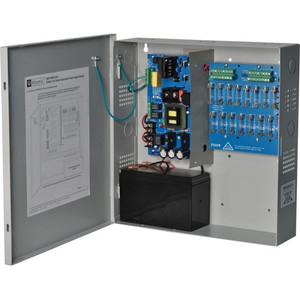
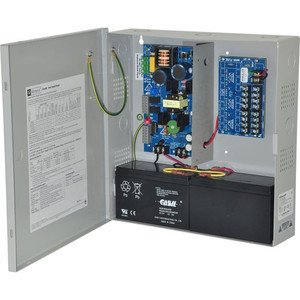
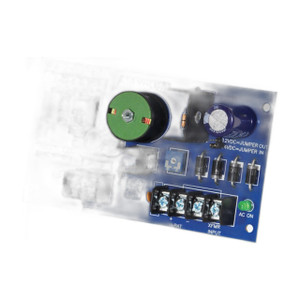
Altronix AL400ULXPD16 16-Output Power Supply Charger
The Altronix AL400ULXPD16 is a 16-output AC/DC power supply and charger designed to distribute regulated DC power across access control, alarm, and security camera installations. It accepts 115VAC input and produces either 12VDC at 4A or 24VDC at 3A — you select the voltage to match your connected devices. The real value lies in its ability to power up to 16 low-current security devices from a single chassis while simultaneously charging a backup battery for continuity during AC mains failure.
Key Features
- 16 independent output terminals: Parallel connections for multiple devices mean you're not running daisy chains or adding complexity to your cabinet wiring. Each output is electrically independent, so a short on one line doesn't cascade to others.
- Selectable output voltage (12VDC or 24VDC): Match your voltage to your door strikes, card readers, or auxiliary sensors without needing multiple supply units. Set once during installation, then forget it.
- Integrated battery charging circuit: Connects to a lead-acid or sealed battery backup and automatically maintains charge. When AC drops, the battery supplies the 16 outputs without manual intervention or external charger hardware.
- AC Fail supervision: The unit signals your control panel or monitoring system the instant AC power is lost, so your access logs and alarm events reflect the failure event.
- Low Battery and Battery Presence supervision: Continuous monitoring tells you if a battery is disconnected, failed, or running low — critical for compliance audits and troubleshooting unexpected downtime.
- 115VAC input with standard North American plug compatibility: No special wiring or voltage conversion needed in typical commercial installations. Cabinet-mountable footprint fits standard 19-inch or wall-mount racks without consuming excessive space.
Integration and Compatibility
The AL400ULXPD16 is vendor-agnostic and works with any access control panel, alarm receiver, or security device that accepts 12VDC or 24VDC. Its supervision outputs (AC Fail, Low Battery, Battery Presence) connect to dry-contact or supervised alarm inputs on your control panel, giving you real-time status reporting. Battery charging and management are fully automatic — no external chargers or switching logic required.
Real-World Deployment Notes
This unit shines in multi-door access control systems where you're powering card readers, electronic strikes, and request-to-exit sensors across multiple entry points. A typical four-door installation might consume 8–12 outputs, leaving headroom for future expansion. If your load approaches or exceeds the per-output current limits (4A at 12V, 3A at 24V), you'll need a second supply or a higher-capacity unit — plan your device power budgets upfront. For installations requiring 24/7 power resilience, pair this with a properly sized lead-acid battery (typically 7–20Ah depending on your hold time requirement). The integrated charging circuit eliminates the need for a separate battery charger in your cabinet, saving space and reducing complexity.
The power supply category includes larger distribution units if you need more outputs or higher current capacity. For access control systems with multiple integration points, check compatibility with your specific panel's supervision input requirements before specifying.
Warranty
Altronix backs this unit with a Lifetime Limited Warranty covering manufacturing defects under normal use — a meaningful commitment on a component expected to run continuously for 10+ years in a cabinet.
Frequently Asked Questions
Q: Does the AL400ULXPD16 support 240VAC input, or is it 115VAC only?
A: The AL400ULXPD16 is designed for 115VAC input only. If your facility runs 240VAC single-phase or three-phase, you'll need a step-down transformer or a different unit from the Altronix supply family rated for higher input voltage.
Q: What size backup battery should I pair with this unit?
A: That depends on your hold-time requirement (typically 24 hours for access control per NFPA 72) and your total device load. A rough rule: add up the current draw of all powered devices and select a lead-acid battery in the 7–20Ah range. The AL400ULXPD16's charging circuit will maintain it; consult your system engineer for exact sizing.
Q: Can I mix 12V and 24V devices on the same AL400ULXPD16 by using a jumper or selector?
A: No. The voltage is selectable at installation — either all 16 outputs are 12VDC or all are 24VDC. You cannot split the unit or run different voltages simultaneously. If you have a mixed-voltage install, you need two separate supplies.
Q: Does the unit have any built-in surge or short-circuit protection per output?
A: The AL400ULXPD16 uses a distributed output architecture with supervision; check the detailed datasheet or contact the manufacturer for specific circuit protection details (fusing, resettable breakers, etc.). For high-risk installations, external panel-mount fuses or individual output protectors are often recommended.
Q: How long will the battery backup power the system if AC fails?
A: Runtime depends entirely on battery capacity (Ah rating) and total device current draw. With a typical 12Ah battery and a 2A load, you'd achieve roughly 6 hours of backup. Larger batteries or lower-current systems can extend runtime significantly. Work with your integrator to spec the battery size for your required hold time.
Q: Is the AL400ULXPD16 NDAA or TAA compliant?
A: Compliance certifications are not indicated in the available product documentation. Contact the manufacturer or your specialty distributor for detailed compliance details if required by your procurement policy.
Ted PerryPerspective based on aggregated IP Security Depot and affiliated engineering team experience.
The AL400ULXPD16 is a workhorse for mid-scale access control and alarm system power distribution — exactly the kind of unit that runs silently for a decade without calling attention to itself. Its 16 independent outputs at selectable 12/24VDC, combined with integrated battery charging and comprehensive supervision (AC Fail, Low Battery, Battery Presence), make it a solid choice for distributed DC power management where you need both reliability and expandability without cabinet bloat.
Technical Highlights:
- Selectable 12VDC @ 4A or 24VDC @ 3A: Pick your voltage once at installation. The 4A capacity at 12V and 3A at 24V gives you enough headroom for a typical multi-door access system with four to six doors plus auxiliary devices, assuming you're not driving high-current solenoids or heavy-duty electromagnetic locks directly from this unit.
- Integrated battery charging with supervision: Automatic float charging keeps your backup battery healthy without external charger hardware. AC Fail, Low Battery, and Battery Presence supervision report directly to your control panel, eliminating guesswork about system readiness during mains loss — compliance auditors will appreciate the audit trail.
- 16 independent outputs: Each terminal is electrically isolated, so a short or failed device on one output doesn't drag down the others. Install without daisy-chaining; cabinet wiring stays clean and troubleshooting is straightforward.
Deployment Considerations:
- The output current limits (4A at 12V, 3A at 24V) are per-supply, not per-output. If you're powering high-current door strikes or readers, calculate total load first. A second AL400ULXPD16 in parallel is often cheaper than a larger single unit and simplifies load balancing.
- 115VAC input only — no 240V or three-phase variant. If your electrical service is 240V single-phase, budget for a step-down transformer or specify a different Altronix supply family.
- Battery sizing is critical. Undersizing a backup battery defeats the point; oversizing costs money. Work the math: device load (amps) × hold time (hours) ÷ battery efficiency (roughly 0.8–0.9) = Ah rating. A typical 12Ah lead-acid battery with a 2A access control load gives you 6 hours of backup — adequate for most overnight access continuity scenarios.
Best fit: multi-door access control systems in commercial buildings, warehouse entry points, and alarm systems where you need to power 4–12 low-current devices from a single cabinet location and require automatic battery backup with status supervision. If your load approaches 16 outputs or you're managing purely analog alarm circuits with minimal expansion, this unit will carry the job without overengineering.