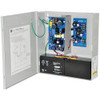
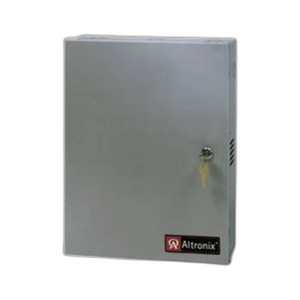
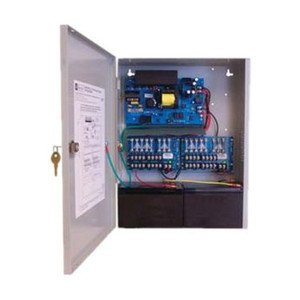
Altronix AL400UL3 Triple Output Power Supply
The AL400UL3 is a UL-listed multi-output power supply and battery charger built for mixed-voltage security infrastructure. It delivers three independent DC outputs—5VDC @ 1.75A, 12VDC @ 1.75A, and 24VDC @ 1.5A—simultaneously to the same enclosure. This simultaneous multi-voltage capability eliminates the need for separate power supplies when your access control, burglar alarm, or fire protective signaling system uses a mix of voltages. The unit also integrates a charger for up to two 12VDC/7AH sealed lead acid or gel batteries, providing integrated backup power with supervised status monitoring.
Key Features
- Three independent outputs (5V, 12V, 24V): Delivers all three voltages at the same time without voltage-sharing or ripple interaction, so your 5V readers, 12V alarm panels, and 24V door locks all get clean, independent power rails. This reduces cabinet clutter and eliminates cross-system interference that can occur when undersized supplies are daisy-chained.
- Integrated battery charger for dual 7AH cells: Charges up to two 12VDC/7AH sealed lead acid or gel batteries automatically, giving you roughly 14AH of backup capacity. This means your access control or alarm system stays live during AC failures without requiring a separate battery charger module—real estate and cost savings on the controller side.
- AC Failure Form C contacts: Provides supervised alarm relay output when line voltage drops, allowing your monitoring station or local panel to detect a utility power loss in real time. Essential for fire and alarm system compliance.
- Battery Presence and Battery Status Form C contacts: Monitors battery connection and health automatically, triggering alarms if a battery is missing or discharged below usable levels. Prevents silent system failures during power outages.
- Compact 13.5" × 13" × 3.25" footprint: Fits in standard-depth wall cabinets and electrical enclosures without consuming floor space. The low-profile form factor makes it ideal for retrofit installations where cabinet real estate is tight.
- 115VAC 60Hz input with 1.45A draw: Draws minimal current from a standard wall outlet, so it won't overload shared circuits. No special wiring required; standard 15A breaker is sufficient for this unit alone.
- UL294, UL603, UL1069, UL1481 certifications: Approved for access control, burglar alarm, fire protective signaling, and hospital signaling installations. Each certification mark is evidence of third-party testing for fire, shock, and reliability hazards specific to that application. CSFM and MEA NYC approvals cover California and New York City municipal requirements.
- Operating temperature 0°C to 49°C (32°F to 120°F): Suitable for indoor utility rooms, server closets, and non-conditioned mechanical spaces within this band. Exceeding 49°C will reduce battery charge rate and shorten battery life; plan cooling or relocate the unit if ambient runs hotter.
When the AL400UL3 Makes Sense
Choose this model when your system genuinely requires three distinct voltages at the same time—for example, 5V for biometric readers, 12V for an alarm panel, and 24V for electric strikes and solenoid locks. If your entire system runs on 12V or 24V alone, a single-output Altronix supply will save cost and cabinet space. Also select this model when battery backup is mandatory (fire or life-safety code), because the integrated charger avoids the need for a separate charger module and reduces wiring. If your site experiences frequent or prolonged power outages, the 14AH total capacity (two 7AH cells) may be marginal—consider adding external battery boxes if runtime beyond 30–45 minutes is required.
Integration & Compatibility
The AL400UL3 integrates into any access control, alarm, or fire protective signaling system that uses 5V, 12V, and/or 24V DC power rails. The Form C relay contacts (AC Failure, Battery Presence, Battery Status) connect to hardwired alarm inputs on your panel or NVR for real-time fault monitoring. No ONVIF, IP integration, or software drivers are required—this is purely a hardwired power and battery infrastructure device. Configure the relay contacts during final system commissioning to ensure your monitoring station or local alarm panel is aware of power and battery events.
Frequently Asked Questions
Q: Can I use different battery types—lithium or AGM instead of lead acid/gel?
A: No. The AL400UL3 is rated for sealed lead acid or gel cells only, specifically 12VDC/7AH capacity. Lithium or AGM batteries have different charge profiles and will not charge correctly. Always use the specified battery type.
Q: What is the actual battery runtime on the AL400UL3?
A: Runtime depends on the load connected to each output during the power outage. The unit can charge and support up to 14AH (two 7AH cells) at 12V. For rough estimation: a 2A load on the 12V output would deplete both cells in roughly 6–7 hours under ideal conditions. Actual runtime is shorter due to inverter inefficiency and the fact that as battery voltage drops, some devices may drop offline. Test with your specific load to confirm acceptable runtime.
Q: Is the AL400UL3 compliant with NDAA Section 889 or other government procurement rules?
A: The datasheet provided does not state NDAA compliance. Contact the manufacturer or your distributor if government procurement compliance is required for your project.
Q: Do I need external fuses or circuit protection on each output?
A: Yes. Although the AL400UL3 has internal protection, best practice is to place a fused disconnect or breaker on each output close to the load (especially the 24V power to electric strikes). This provides fast local fault isolation and meets fire code requirements in most jurisdictions.
Q: Can the AL400UL3 be mounted vertically or does it require a specific orientation?
A: Mount horizontally on a shelf or rail inside a cabinet. Vertical mounting is not recommended because internal heat dissipation relies on natural convection from the horizontal orientation. Verify adequate airflow around the unit, especially if the ambient temperature approaches 49°C.
Q: What happens if both batteries are disconnected or missing?
A: The AL400UL3 will continue to deliver DC power to the three outputs as long as AC mains voltage is present. When the AC fails and no batteries are available, power to all outputs stops immediately. The Battery Presence relay contact will signal alarm, alerting you to the missing or disconnected battery.
Ted PerryPerspective based on aggregated IP Security Depot and affiliated engineering team experience.
I've specified the AL400UL3 on access control retrofits where the existing panel runs 12V for the alarm loop, the card readers need 5V, and the door hardware expects 24V. A single power supply that handles all three voltages simultaneously is a real advantage here. The integrated battery charger is the kicker—one less module to buy, one fewer point of failure, and the supervised relay contacts give you genuine fault visibility instead of guessing whether the batteries are actually there or charged.
Technical Highlights:
- Simultaneous triple-voltage outputs: The 5V @ 1.75A, 12V @ 1.75A, and 24V @ 1.5A channels do not share a common ground or power rail, so there's no cross-talk or ripple bleed between circuits. This matters when your card readers (5V) are sensitive to noise from solenoid kicks on the 24V line.
- Integrated dual-battery charger with 14AH total capacity: Two 7AH sealed lead acid or gel cells charge automatically and supply backup power during AC outages. For most small-to-mid-size access control systems, this runtime is 30–60 minutes depending on load, which is usually enough to alert staff and gracefully degrade the system. No separate charger module saves cabinet space and eliminates a point of failure.
- Form C relay supervision on AC Failure, Battery Presence, and Battery Status: Three separate hardwired relay outputs that report power and battery health to your panel or monitoring station. This is not remote monitoring—it's direct hardwired supervision that works whether your network is up or down.
Deployment Considerations:
- The 1.45A AC input draw is low enough that you can plug this into a standard 15A outlet without overloading the circuit, but be careful not to oversubscribe the same outlet with other high-draw devices. If the building power is flaky, consider a UPS for the AL400UL3 itself to protect against voltage sags that trigger false AC Failure alarms.
- The 49°C upper operating temperature is a real constraint in non-conditioned mechanical rooms or outdoor electrical cabinets exposed to sun. If your site runs warm, verify ambient temperature during design and plan cabinet ventilation accordingly. Overheating accelerates battery degradation and reduces charger efficiency.
- Battery capacity is finite—14AH is enough for light loads (readers, door locks) but not for prolonged outages with heavy solenoid duty. Test your actual load profile before installation so you know runtime and can brief the customer on what to expect during power loss.
The AL400UL3 is the right choice when you have three genuinely separate voltage requirements in the same cabinet and want integrated battery backup with real supervision. It eliminates external charger modules, reduces wiring, and gives you hardwired visibility into power and battery state. Specify it for medium-complexity access control and alarm systems where battery backup is code-required and multiple voltage rails are unavoidable.