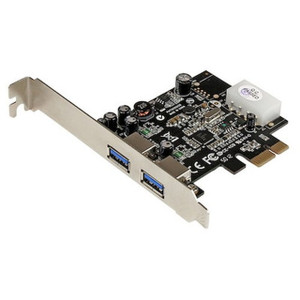
StarTech PEX1394B3 PCIe FireWire 800 Expansion Card
Overview
The StarTech PEX1394B3 is a standard-profile PCI Express FireWire expansion card that adds two FireWire 800 (9-pin) ports and one FireWire 400 (6-pin) port to any desktop with an available PCIe slot. If you're running professional audio interfaces, DV cameras, external drives, or legacy security hardware that still relies on IEEE 1394, this card keeps those devices connected to modern PCIe-based systems without requiring USB adapters or protocol converters that can introduce latency or compatibility issues.
Built on the Texas Instruments XIO2213B chipset — widely regarded as the most stable FireWire controller available — the PEX1394B3 delivers genuine, chipset-level IEEE 1394 support rather than a bridged workaround. For integrators maintaining hybrid environments that include older OHCI-compliant FireWire storage or capture hardware, chipset choice here matters more than most buyers realize.
Key Features
- 2x FireWire 800 (9-pin) External Ports: Each port supports up to 800 Mbps throughput, doubling the bandwidth of original FireWire 400. Daisy-chaining multiple drives or capture devices off a single port without saturating the bus is practical at this speed — important in multi-device audio or video capture rigs.
- 1x FireWire 400 (6-pin) External Port: Backward compatibility built in. Legacy 6-pin FireWire 400 peripherals connect directly without a separate adapter, so you don't have to retire older hardware the moment you install this card.
- Texas Instruments XIO2213B Chipset: TI's XIO2213B is the reference chipset for stable FireWire operation under Windows and macOS. Avoid generic or unknown-chipset FireWire cards in production environments — driver stability and OHCI compliance are not guaranteed with off-brand silicon. The TI chip eliminates that variable.
- 800 Mbps Maximum Data Transfer Rate: Full IEEE 1394b specification bandwidth. For external FireWire drives used in real-time video editing or surveillance archive offload, 800 Mbps provides headroom that FireWire 400 (400 Mbps) or USB 2.0 (480 Mbps theoretical, lower sustained) cannot match in sustained sequential transfers.
- PCI Express Bus Interface: PCIe has lower CPU overhead than PCI, and the available bandwidth far exceeds what FireWire 800 requires — meaning the card won't bottleneck at the bus level, even with all three ports active simultaneously.
- Standard Profile Form Factor: At 3.3 in × 4.7 in (L × H), this card fits standard ATX and mid-tower enclosures. The 0.7-inch width means single-slot occupation — no interference with adjacent cards.
- Internal LP4 (4-pin) Power Connector: The onboard LP4 connector draws supplemental power from the system PSU, ensuring the FireWire bus can deliver the full 800 Mbps bandwidth without relying solely on PCIe slot power — critical when powering bus-powered FireWire peripherals.
- Operating Temperature 0°C to 70°C: Covers standard data center and office rack environments without active cooling requirements. Storage is rated to 90°C, so the card won't be damaged by brief high-temperature exposure during transit or storage.
- Lifetime Warranty: StarTech backs the PEX1394B3 with a lifetime manufacturer warranty — an indicator of confidence in the TI chipset's longevity and a meaningful factor when specifying expansion cards for long-term deployments.
Integration and Compatibility
The PEX1394B3 works with any operating system that supports OHCI-compliant IEEE 1394 controllers, which includes all major versions of Windows, Linux distributions with OHCI kernel modules, and macOS versions that still support FireWire. Because the TI XIO2213B is natively recognized by these OS kernels, driver installation is typically automatic — no third-party software required in most deployments.
This card is well-suited to environments running network video recorders or legacy video capture appliances that use FireWire as the capture interface, professional audio interfaces (Focusrite, MOTU, PreSonus legacy lines), and DV/HDV cameras used in evidence recording or broadcast applications. It also integrates cleanly with FireWire-attached external storage arrays used for surveillance archive management.
For system builders evaluating PCIe expansion cards more broadly — including USB, eSATA, or serial port additions — the same standard-profile form factor constraint applies: confirm your chassis supports full-height brackets or source a low-profile bracket separately if installing in a 1U or slim chassis.
Humidity tolerance of 0–90% RH (non-condensing assumed at operating temperature) means the card handles typical ambient conditions in server rooms and workstations without issue. A server-grade workstation build targeting mixed FireWire and PCIe storage is a natural home for this card.
Frequently Asked Questions
Q: What chipset does the PEX1394B3 use, and why does it matter?
A: The PEX1394B3 uses the Texas Instruments XIO2213B chipset. TI's FireWire controllers are natively supported by Windows, macOS, and Linux kernels as OHCI-compliant devices, which means stable driver support and reliable operation with professional audio interfaces, DV cameras, and FireWire storage — categories where generic chipsets frequently cause dropouts or compatibility failures.
Q: Can I connect a FireWire 400 device to the PEX1394B3?
A: Yes. The card includes one dedicated FireWire 400 (6-pin) external port for direct connection of legacy IEEE 1394a peripherals. FireWire 400 devices can also connect to the FireWire 800 ports using a 9-pin to 6-pin or 9-pin to 4-pin adapter cable — though the adapter is not included.
Q: Does the PEX1394B3 fit a low-profile or slim desktop chassis?
A: The PEX1394B3 ships as a standard-profile card (4.7 in bracket height). It does not fit low-profile or slim chassis without a separately sourced low-profile bracket. Confirm your enclosure accommodates full-height PCIe cards before ordering.
Q: What is the maximum data transfer rate of the PEX1394B3?
A: The PEX1394B3 supports up to 800 Mbps per the IEEE 1394b (FireWire 800) specification. This applies to each FireWire 800 port independently — the PCIe bus interface provides sufficient bandwidth for all ports to operate at full speed simultaneously.
Q: What warranty does the PEX1394B3 carry?
A: StarTech provides a lifetime manufacturer warranty on the PEX1394B3.
Q: Does the PEX1394B3 require a separate power connection?
A: Yes. The card includes an internal LP4 (4-pin Molex) connector that should be connected to an available power lead from your system's power supply. This ensures the FireWire ports can deliver adequate bus power to connected peripherals, particularly bus-powered devices such as external drives.
The detail I always flag when someone asks about the PEX1394B3 is the Texas Instruments XIO2213B chipset — not because it sounds impressive, but because it's the specific reason this card works reliably in professional deployments where a generic FireWire card would cause intermittent device drops. The PEX1394B3 is straightforward hardware, but chipset selection here directly determines whether your FireWire devices operate consistently or require constant troubleshooting.
Technical Highlights:
- 800 Mbps FireWire 800 Ports: Two independent 9-pin ports each capable of 800 Mbps — double FireWire 400's ceiling. For sustained external storage transfers or multi-channel DV capture, this bandwidth headroom keeps the interface from becoming the bottleneck.
- LP4 Internal Power Connector: Bus-powered FireWire peripherals draw power from the controller card, not just the PCIe slot. The LP4 connection ensures the card can source that power from the PSU rail rather than stressing the slot's 25W limit — important when daisy-chaining multiple bus-powered drives.
- Lifetime Warranty: StarTech's lifetime coverage on the PEX1394B3 reflects the TI chipset's track record. For a card going into a workstation that won't be refreshed for five or more years, that warranty horizon removes a hardware refresh risk.
Deployment Considerations:
- Verify your chassis has a standard-profile PCIe slot available. At 4.7 in bracket height, this card will not fit 1U rackmount workstations or slim-tower builds without a separate low-profile bracket — one is not included.
- Connect the LP4 Molex power lead before first boot. Skipping it may work initially but can cause instability or insufficient bus power when multiple FireWire peripherals are connected simultaneously.
The PEX1394B3 is the right card for a professional audio or legacy video capture workstation where the integrator needs guaranteed OHCI compliance and driver stability — specifically mid-tower ATX systems running MOTU, Focusrite, or similar legacy FireWire audio interfaces where dropouts during a session are unacceptable.