
Credentials
Sub categories
Showing Results for Credentials
-
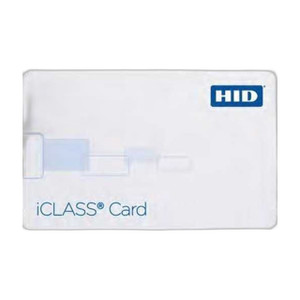
HID
SKU: 2000HPGGMN
HID Iclass SR 2K/2 Prgmd F-gloss B-gloss Match # NO Slot LAM Lifetime Warrant - 2000HPGGMN
- RF-only operation eliminates slot wear; no physical insertion required at reader.
- 137+ billion unique code combinations support formats up to 85 bits for large deployments.
- Laminated, passive design requires no battery and resists cracking in high-traffic use.
$7.14 $4.99 Save $2.15 -

HID
SKU: 2003HPGGMN
HID Iclass SR 32K (16K/2 + 16K/1) Prgmd F-gloss B-gloss Match # NO Slot Lam. 1 - 2003HPGGMN
- Ships factory-programmed with SIO and iCLASS app — no field encoding required.
- 32KB memory supports DESFire, SEOS, MIFARE, iCLASS, and 125 kHz prox fallback.
- OSDP communication enables vendor-agnostic integration with enterprise PACS panels.
$13.44 $8.99 Save $4.45 -

HID
SKU: 2063PKSMN
HID Iclass TG 16K/2+16K/1 Prgmd BLK ADH SEQ Matching None Lead Free - 2063PKSMN
- Factory-programmed iCLASS tag with 16K/2 + 16K/1 memory
- Sequential numbers and matching codes for enrollment audit
- Adhesive backing for permanent or semi-permanent attach
$11.26 $7.99 Save $3.27 -
HID
SKU: 3150PGGMVN
HID Iclass/prox Prog Iclass Non-p. Prox - 3150PGGMVN
- Dual-frequency 125 kHz + 13.56 MHz iCLASS SE/Prox composite supports mixed-reader environments.
- Non-proximity configuration prevents unintended Prox reader triggers in multi-reader doorways.
- 2 KB SIO-encoded memory with 26-bit H10301 format integrates into existing HID platforms.
$15.57 $9.99 Save $5.58 -
HID
SKU: 20NKS-00-00P6G3
HID Igno 20 Blk/slvr - 20NKS-00-00P6G3
- Reads 125 kHz and 13.56 MHz credentials plus BLE/NFC mobile access in one reader.
- OSDP v2 Secure Channel and Wiegand outputs support both modern and legacy controller wiring.
- IP65-rated housing operates from -31°F to 150°F for indoor or outdoor deployment.
$440.68 $265.99 Save $174.69 -

HID
SKU: 1386NGGNH
HID Isoprox II Non-prog F-gloss B-gloss - 1386NGGNH
- Passive 125 kHz HID proximity format; no battery or reprogramming overhead.
- Compatible with any HID proximity reader — no reader-specific pairing required.
- Supports formats up to 85 bits, yielding over 137 billion unique credential codes.
$8.18 $4.99 Save $3.19 -

HID
SKU: 1386NGGNN
HID Isoprox II Non-prog F-gloss B-gloss - 1386NGGNN
- Passive proximity card works with all HID proximity readers—no active power required.
- Supports up to 85-bit formats with 137B+ unique codes, preventing ID collision at scale.
- Non-programmed credential lets you assign card identity in your PACS software post-issuance.
$8.18 $4.99 Save $3.19 -
HID
SKU: 1386CGGNN
HID Isoprox II Prog Casi-rusco F-gloss B-gloss NO # NO Slot - 1386CGGNN
- 125 kHz Casi-Rusco format compatibility keeps legacy access control systems operational.
- Field-programmable on-site encoding eliminates vendor lead times for credential provisioning.
- No slot punch or printed numbering gives full control over physical badge customization.
$8.28 $4.99 Save $3.29 -

HID
SKU: 1386LGGAH
HID Isoprox II Prog Engraved Match Hzntl - 1386LGGAH
- Passive 125 kHz card works with all HID proximity readers—no hardware changes needed.
- Supports formats up to 85 bits with 137B+ unique codes for large enterprise deployments.
- Engraved matching number simplifies user administration and card-to-ID cross-referencing.
$8.28 $5.99 Save $2.29 -

HID
SKU: 1386LGGAN
HID Isoprox II Prog F-gloss B-gloss Engr - 1386LGGAN
- Ships pre-programmed with 26-bit H10301 format for drop-in use with installed HID Prox readers.
- Dual-gloss PVC composite construction withstands -40°F to 158°F for indoor and harsh-entry deployments.
- 0.033 in ISO thickness fits standard badge holders; dye-sublimation print-ready for photo ID integration.
$8.28 $5.99 Save $2.29 -

HID
SKU: 1386LGGAV
HID Isoprox II Prog F-gloss B-gloss Engr - 1386LGGAV
- HID Isoprox II proximity access card — programmed credential
- Wallet-sized passive card for door access control integration
- Front gloss and back gloss finish with engraving area
$8.28 $5.99 Save $2.29 -

HID
SKU: 1386LGGMH
HID Isoprox II Prog F-gloss B-gloss Matc - 1386LGGMH
- Works with all HID proximity readers—no firmware updates or provisioning software needed.
- Sequential matching cross-reference links card numbers to programmed IDs for audit accuracy.
- At 6.8 g, fits standard wallet and badge holders without adding bulk to daily carry.
$8.28 $5.99 Save $2.29 -

HID
SKU: 1386LGGMN
HID Isoprox II Prog F-gloss B-gloss Matc - 1386LGGMN
- Passive RF design requires no battery, ensuring consistent read performance over card lifetime.
- Encodes 137 billion+ unique codes, eliminating credential collisions in large multi-site deployments.
- High-gloss PVC construction on both faces supports photo ID overlay and resists daily wear.
$8.28 $5.99 Save $2.29 -

HID
SKU: 1386LGGMV
HID Isoprox II Prog F-gloss B-gloss Matc - 1386LGGMV
- RF-programmable passive card requires no battery, eliminating maintenance overhead.
- Supports up to 85-bit formats with 137 billion unique codes for large multi-site deployments.
- Sequential vertical-slot-punch format ships in 100-card batches, simplifying bulk provisioning.
$8.28 $4.99 Save $3.29 -

HID
SKU: 1386LGGNH
HID Isoprox II Prog F-gloss B-gloss NO # - 1386LGGNH
- Passive RF card requires no battery and programs via standard HID readers or programmers.
- Supports formats up to 85 bits with 137B+ unique codes, eliminating credential collision risk.
- Gloss/gloss finish with no printed card number limits identifier exposure in sensitive environments.
$8.33 $5.99 Save $2.34 -
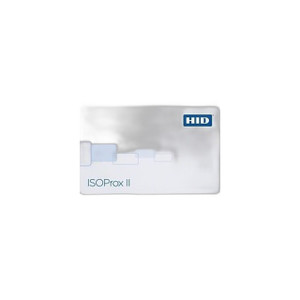
HID
SKU: 1386LGGNV
HID Isoprox II Prog F-gloss B-gloss NO # - 1386LGGNV
- Passive, battery-free design eliminates maintenance cycles and supports infinite shelf life.
- Supports formats up to 85 bits, yielding 137B+ unique codes for large multi-facility rollouts.
- Compatible with any standard HID proximity reader; no specialized hardware required at commissioning.
$8.28 $5.99 Save $2.29
Credentials
Credentials are the identifiers used to grant access through readers and access control systems. Select cards, key fobs, and credential formats that align with your reader technology, security requirements, and facility-wide standardization.
Plan Your Deployment
- Credential type (cards, fobs, or mobile credentials)
- Compatibility with your readers and control platform
- Facility standardization across sites and door groups
- Enrollment workflow and replacement process planning
- Security level requirements (basic vs encrypted formats)
- Access Control Overview
- Readers and Authentication
- Request credential recommendations
Credentials — Engineering-Grade Credential Reading for Commercial Deployments
This category covers 0 working models of credentials sourced manufacturer-direct or through channel-direct US distribution. Build the rest of your system around the architectural choices below — compatibility, environmental rating, and lifecycle decisions made here propagate through every downstream component you specify.
What to Look For
Credential technology drives reader choice. Legacy 125 kHz prox is easy to clone with off-the-shelf tools and should be retired wherever security matters. 13.56 MHz contactless (HID iCLASS Seos, Mifare DESFire EV2/EV3) uses encrypted mutual authentication and is the current standard. Multi-format readers buy migration flexibility but cost more per door and consume more current.
Form factor and mounting decide installation cost and aesthetic fit. Mullion-mount readers fit narrow door frames; wall-mount readers offer larger antennas and longer read range. Indoor versus outdoor (IP65/IP67) ratings drive housing choice. Backlit keypads, LED indicators, and audible beep volume affect usability — operator complaints almost always trace back to ergonomics, not the controller logic upstream.
OSDP support is now baseline for any new reader purchase. OSDP brings encrypted communication, tamper detection, and over-the-wire firmware updates. SIA OSDP Verified compliance (and OSDP Secure Channel) signals interoperability with controllers across vendors. Wiegand-only readers should be reserved for retrofit-only situations where pulling new cable isn't feasible.
Biometric and facial recognition readers add convenience but introduce template management, lighting requirements, and accuracy/false-rejection tradeoffs. Plan enrollment workflow, GDPR/BIPA compliance for stored biometric templates, and lighting upgrades at the reader site. Hybrid readers — credential + biometric — are common for compliance-sensitive environments where two-factor at the door is required.
Frequently Asked Questions
How far away can a credential be read?
13.56 MHz contactless reads at 2-4 inches with standard antennas. Long-range UHF readers (433 MHz, 900 MHz) read at 5-30 feet and are common in parking, vehicle ingress, and hands-free entry applications. The tradeoff is security — longer-range reads create larger opportunities for relay attacks. Match read range to the use case and confirm reader-credential pairing before mass-issuing credentials.
Can I read multiple credential types on one reader?
Multi-format readers (HID multiCLASS SE, ASSA OSDP multi-tech) support 125 kHz, 13.56 MHz, and mobile credentials simultaneously. They cost roughly 30-50% more than single-format readers but eliminate the credential-migration cliff. For organizations issuing mobile credentials alongside cards or transitioning from legacy prox, multi-format is almost always the right choice.
What's the difference between iCLASS Seos and Mifare DESFire?
Both are encrypted 13.56 MHz contactless standards used in modern access control. HID iCLASS Seos is HID's proprietary platform — broad reader ecosystem, mobile credential support via HID Mobile Access. Mifare DESFire EV2/EV3 is an open NXP standard used by many independent vendors and transit systems. Choose based on which controller/reader ecosystem you've committed to; performance is comparable.
How long do credentials last?
Physical cards last 5-7 years under normal pocket-and-purse use. Key fobs typically last longer, 7-10 years. Battery-powered active credentials (UHF tags) are limited by battery life, often 3-5 years. Mobile credentials don't have physical wear but require active phone OS support. Build credential replacement into annual budget; lost-card replacement runs $5-25 per card depending on technology.
Are biometric readers reliable enough for primary entry?
Modern fingerprint and facial recognition readers achieve very low false-reject rates (under 1% with good enrollment) and false-accept rates well below 1 in 100,000. They're reliable enough for primary entry in most commercial applications, with two important caveats: lighting and angle requirements for facial readers are strict, and a small minority of users have fingerprints that don't enroll reliably. Always pair biometrics with a credential fallback path.
Need help choosing? Talk to a Senior Specialist — direct line 877-277-7147 or request a quote.