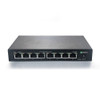
Comnet CNFE8TXM12US 8-Port Hardened Ethernet Switch
Overview
The Comnet CNFE8TXM12US is an 8-port unmanaged Ethernet switch purpose-built for hardened surveillance and industrial network environments. Each port runs at 10/100 Mbps over M12 connectors—the same rugged circular connectors you see on distributed I/O modules and field-mounted encoders. The 1.6 Gbps switching fabric means all eight ports can sustain near-wire-speed throughput simultaneously without bottleneck, critical when you're streaming multiple camera feeds or pushing data across geographically dispersed sites. Operating range of −40°C to +75°C and compact form factor (140 × 120 × 45 mm) make this switch suitable for everything from outdoor junction boxes to equipment racks in unheated warehouses.
Key Features
- 8 × 10/100 Mbps M12 Ports: M12 A-coded connectors eliminate the need for RJ-45 to M12 adapters at every node—you run M12 camera cable directly to the switch, reducing connection points and the failure modes that come with them.
- 1.6 Gbps Switching Capacity: Non-blocking throughput across all ports simultaneously means you won't see packet loss if you load all eight ports. In a 4-camera surveillance network where each camera pushes 4–6 Mbps, that leaves you with bandwidth headroom for future expansion without swapping hardware.
- Unmanaged Design: No configuration, no web interface, no learning curve. Plug in power and cable; it works. Reliability comes from simplicity—fewer firmware updates, fewer things to break, no IP address conflicts or management overhead.
- Wide Power Input (12–48V DC): Accepts any DC supply from 12V to 48V, meaning a single 24V PoE injector, a 48V industrial UPS, or even dual redundant supplies can feed it. No need for regulated 24V-only PSUs on every cabinet.
- −40°C to +75°C Operating Temperature: Handles outdoor cable splice boxes, rooftop equipment vaults, and uninsulated storage areas without derating. Passive (fanless) design means no cooling infrastructure needed and no risk of dust ingestion in harsh environments.
- Compact, Lightweight Form: At 1.2 kg and roughly 5.5 × 4.7 × 1.75 inches, fits into wall-mounted or pole-mounted enclosures where space is at a premium. Low profile also reduces wind loading on exterior installations.
Integration & Compatibility
The CNFE8TXM12US is a layer-2 bridge with no VLAN, SNMP, or DHCP capabilities—it simply forwards Ethernet frames between any two ports. That makes it universally compatible with any IP camera, encoder, NVR, or PoE injector that speaks standard 802.3 Ethernet. M12 connectors are industry-standard; camera manufacturers from Axis to Hikvision to Bosch offer M12-tipped cables as OEM or third-party options. If your existing plant uses RJ-45 exclusively, you'll need M12-to-RJ-45 converter cables or a hybrid patch panel, but the switch itself imposes no VMS or protocol restrictions.
Frequently Asked Questions
Q: Can I use the CNFE8TXM12US in a 48V power line to reduce voltage drop on long cable runs?
A: Yes. The switch accepts 12–48V DC input, so you can power it directly from a 48V source, then step down voltage locally if needed. This is common in remote sites where a single 48V feed is more practical than distributing 24V across multiple circuits.
Q: Does the switch support PoE power output on its ports?
A: No. The CNFE8TXM12US is a passive switch only. It passes data but does not inject power. If your cameras require PoE, you'll need a separate PoE injector or PoE mid-span device upstream.
Q: What happens if I mix 10 Mbps and 100 Mbps devices on the same switch?
A: The switch auto-negotiates each port independently. A 10 Mbps device will communicate at 10 Mbps; a 100 Mbps device will lock onto 100 Mbps. Mixed speeds work without issue, though obviously the slower device is a bottleneck for its own port.
Q: Is the CNFE8TXM12US industrial-grade or consumer-grade?
A: It's industrial-grade. M12 connectors, −40°C to +75°C rating, and fanless design are hallmarks of commercial-grade equipment. It's not a desktop consumer switch.
Q: Can I mount the CNFE8TXM12US on a DIN rail?
A: The product evidence does not specify DIN-rail mounting. Contact the manufacturer or your supplier to confirm mounting options and any required brackets.
Q: What certifications does the CNFE8TXM12US carry?
A: Specific certifications (FCC, CE, UL, etc.) are not detailed in available documentation. Consult the manufacturer datasheet or compliance documentation for a complete list.
I've deployed the CNFE8TXM12US in remote surveillance clusters where M12 cabling already terminates the camera nodes, and the lack of management overhead is genuinely valuable. The 1.6 Gbps fabric is overkill for an 8-port 100 Mbps switch on paper, but in practice it means no backpressure even if every port is saturated. The operating temperature range—minus 40 to plus 75 Celsius—is the real differentiator for unheated outdoor cabinets and rooftop enclosures where standard desktop switches would throttle or fail.
Technical Highlights:
- M12 Circular Connectors: Eliminates adapter chains at camera drop points. One M12 camera cable plugs directly in; weather seals are inherent to the connector design, not afterthought RJ-45 caps.
- 12–48V Input Range: A single 48V industrial UPS can feed multiple cabinets of this switch without step-down regulators. Reduces single points of failure in power distribution and cuts BOM cost across large deployments.
- Fanless, Passive Design: Zero moving parts, zero firmware updates to schedule. Mean time between failure is measured in years of shelf life, not operating hours.
Deployment Considerations:
- This is a layer-2 bridge only—no IP address, no management interface. If you need VLAN or traffic shaping, you'll step up to a managed switch family.
- No PoE injection on any port. If your cameras draw PoE, you need an external PoE injector or mid-span tapped ahead of this switch.
The CNFE8TXM12US is the right fit for outdoor cable-head consolidation—think rooftop camera clusters, buried conduit splice boxes, and equipment vaults where you want a switch that asks nothing of you and fails predictably if it fails at all.