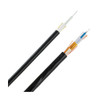
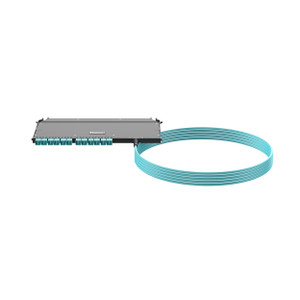
Panduit FONLZ24Y Opti-Core 24-Fiber OM4 LSZH Indoor/Outdoor Fiber Optic Cable
The Panduit FONLZ24Y delivers 24 strands of OM4 laser-optimized 50/125μm multimode fiber in a gel-free loose tube design rated for both indoor riser and outdoor exposure. The LSZH (Low Smoke Zero Halogen) jacket provides plenum-alternative fire safety without the cost and installation restrictions of true plenum cable, while the UV-resistant black polyethylene outer sheath handles direct sunlight, aerial routing, and outdoor-to-indoor transitions without requiring splice enclosures at the building envelope. For integrators running 40GBASE-SR4 or 100GBASE-SR10 campus backbones, datacenter risers, or building-to-building links where a single cable must traverse both environmental zones, this construction eliminates the labor and failure points of mid-span enclosures while maintaining full OM4 bandwidth out to 150 meters at 40GbE and 100 meters at 100GbE.
Key Features
- 24-fiber OM4 (50/125μm) laser-optimized multimode — 10GbE to 550m, 40GbE to 150m, 100GbE to 100m per TIA-492-AAAD
- LSZH jacket compound — IEC 60332-3 flame test, reduced smoke density and halogen acid gas emission vs. PVC
- Gel-free loose tube construction — no messy petroleum filling compound, faster stripping, cleaner vertical installations
- UV-resistant black PE outer jacket — direct sunlight exposure, aerial lashing, conduit-to-open-air transitions
- Indoor/outdoor dual rating — single cable run from MDF through riser to rooftop equipment or across campus without splicing at building penetrations
- Panduit Opti-Core quality — factory geometry testing, insertion loss verification, length marking every meter
OM4 fiber became the datacenter and campus standard because it extends 10GBASE-SR from 300 meters (OM3) to 550 meters while simultaneously supporting 40GBASE-SR4 and 100GBASE-SR10 over the installed base. The FONLZ24Y uses laser-optimized 50μm core fiber with a calculated EMBc (Effective Modal Bandwidth) of 4700 MHz·km at 850nm, which translates to 400 meters at 10GbE when using a single-mode-conditioned launch (common with QSFP+ optics), 150 meters at 40GbE with MPO-12 breakout, and 100 meters at 100GbE with MPO-24 parallel optics. Those distances cover the vast majority of intra-building risers and inter-building campus spans without forcing a step up to single-mode infrastructure. In loose tube construction, each 250μm color-coded fiber sits inside a larger buffer tube with controlled slack, allowing the cable to flex, bend, and experience temperature-driven expansion/contraction without transmitting mechanical stress to the glass itself. This is critical for outdoor aerial runs where summer-to-winter thermal cycles can impose several feet of length change on a 1000-foot span — the fiber floats inside the tube and never sees tensile load. Contrast this with tight-buffered designs (900μm individually jacketed fibers) where the jacket is bonded to the glass; outdoor temperature swings will eventually microbend or even fracture the core. The FONLZ24Y's loose tube design is also gel-free, meaning Panduit replaced the traditional petroleum-based flooding compound (used to block water ingress) with superabsorbent water-blocking yarns and tapes. The result: no sticky mess during termination, no solvent cleanup step, no risk of gel wicking into patch panels and contaminating connectors, and significantly faster prep time when you're landing two dozen fibers into an MPO cassette or breakout panel under a service window.
The LSZH jacket compound solves a building-code problem: you need riser-rated fire performance but you're in a high-occupancy or critical-infrastructure facility where PVC combustion byproducts (hydrochloric acid gas, dense black smoke) are unacceptable. LSZH formulations use halogen-free polymers (typically polyolefin or ethylene copolymers) with metal hydroxide flame retardants; when exposed to fire they release water vapor and minimal smoke, with no corrosive halogens that damage electronics or impair visibility during evacuation. The FONLZ24Y meets IEC 60332-3 Category C flame propagation (equivalent to UL 1666 riser in vertical tray loading) and IEC 61034 smoke density (<60% light obscuration), making it compliant for installation in cable trays, vertical risers, and enclosed pathways in hospitals, airports, tunnels, rail systems, and any facility where smoke toxicity is a life-safety or equipment-protection concern. It is not a plenum-substitute (does not meet UL 910 or NFPA 262), but in applications where you have a dedicated riser shaft or conduit pathway that does not serve as an HVAC air return, LSZH riser is both code-compliant and safer than PVC riser. The outdoor jacket is UV-stabilized black polyethylene, tested to resist 20 years of direct sunlight exposure per ASTM G155 xenon-arc weathering; this allows aerial lashing between poles, rooftop-to-rooftop spans, or direct-burial with proper armoring, then a straight pull indoors without requiring a splice enclosure at the building penetration. Many campus installations use j-hooks or cable tray outdoors, then the same cable enters through a roof conduit or wall sleeve and continues down the riser — one continuous pull, one set of terminations, zero outdoor enclosures to maintain.
A 24-fiber count hits the sweet spot for medium-density installations: it provides twelve duplex LC circuits (enough for a 10GbE core switch uplink plus several building distribution switches) or two 12-fiber MPO trunks (supporting 40GbE or 100GbE with breakout modules), while remaining light and flexible enough for single-person pulls through 2-inch conduit. The cable's outer diameter is approximately 11mm, so it will bundle with power and copper in standard 4-inch tray or occupy minimal real estate in a riser sleeve. Each fiber is color-coded per TIA-598 (blue, orange, green, brown, slate, white, red, black, yellow, violet, rose, aqua for fibers 1–12, then repeated for 13–24), and Panduit prints sequential meter marks on the jacket for accurate cut-to-length and installation documentation. The loose tube design also makes mid-span access straightforward: score the PE jacket, peel back the armor tape, extract the buffer tube, and you can splice or breakout individual fibers without disturbing the rest of the cable. This is particularly valuable in phased campus builds where you install the backbone during site prep, then activate circuits building-by-building as construction completes. You're not cutting and re-terminating the entire cable each time — just tap the tube, splice in a breakout pigtail, and move on.
The FONLZ24Y is third-party tested to TIA-492-AAAD (OM4 multimode fiber spec), TIA-568.3-D (optical fiber cabling standard), IEC 60332-3-24 (vertical flame propagation), and IEC 61034-2 (smoke emission), with Panduit's factory certification covering insertion loss, return loss, and length accuracy on every reel. For integrators managing campus fiber infrastructure, this cable provides a single SKU that handles both the outdoor building-to-building span and the indoor riser backbone, reducing inventory, simplifying procurement, and eliminating the most common field failure point — the outdoor splice enclosure where moisture, temperature cycling, and fiber movement eventually degrade connections. You pull one continuous cable, terminate both ends indoors in climate-controlled spaces, and the loose tube construction absorbs every environmental stress along the way.