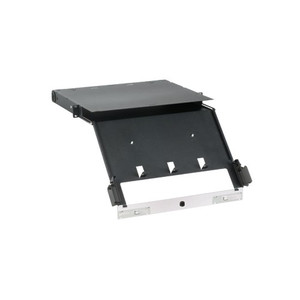
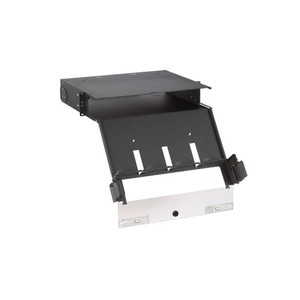
Panduit FLEX4U06 HD Flex™ 4 RU Fiber Enclosure
The Panduit FLEX4U06 is a 4 rack-unit fiber enclosure engineered for high-density datacenter and enterprise fiber optic deployments. Ships configured for 6 ports using HD Flex™ cassettes, but the modular architecture scales to 144 fibers per RU when fully populated with 12 cassettes per rack unit. Front and rear accessible split enclosure tray simplifies adds, moves, and changes without disrupting active circuits. Compatible with the complete HD Flex Fiber Cassette family and standard Fiber Adapter Panels, giving you migration flexibility as port counts and fiber types evolve. Includes rack/cabinet rail mounting bracket with integrated cable management.
Key Features
- Modular cassette design scales from 6 ports (as shipped) to 144 fibers per RU maximum density
- 4 RU (6.63" / 168.4 mm) height fits standard 19" racks and cabinets
- Front and rear accessible enclosure tray for service without downtime
- Split tray design with multi-positional mounting for organized fiber routing
- Universal compatibility with all HD Flex Fiber Cassettes and Fiber Adapter Panels
- Rack/cabinet rail mounting bracket with integrated cable management
- Black powder-coat finish, RoHS compliant
The FLEX4U06 addresses a common datacenter challenge: balancing immediate port requirements against future growth without over-provisioning rack space. Many fiber enclosures force you to choose between wasted capacity (buying a 144-port chassis for 12 active circuits) or costly forklift upgrades when you outgrow a fixed-density panel. Panduit's HD Flex architecture solves this by decoupling the enclosure from the port configuration. You purchase the 4 RU chassis once, then populate it incrementally as circuits come online. Each cassette slot accepts any HD Flex module—LC duplex, MPO/MTP trunk, SC, ST—so a single enclosure can support mixed fiber types and evolving backbone standards. The split enclosure tray divides incoming and outgoing cable paths, preventing the tangled bundles that plague dense fiber installations and making it possible to trace a circuit visually during troubleshooting.
Front and rear accessibility is critical in production environments where maintenance windows are measured in minutes. The FLEX4U06's tray slides out from the front for cassette insertion and patch cord dressing, but trunk cables terminate from the rear, so you never need to disturb live customer-facing connections to add capacity. The multi-positional tray design lets you angle the cassette mounting plane to match your cable entry point—top, bottom, or side—reducing bend radius stress on fiber bundles entering the enclosure. The included cable management bracket mounts directly to the rack rails and provides bend-radius-compliant routing channels for both distribution cables and patch cords, keeping slack organized and preventing the fiber damage that occurs when cables rest on sharp chassis edges or get pinched by adjacent equipment.
Compatibility across the HD Flex ecosystem means you're not locked into a single connector format or fiber count per cassette. A typical deployment might start with six LC duplex cassettes (12 fibers) for server connectivity, then add MPO-12 trunk cassettes as bandwidth needs drive 40G/100G migrations. The cassette-to-enclosure interface is identical across the product line, so you can mix generations and connector types in the same chassis without adapter brackets or custom mounting hardware. This modularity extends the useful life of the enclosure well beyond typical 5-7 year datacenter refresh cycles. The 4 RU form factor strikes a density-to-accessibility balance suited for both main distribution areas (MDAs) and intermediate distribution frames (IDFs): tall enough to justify rack space in a core facility, compact enough for branch or edge locations where rack real estate is constrained.
The FLEX4U06 meets RoHS compliance requirements for enterprise and public sector installations subject to hazardous materials restrictions. It mounts to standard 19-inch EIA racks and four-post cabinets using the supplied rail brackets, occupying 7 rack units total when you account for the 4 RU chassis height plus required bend radius clearance above and below. For integrators managing fiber deployments across multiple sites, the HD Flex platform standardizes enclosure hardware, reducing the number of SKUs you stock for service calls and simplifying technician training. When a cassette fails or a fiber type needs upgrading, you swap the module in under five minutes without tools, avoiding the full-chassis replacements that traditional fixed-density panels require.