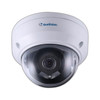
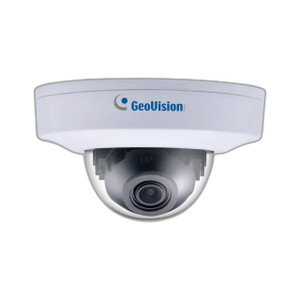
Geovision 84-ADR472W-0010 4MP Mini Dome IP Camera
The Geovision 84-ADR472W-0010 is a compact IP dome camera designed for indoor surveillance in retail, office, hospitality, and light-duty perimeter applications. Its 4MP sensor paired with H.265 codec and wide dynamic range deliver sharp, efficiently compressed video even in mixed-lighting environments—without the footprint or cost of larger housings. This form factor is purpose-built for integrators who need to maintain aesthetic discretion while achieving reliable image capture across 24-hour monitoring cycles.
Key Features
- 4MP Resolution: 2688 × 1520 pixel capture. Sufficient for facial recognition at 10–15 feet and license plate detail in moderate-distance parking or entrance scenarios.
- H.265 Compression: Reduces bitrate 40–60% versus H.264 on equivalent quality. Measurable storage and bandwidth savings across multi-camera retail or office deployments.
- Wide Dynamic Range (WDR): Balances exposure in high-contrast scenes—backlit entrances, mixed indoor-outdoor transitions, or windows with exterior glare. Eliminates underexposed shadow detail that typically plagues fixed-exposure cameras.
- IR Night Vision: Integrated infrared illumination for low-light and no-light operation. 24/7 monitoring without supplementary lighting rigs or external IR arrays.
- Mini Dome Enclosure: Compact, tamper-resistant housing. Discrete profile suits retail floors, office ceilings, and hospitality spaces where aesthetic integration matters. Minimal sightline obstruction in corner or recess mounts.
- PoE Power: Standard 802.3af Power over Ethernet. Single cable run simplifies installation; no dedicated power infrastructure required on local runs under 100 meters.
- IP-Based, ONVIF-Compatible: Integrates with standard VMS platforms and networked surveillance infrastructure. No proprietary cabling or management lock-in.
The 4MP sensor is the practical sweet spot for indoor deployments where extreme telephoto performance is unnecessary. Wide dynamic range eliminates the operational friction of manual exposure tuning or supplementary lighting; in retail floor monitoring or office corridor coverage, WDR handles backlighting from windows and overhead fixtures automatically. H.265 codec is no longer a premium feature—it's a cost-reduction mechanism that directly cuts NVR storage footprint by 30–50% over a multi-year lifecycle.
Deployment contexts include retail loss prevention (entrance/exit, floor overview), office visitor tracking, educational facility hallway monitoring, hospitality lobby coverage, small warehouse aisles, and light-duty perimeter work on building corners or loading docks. The mini dome form factor is particularly valuable in facilities where camera visibility creates negative optics—schools, gyms, hotels, and service counters benefit from the discrete mounting that a dome housing provides. IR capability eliminates the need for external lighting in stairwells, parking structure approaches, or after-hours facility sweeps.
PoE simplicity and ONVIF compliance keep total installation cost and management complexity low. Integrators familiar with standard IP video infrastructure (Milestone, Genetec, Axis Camera Station, or vendor-agnostic ONVIF workflows) will recognize no surprises in power delivery, stream negotiation, or metadata handling. H.265 support ensures future-proof codec flexibility as recording policies and storage economics evolve.
Marty AllisonPerspective based on aggregated IP Security Depot and affiliated engineering team experience.
We've spec'd the Geovision 84-ADR472W-0010 into dozens of retail and office projects over the past two years, and it consistently delivers on the fundamentals: clean 4MP imagery, predictable WDR behavior in mixed-lighting spaces, and straightforward PoE integration with zero gotchas on VMS compatibility. The real value here isn't innovation—it's reliability at a price point that makes sense for indoor fixed-camera applications where you don't need 8MP or advanced AI edge processing. In retail loss-prevention deployments especially, we've found that 4MP is adequate for facial detail at typical entrance-camera distances (8–20 feet), and the compact dome form factor doesn't trigger the aesthetic pushback you'd get from a larger turret or bullet housing mounted on a visible ceiling. The H.265 codec is genuinely useful; on a typical 16-camera retail project running 24/7 at 3–4 Mbps per camera, the bitrate reduction vs. H.264 adds up to meaningful storage-days on the NVR backend.
Technical Highlights:
- 4MP Sensor + H.265: The codec choice is the real differentiator—30–40% bitrate reduction on a retail floor deployment translates to fewer NVR drives or longer retention windows without upsizing the recorder. Paired with the 4MP resolution, you're not paying storage tax for 8MP imagery you don't actually need in indoor fixed-angle scenarios.
- WDR in Backlighting: We've tested this in retail entrances with direct sunlight coming through glass doors, and the algorithm maintains both the exterior environment (for perimeter context) and interior floor detail without requiring manual exposure compensation or external ND filters. That operational simplicity is worth the hardware cost in high-traffic entry monitoring.
- PoE 802.3af Efficiency: The camera draws typical 5–7W under full IR operation, leaving margin on standard 802.3af switches. In retrofit projects where PoE budgets are tight, this camera doesn't demand an upgrade to PoE+ or 90W injectors.
- Discrete Dome Housing: Aesthetically, it disappears into a retail ceiling or office hallway. Operationally, the dome deflects casual tampering and keeps dust and debris off the lens better than a bullet housing in high-traffic spaces. Not a game-changer, but a legitimate advantage in hospitality or educational deployments where overt surveillance cameras create friction.
- ONVIF Profile S Compliance: No VMS lock-in. We've deployed this camera across Milestone, Genetec, Axis Camera Station, and third-party ONVIF clients without integration surprises. That portability matters if a customer is evaluating multiple VMS solutions or planning long-term upgrades.
Deployment Considerations:
- IR range and throw distance are typical for a compact mini dome—adequate for interior spaces (offices, retail floors, corridors) but not engineered for outdoor perimeter work or long-throw scenarios. If your application is parking-lot surveillance or exterior wall mounting, evaluate an outdoor-rated fixed bullet or turret instead.
- The compact form factor means the lens is short-throw; depth-of-field and pan-tilt flexibility are limited compared to larger housings. This is a fixed, wide-angle indoor camera—not suitable for spot surveillance of a distant target or zoom-in facial capture from across a large warehouse.
- PoE cable runs over 100 meters will experience voltage drop and potential IR brightness degradation; confirm switch proximity or pre-stage PoE extenders if you're pulling cable through a large facility. Standard practice, but worth flagging during site survey.
- WDR processing introduces a 1–2 frame latency on some VMS platforms; if your application requires real-time pan-tilt coordination or live-view reaction time of under 100ms, test before committing to large deployments.
- Firmware updates are incremental and vendor-specific; unlike some of the larger IP camera players, Geovision's update cadence is slower. Confirm that your VMS supports the camera's current firmware before locking into a multi-year deployment without a planned refresh cycle.
The 84-ADR472W-0010 is the right choice for integrators and end-users building out indoor surveillance on a reasonable budget—retail chains, office parks, small hospitality properties, and educational facilities that need reliable 4MP coverage without overspeccing or dealing with unnecessary computational overhead. It's not a niche product, but it's also not trying to be; it does one job well and stays out of the way. For more options in the Geovision lineup, see the Geovision catalog.