
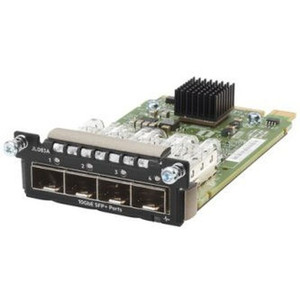
HPE 4-Port 10GbE SFP+ Module for Aruba 3810M Switch - JL083A
In stock · Ships same business day
Free shipping over $499
$514.99

Manufacturer-verified compatible cameras, recorders, mounts, accessories, and licenses for this product. Adjust quantities and add the entire bundle to your cart in one click.
Questions about this product? Free pre-sales support from a senior specialist — product questions, compatibility checks, BOM quotes, price confirmation — typically answered within one business day. Need camera placement or system design work? Engineering time is $175 per hour (qty 1 = 1 hour). Hardware buyers get up to one hour ($175) credited back on their order.
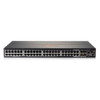
The HPE Aruba 2930M JL321A is a 1U rack-mount gigabit access switch built for enterprise wiring closets, IP surveillance deployments, and converged campus networks where you need dense PoE capacity, modular uplink flexibility, and proper managed-switch control — without stepping up to a core-class chassis. With 44 fixed RJ-45 ports, four dual-personality ports that swing between copper GbE and SFP fiber, a 1440W PoE power budget, and a modular slot that accepts 10GbE SFP+ or 40GbE QSFP+ uplink modules, the JL321A covers most enterprise access-layer designs in a single 1U footprint.
If you are speccing a PoE switch for a large IP camera deployment, a VoIP rollout, or a converged access layer running wireless APs, IP phones, and cameras simultaneously, this switch belongs on your short list. The 60W per-port ceiling means 802.3bt (PoE++) devices like pan-tilt-zoom cameras and dual-radio Wi-Fi 6 APs draw what they need without requiring a separate injector.
The JL321A integrates into Aruba's network management ecosystem via Aruba Central for cloud-managed deployments or AirWave for on-premises management. CLI, web GUI, SNMP, Telnet, and RMON1/2 are all available for integration into third-party NMS platforms. The switch supports standard 802.1Q VLANs, making it straightforward to segment camera traffic, management traffic, and user data onto isolated networks — a standard requirement in surveillance and enterprise access deployments.
For NVR-based surveillance architectures, pairing this switch with a compatible network video recorder on a dedicated camera VLAN gives you the switching headroom and PoE budget to support 40+ IP cameras on a single access layer device. The 12.38MB packet buffer helps absorb I-frame bursts from cameras transitioning between scenes — a common source of dropped frames on underpowered access switches.
Routing protocol support (OSPF, RIP, static) and Layer 3 forwarding mean the JL321A can participate in routed networks rather than requiring a purely flat Layer 2 topology. This simplifies multi-building or multi-floor deployments where you want camera subnets routed directly at the closet rather than centralized.
Q: What is the total PoE budget on the JL321A, and how many high-draw devices can it support simultaneously?
A: The JL321A provides a 1440W aggregate PoE budget with a maximum of 60W per port. In a worst-case scenario with all ports running 60W devices, you could sustain approximately 24 devices at full draw simultaneously. In typical mixed deployments (cameras at 12–25W, APs at 25–30W), the budget supports a full 48-port load with significant headroom.
Q: Does the JL321A support 10GbE and 40GbE uplinks?
A: Yes. The single uplink module slot accepts Aruba uplink modules for 10GbE SFP+ or 40GbE QSFP+ connectivity. The specific module must be purchased separately; the JL321A base unit ships with the slot empty. A separate stacking module slot also exists for chassis stacking.
Q: How many switches can I stack with the JL321A?
A: The JL321A supports stacking up to 10 chassis using the dedicated stacking module slot. Stacked units appear as a single managed switch, simplifying VLAN, port, and policy management across a large access layer deployment.
Q: What routing protocols does the JL321A support?
A: The JL321A supports static routing, RIP, and OSPF at Layer 3. This allows inter-VLAN routing to be handled locally at the access switch rather than requiring all traffic to transit a core or distribution router.
Q: What are the management options for the JL321A?
A: Management interfaces include CLI (via serial RS-232C or micro USB console), web browser GUI, SNMP, Telnet, FTP, and RMON1. The switch integrates with Aruba Central (cloud) and AirWave (on-premises) for centralized fleet management.
Q: What is the form factor and rack space required for the JL321A?
A: The JL321A is a 1U rack-mount switch with dimensions of 44.25 x 32.43 x 4.39 cm (W x D x H). It weighs 4.60 kg and draws a maximum of 78W at full non-PoE system load, dissipating 185 BTU/hr — relevant when calculating rack cooling and PDU capacity.

The JL321A is the switch I spec when a customer needs a real PoE access layer device — not a budget unmanaged box — and has a mix of cameras, APs, and IP phones on the same closet run. The 1440W aggregate budget is the headline number, but the 60W per-port ceiling is what makes it practical: you can drop a full-spec 802.3bt PTZ camera or a dual-radio Wi-Fi 6 AP on any port without pre-planning which ports get a midspan injector.
Technical Highlights:
Deployment Considerations:
This switch is a strong fit for enterprise wiring closets in healthcare, education, or commercial building deployments where a single 1U device needs to carry dense IP surveillance, wireless infrastructure, and endpoint access simultaneously — all managed centrally through Aruba's tooling without a separate PoE injector budget line.

Manufacturer-verified compatible cameras, recorders, mounts, accessories, and licenses for this product. Adjust quantities and add the entire bundle to your cart in one click.

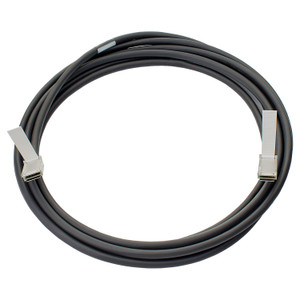
5-meter direct attach copper cable designed for high-speed network connections
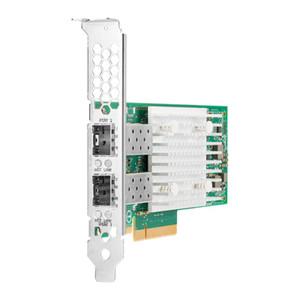
10 Gigabit Ethernet dual-port SFP+ network adapter designed for server deployments requiring high-speed connectivity over fiber optics
Looking for more HPE products? Shop the full HPE catalog →
Support services and planning resources for commercial surveillance, access control, and infrastructure deployments.
Fixed scope • Fixed price