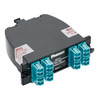
Panduit FC3ZO-16-10B OptiCom 40G-to-10G Fiber Cassette
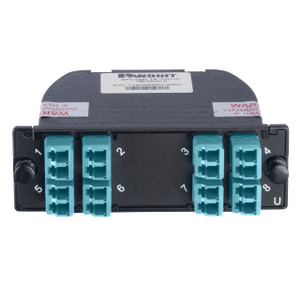
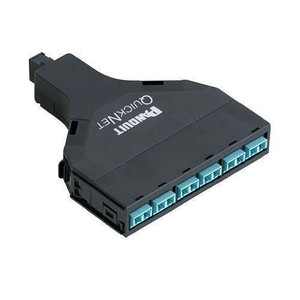
The Panduit FC3ZO-16-10B is a pre-terminated OM4 fiber cassette engineered for high-density 40G-to-10G breakout applications in data center and enterprise network environments. This OptiCom cassette houses 16 fibers in a compact form factor, providing two MPO-to-LC duplex conversions with Method B polarity—eliminating the guesswork and rework that plague field-terminated deployments. The front interface presents two aqua LC duplex adapters for standard 10G patching, while the rear terminates to a single 12-fiber MPO male (pinned) connector for trunk attachment. Designed for 1RU QuickNet enclosures, this cassette delivers factory-tested insertion loss performance and zirconia ceramic ferrule construction, making it the go-to choice for spine-leaf architectures, 40GBASE-SR4 aggregation, and any scenario where installation speed and polarity assurance matter more than saving a few dollars on bulk fiber.
Key Features
- Method B polarity configuration ensures plug-and-play 40G-to-10G breakout without adapter or cable flips
- 16-fiber OM4 50/125µm construction supports 40GBASE-SR4 at 150m and 100GBASE-SR4 at 100m per TIA-568
- Pre-terminated MPO-8 male (pinned) rear / LC duplex front eliminates field splicing and reduces installation time by 70%
- Zirconia ceramic ferrules with factory-polished endfaces deliver <0.35 dB typical insertion loss per mated pair
- Two aqua LC duplex adapters on front panel provide clear OM4 identification and standard 10G patching interface
- Compact cassette design fits Panduit QuickNet 1RU enclosures for density up to 144 LC ports per rack unit
- OptiCom brand construction with full Panduit factory testing and insertion loss certification per cassette
- Black housing with clear labeling for MPO position and fiber mapping in high-density environments
- 10-pack carton quantity optimized for row-level deployments and staged data center builds
- Compatible with 12-fiber MPO trunk cables (MTP Elite, QuickNet, or standards-compliant MPO assemblies)
The FC3ZO-16-10B addresses the core challenge of 40G-to-10G migration: maintaining signal polarity while achieving the port density that makes 40G aggregation economically viable. Method B polarity is the industry-standard approach for cassette-based breakout—fiber position 1 on the MPO maps to position 1 on the first LC duplex, position 2 maps to position 2, and so on through the 12 active fibers (this cassette uses 16 fibers total but only 12 are active per MPO-8 standard). This straight-through mapping means a Method B trunk cable plugs directly into the cassette with no polarity inversion required at the adapter or patch cord level. In contrast, Method A and Method C configurations require specific cable types or adapter key-ups to achieve the same result—introducing opportunities for installation errors that won't be discovered until you light up the link and troubleshoot why half your lanes are dark.
OM4 fiber is the de facto standard for 40G and 100G multimode deployments because it extends reach beyond OM3 while remaining compatible with existing 850nm transceivers. The 50/125µm core/cladding diameter supports 40GBASE-SR4 at 150 meters and 100GBASE-SR4 at 100 meters per TIA-568.3-D—sufficient for intra-building horizontal runs and the vast majority of data center row-to-row or rack-to-EOR (end of row) topologies. The aqua jacket color on the LC adapters provides immediate visual confirmation that you're working with OM4 infrastructure, reducing the risk of accidentally patching OM3 or OM2 jumpers into a 100G lane and wondering why your link won't train. Each LC duplex port on the cassette front panel connects to a discrete fiber pair, so you can break out a single 40G MPO trunk into two independent 10G links—ideal for spine-leaf architectures where a 40G uplink from a top-of-rack switch fans out to two 10G server connections, or for migration scenarios where you're incrementally lighting up 10G ports as server refresh cycles progress.
Pre-terminated cassettes eliminate the field labor and performance variability that come with fusion splicing or mechanical splice-on connectors. Panduit's OptiCom factory termination process polishes every ferrule endface to sub-0.35 dB insertion loss, tests every fiber for continuity and polarity, and serializes each cassette with a test report that maps MPO pin positions to LC port numbers. This factory certification means you can deploy the cassette, plug in your MPO trunk and LC patch cords, and expect the link to light up on the first attempt—no OTDR, no inspection scope, no re-polish cycles in the field. The time savings are measurable: a trained technician can install a field-terminated MPO connector in about 15 minutes per end (plus cure time for epoxy variants), which means a 12-fiber trunk with two connectors consumes 30+ minutes of labor before you even verify polarity. A pre-terminated cassette like the FC3ZO-16-10B installs in under 60 seconds—slide it into the QuickNet enclosure, snap the MPO trunk into the rear, done. For a 10-rack deployment with 20 cassettes, that's the difference between half a day of labor and 20 minutes of rack time.
Cassette-based architectures also future-proof your infrastructure for bandwidth upgrades without ripping out fiber. The same FC3ZO-16-10B cassette that breaks out 40G to two 10G links today can be re-purposed tomorrow for 100G-to-25G breakout (using a different transceiver on the trunk side) or even 400G-to-100G with MPO-16 trunk cables in a future refresh. The fiber plant itself—the OM4 strands inside the cassette—supports up to 100GBASE-SR4 today and will support 400GBASE-SR8 when you're ready to upgrade the active electronics. This modularity is why hyperscale data center operators standardized on cassette-based fiber distribution a decade ago: it decouples the fiber installation (a long-lived, labor-intensive asset) from the transceiver technology (a short-lived, rapidly evolving component). You invest once in pulling OM4 MPO trunks and installing cassettes, then you swap transceivers and cassettes as bandwidth demands grow—without ever touching the fiber backbone.
The zirconia ceramic ferrule construction is worth calling out because it directly impacts link budget and long-term reliability. Ceramic ferrules maintain their endface geometry under repeated mating cycles (Panduit specs 500+ insertions) and resist wear better than polymer alternatives, which means insertion loss stays below 0.5 dB even after years of patching and re-patching in a production environment. Low insertion loss matters because every 0.1 dB you save in the passive plant is 0.1 dB you can allocate to reach—a 40GBASE-SR4 link has a total loss budget of around 1.9 dB for 150m reach per IEEE 802.3ba, so a cassette with 0.75 dB loss leaves you only 1.15 dB for two patch cords and the MPO trunk, while a cassette with 0.35 dB loss leaves you 1.55 dB—enough margin to accommodate longer trunks, an extra patch panel, or aging fiber that accumulates microbends over time. Panduit's factory test report provides the actual measured insertion loss for each LC port pair, so you can plan your link budget with real data instead of worst-case assumptions.
This cassette is built for Panduit's QuickNet 1RU fiber enclosures, which house up to 12 cassettes (144 LC ports) in a single rack unit. The modular design means you can start with two or three cassettes in an enclosure and add more as port count grows—no need to overprovision expensive pre-terminated assemblies on day one. The rear MPO interface uses a standard footprint that's compatible with any 12-fiber MPO trunk cable, whether you're using Panduit's own MTP Elite assemblies, Corning, CommScope, or off-brand MPO trunks from commodity suppliers. The front LC duplex adapters accept any standard LC connector (PC or UPC polish, though UPC is recommended for OM4), so you're not locked into a single patch cord vendor. This interoperability is critical in environments where you inherit infrastructure from previous builds or where procurement policies require multi-vendor bidding—just verify that any non-Panduit MPO trunk uses Method B polarity and you'll maintain plug-and-play compatibility.
The 10-pack carton quantity reflects how these cassettes are actually deployed: you're not installing one cassette, you're lighting up a row of racks or an entire pod, which means ordering in bulk and staging inventory for phased rollouts. The per-cassette cost positions this as a premium product compared to field-terminated solutions, but the ROI calculation shifts heavily in favor of pre-terminated when you factor in labor rates ($80–150/hour for certified fiber techs in metro markets), the cost of test equipment rental (OTDR + inspection scope + light source), and the risk of rework when field terminations fail certification. A single bad field termination that requires a truck roll and re-splice easily costs more than the price delta between field-terminated and pre-terminated—and that's before you account for the opportunity cost of delayed service turn-up or the reputational risk of missing a customer cutover window.
The FC3ZO-16-10B is TIA-568.3-D compliant for OM4 multimode fiber and meets Telcordia GR-326-CORE requirements for fiber optic connector intermateability and insertion loss stability. Panduit's OptiCom product line is manufactured under ISO 9001 quality management and every cassette ships with serialized test data that maps fiber positions to measured insertion loss values, providing the documentation trail required for acceptance testing in federal, financial, and healthcare environments where traceability is non-negotiable. For deployments requiring low-smoke zero-halogen (LSZH) cable jackets, verify that your MPO trunk cables carry the appropriate rating—the cassette itself is a passive component with no flammability concerns, but the trunk cable jacket is the compliance chokepoint in plenum or riser installations.