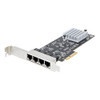
StarTech PR42GI-NETWORK-CARD 4-Port 2.5GbE NBase-T PCIe Network Adapter
Overview
The StarTech PR42GI-NETWORK-CARD is a quad-port, 2.5 Gbps NBase-T PCIe network adapter built around the Intel I225-V chipset — a practical upgrade path for servers, NVR hosts, and workstations that need more bandwidth than Gigabit Ethernet delivers without the cost and infrastructure disruption of jumping straight to 10GbE. Each of the four RJ-45 ports negotiates at 2.5G, 1G, 100Mbps, or 10Mbps, so it drops into existing Cat5e or Cat6 cabling without a forklift switch replacement. If you're consolidating camera feeds, running a multi-channel NVR, or connecting a surveillance server to a managed PoE switch that already supports NBase-T, this card eliminates the bandwidth ceiling that Gigabit NICs impose on high-resolution, multi-stream environments.
Key Features
- Intel I225-V Chipset, Four Ports at 2.5 Gbps Each: The I225-V is a proven silicon choice for NBase-T workloads — it handles four simultaneous 2.5 Gbps links without driver instability issues that have historically plagued off-brand NBase-T controllers. In a 16-channel 4K NVR, four independent 2.5 Gbps interfaces give you enough aggregate throughput headroom to separate camera ingress from client viewing streams entirely.
- PCIe 2.0 Bus Interface: PCIe 2.0 delivers sufficient bandwidth for four concurrent 2.5 Gbps links — total theoretical throughput sits well under the PCIe 2.0 x4 ceiling. The card installs in any standard PCIe x4, x8, or x16 slot, which covers virtually every server motherboard and modern workstation chassis in the field.
- Auto-Negotiating 2.5G/1G/100M/10M Compatibility: The step-down negotiation to 1G, 100Mbps, or 10Mbps means you can connect this card to legacy switches during a phased upgrade and still get full 2.5 Gbps performance on ports that support it — no manual speed-forcing required in most managed switch environments.
- 9K Jumbo Frame Support: Jumbo frames at up to 9,000 bytes reduce CPU overhead on high-throughput transfers by cutting the number of interrupts the system processes per second. In storage-heavy video surveillance workloads — particularly iSCSI-attached NAS or SAN targets — enabling 9K jumbo frames on the network path measurably reduces CPU utilization at high bitrates.
- Standard Profile Card Form Factor: The 4.7 in × 6.6 in × 0.8 in footprint fits full-height standard ATX and server chassis without a low-profile bracket swap. At 3.5 oz, it's light enough that chassis flex isn't a concern even in rack-mounted servers that see vibration.
- Operating Temperature 0°C to 55°C: Covers standard server room and wiring closet thermal envelopes. If the card is destined for an industrial edge server or an enclosure with marginal airflow, confirm ambient temps stay below 55°C under sustained load — the I225-V runs warm under full-load multi-port saturation.
- Broad OS Compatibility — Windows, Windows Server, Linux, VMware: Native driver support across all four OS families means you're not dependent on custom driver packages for hypervisor deployments. VMware compatibility is particularly relevant when the NVR or VMS server is a VM guest — you can pass through individual ports to separate VMs for traffic isolation without leaving the hypervisor stack.
- 5% to 90% RH, Non-Condensing: Standard data center and office humidity tolerance. Not rated for outdoor or high-moisture environments — plan accordingly if the host system is in a utility space.
Integration and Compatibility
The PR42GI-NETWORK-CARD (often searched as PR42GI NETWORK CARD) integrates cleanly with NBase-T-capable managed switches — look for switches advertising IEEE 802.3bz support on their uplink or access ports. In network switches built for surveillance infrastructure, NBase-T ports are increasingly standard on mid-range managed models. Pair this card with a PoE switch that has NBase-T uplinks and you eliminate the 1G bottleneck between your camera aggregation layer and the NVR host entirely.
For VMS deployments on platforms like Milestone XProtect or Genetec Security Center, the four independent interfaces allow you to assign dedicated ports to recording traffic, live view streams, and management plane communication — a configuration that prevents recording drops during peak operator activity. Refer to your network video recorder vendor's NIC teaming documentation before configuring LACP or failover bonding across these ports, as NBase-T bonding behavior varies by switch vendor.
On Linux hosts, the I225-V is supported in kernel 5.4 and later without out-of-tree drivers — relevant for NVR appliances running Ubuntu LTS or CentOS Stream builds. VMware ESXi compatibility allows port-level passthrough to guest VMs, which is useful for segmenting recording and viewing traffic in virtualized surveillance server architectures. For further context on building out the network layer for IP camera systems, the surveillance networking guide covers switch selection, VLAN segmentation, and bandwidth planning in detail.
This card does not provide PoE output — it is a receive/transmit NIC only. Camera power must come from a dedicated PoE switch or midspan injector on the camera-facing network segment.
Frequently Asked Questions
Q: Does the PR42GI-NETWORK-CARD support link aggregation or NIC teaming across its four ports?
A: The card presents four independent network interfaces to the OS. Link aggregation (LACP/802.3ad) or NIC teaming depends on your switch's support and the OS or hypervisor bonding driver — it is not a hardware-enforced feature of the card itself. Confirm your switch supports NBase-T LACP before configuring bonding.
Q: Will this card work in a PCIe x1 slot?
A: No. The PR42GI-NETWORK-CARD requires at minimum a PCIe x4 slot. A PCIe x1 slot does not provide sufficient lane bandwidth or physical connector space for this card.
Q: What is the warranty on the PR42GI-NETWORK-CARD?
A: StarTech provides a 2-year manufacturer warranty on this product.
Q: Does the card provide PoE power to connected devices?
A: No. The PR42GI-NETWORK-CARD is a data NIC only — it does not supply PoE power. Connected IP cameras or other PoE devices must be powered by a separate PoE switch or injector.
Q: Is the PR42GI-NETWORK-CARD compatible with VMware ESXi?
A: Yes. The card lists VMware as a supported OS, making it suitable for virtualized NVR and VMS server deployments where port-level passthrough to guest VMs is required.
Q: Does this card support jumbo frames, and does that matter for surveillance workloads?
A: Yes, jumbo frames up to 9K bytes are supported. For surveillance servers writing high-bitrate streams to iSCSI-attached storage, enabling 9K jumbo frames on the storage network path reduces CPU interrupt overhead and can improve sustained write throughput under multi-camera load.
The PR42GI-NETWORK-CARD is the card I recommend when a single-port 2.5GbE upgrade isn't enough — specifically, when you're building or upgrading an NVR host that needs to handle camera ingress, client viewing, and storage I/O on separate interfaces without introducing a 10GbE switch into the budget. Four independent Intel I225-V ports at 2.5 Gbps each gives you 10 Gbps of aggregate bandwidth across the four links, and the I225-V's driver maturity on Linux and VMware ESXi means you're not troubleshooting instability under sustained multi-stream load.
Technical Highlights:
- Intel I225-V Chipset: Proven NBase-T silicon with stable driver support on Linux kernel 5.4+ and VMware ESXi — avoids the driver quality issues that have affected some competing NBase-T controllers in production deployments.
- 9K Jumbo Frame Support: Critical for iSCSI storage paths in surveillance servers — reduces CPU interrupt frequency at high aggregate bitrates, which translates directly to fewer dropped frames under peak recording load.
- Auto-Negotiation to 1G/100M/10M: Lets you phase in NBase-T infrastructure one switch port at a time — the card won't force a speed mismatch on legacy switch ports still running at 1G during a staged upgrade.
Deployment Considerations:
- The PCIe 2.0 requirement means confirming slot availability before ordering — this card needs a physical x4, x8, or x16 slot, and many compact server chassis or small form factor workstations have limited x4+ slots available after storage and GPU cards are seated.
- Operating temperature ceiling of 55°C is worth checking in edge server enclosures with restricted airflow — the I225-V generates meaningful heat under four-port simultaneous saturation, and chassis airflow design matters more than it would for a single-port card.
This card is the right fit for a dedicated 16- to 32-channel NVR host running on a tower server or 1U/2U rack chassis where the operator wants to segment camera, client, and storage traffic across dedicated interfaces without moving to a more expensive 10GbE infrastructure stack.