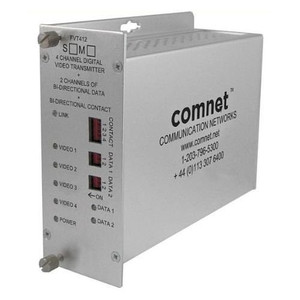
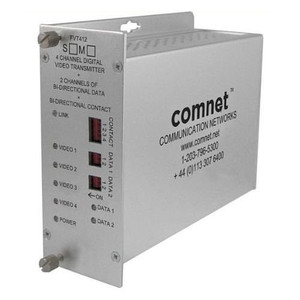
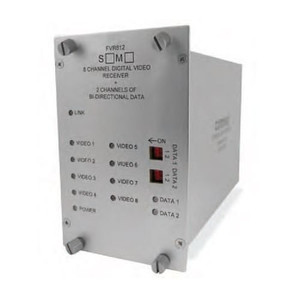
Comnet FVT4014M1SHR 4-Channel Video Transmitter
Overview
The Comnet FVT4014M1SHR is a 4-channel digitally encoded video transmitter paired with a 4-channel bidirectional data transceiver, designed for long-haul fiber-optic deployments where you need to consolidate multiple video feeds and control signals over a single strand of single-mode fiber. This is the right tool when you're running surveillance across sprawling industrial sites, municipal networks, or campuses where copper runs become impractical or where electromagnetic interference would degrade analog video. The 30-mile (48 km) reach over single-mode fiber means you can span large geographical areas without intermediate repeaters, and the self-healing ring (SHR) topology keeps the network live even if one fiber segment fails — a critical feature for sites where downtime costs money.
Key Features
- 4-Channel Video Transmission: Each channel encodes full-motion video digitally, eliminating the signal degradation and noise that plague long analog video runs. At 30 miles, analog would be unusable; digital ensures evidence-grade clarity at the receiver end.
- RS250C Medium Haul Quality Standard: Comnet's RS250C encoding delivers commercial-grade video fidelity optimized for surveillance — you get the video detail you need without the bloat of constant-bitrate encoding. This matters on long fiber runs where bandwidth efficiency prevents you from overprovisioning the receiver side.
- 10-Bit Encoding: 10-bit color depth captures finer tonal gradation than 8-bit, particularly useful in low-light scenes or when you need to extract detail from shadows during forensic review. On a 24/7 surveillance network, that extra bit of resolution across millions of frames adds up to better evidence.
- Single-Mode Fiber, 1-Fiber Configuration: Single-mode fiber (typically 9µm core) supports longer distances with less attenuation than multimode. The FVT4014M1SHR runs on a single fiber strand, meaning you install one fiber pair (transmit and receive wavelengths multiplexed onto the same fiber) instead of two separate fibers. This cuts installation cost and physical footprint in conduit.
- 30-Mile Transmission Range: Eliminates the need for intermediate repeaters across long campus networks, municipal systems, or industrial perimeters. You connect one transmitter at the source site and one receiver at the destination — no active equipment in the middle means fewer points of failure and simpler maintenance.
- Self-Healing Ring (SHR) Topology: If one fiber link in your ring network fails, traffic automatically reroutes around the break within milliseconds. For critical surveillance infrastructure (airports, utilities, hospitals), SHR redundancy is the difference between continuous monitoring and a gap in coverage during the exact moment something goes wrong.
- 4 Bi-directional Data Channels: Beyond video, you get four independent data paths for control signals, alarm triggers, or PTZ commands. This means your camera control, relay outputs, and sensor inputs all ride the same fiber infrastructure — no separate copper runs for ancillary signals.
- 8-Video-Link Daisy-Chain Capability: You can cascade up to 8 transmitter-receiver pairs on a single ring, supporting complex multi-site networks without the cost of parallel fiber runs. Each link stays independent, so a fault on one doesn't cascade.
- Rack and Surface Mount Options: Flexibility to install in central equipment rooms (rack mount) or at remote sites where you need compact wall or pole mounting. Hot-swappable rack modules mean you replace a failed unit without powering down the entire shelf.
- Transient Protection and Auto-Resettable Fuses: Power surges from nearby lightning strikes or switching transients won't blow the board — transient protection clamps the spike, and automatic resettable fuses restore operation without manual intervention. On remote sites where you can't physically visit daily, this passive resilience keeps the link alive through electrical noise.
- ST Connectors (Single-Mode): Industry-standard ST fiber connection ensures compatibility with standard fiber patch panels and termination standards. No proprietary connector means you can source repair fiber from any telecom supplier.
Integration & Compatibility
The FVT4014M1SHR integrates into mixed-protocol surveillance networks where your cameras may use analog baseband, composite video, or digital formats. The transmitter accepts baseband composite video input (standard in analog camera systems) and encodes it digitally for the fiber span. At the receiver end, you recover that video back to analog composite or digital output depending on your recording backend. The bidirectional data channels support legacy relay control, pan-tilt-zoom (PTZ) commands, and sensor alarms — anything that traditionally ran on shielded twisted-pair can run on these data channels.
Deployed in conjunction with network infrastructure for sites that mix analog and IP systems, the FVT4014M1SHR becomes your analog-to-fiber bridge. In ring topology, you can link multiple sites without worrying about how one site's power failure affects the others — the ring heals around the break.
What's in the Box
The evidence provided does not include detailed package contents. Contact the manufacturer or your vendor for exact items included with your unit.
Frequently Asked Questions
Q: Can the FVT4014M1SHR transmit video and control signals simultaneously?
A: Yes. The unit transmits 4 channels of video plus 4 bidirectional data channels on the same single-mode fiber. Video and data are wavelength-multiplexed, so they don't interfere with each other.
Q: What happens if the fiber link fails in an SHR ring topology?
A: Traffic automatically reroutes around the failed segment. If you have 4 sites in a ring and one fiber link between sites 2 and 3 breaks, data from site 1 still reaches site 4 by going through site 1 → site 2 → site 4 (the long way) instead. The switch happens in milliseconds with no manual intervention required.
Q: Is the FVT4014M1SHR compatible with existing analog cameras?
A: Yes. The transmitter accepts baseband composite video input, which is the standard output of most analog cameras. At the receiver end, you recover composite video or route it to a DVR/capture card. No camera modification needed.
Q: What is the difference between single-mode and multimode fiber in this unit?
A: The FVT4014M1SHR uses single-mode fiber (9µm core), which supports longer distances (30 miles in this case) with less signal loss than multimode (typically 50µm core). Single-mode is the choice for long-haul transmission; multimode is limited to shorter runs (typically under 2 km) but costs less. For 30-mile spans, single-mode is essential.
Q: Can I mix the FVT4014M1SHR with other Comnet fiber products in the same ring?
A: Yes, as long as they support SHR topology and operate on the same wavelengths (typically 1310 nm and 1550 nm for single-mode). Consult the product datasheets to confirm compatibility before mixing units.
Q: What is the power requirement for the FVT4014M1SHR?
A: The evidence provided does not specify the power voltage or current requirements. Contact the manufacturer or your vendor for detailed power specifications.
I spec the FVT4014M1SHR when analog surveillance has to cross distances where copper becomes impractical. The 30-mile single-mode reach and self-healing ring topology make this the backbone of large municipal or campus security networks where continuous uptime matters more than cost-per-link. The combination of RS250C encoding with 10-bit color depth ensures that when you pull forensic evidence at the far end of a 48 km fiber run, you're working with the clearest signal possible — not a degraded, noisy analog artifact.
Technical Highlights:
- 10-Bit Encoding: Captures finer tonal gradation than 8-bit, particularly valuable in low-light forensic review. At scale across thousands of frames per camera, that extra bit translates to recoverable detail in shadow areas that 8-bit encoding would lose to quantization.
- RS250C Medium Haul Quality: Comnet's proprietary standard for surveillance-optimized encoding balances fidelity and bitrate — you don't waste bandwidth on color gradations humans can't resolve, but you preserve the contrast and edge detail needed for face/license-plate forensics.
- Single-Mode Fiber at 30 Miles: Eliminates intermediate repeaters across your network topology. For a 30-mile ring, that's 2–4 fewer active nodes that could fail, need power, or require redundant management. Passive fiber is more reliable than active electronics.
- Self-Healing Ring with 8-Link Daisy-Chain: If you're tying together 4 remote sites, each connected by a separate fiber run, and one run fails, the ring topology keeps all 3 remaining sites operational. You don't get a site-wide outage — you get localized rerouting that most NOC staff won't even notice until they run diagnostics.
- 4 Bi-directional Data Channels: Covers PTZ control, relay triggers, and alarm inputs on the same fiber infrastructure. No copper runs parallel to video — single point of maintenance, single conduit routing cost.
Deployment Considerations:
- Single-mode fiber installation requires precision; poor cleanliness or improper termination at either end tanks your signal. If you're not using certified fiber technicians, budget extra for testing and re-termination.
- The 30-mile range assumes ideal conditions (low-loss fiber, proper splicing). Real-world sites with multiple splices or older installed fiber may see slightly shorter effective range — always test your specific run before committing cameras to it.
- Automatic resettable fuses and transient protection are passive — they buy you time, but lightning strike near the transmitter site can still require a service visit to reset or replace components. Surge protection at the power entry point is not optional on this equipment.
Deploy the FVT4014M1SHR when you're connecting geographically dispersed security zones (airport perimeter sensors feeding a central command room, utility substations feeding SCADA + video to a regional NOC, or campus residence halls feeding a central security office). The single-fiber, ring-redundant topology keeps your analog cameras on air across distances where Ethernet would need active repeaters and where copper baseband would fail completely.