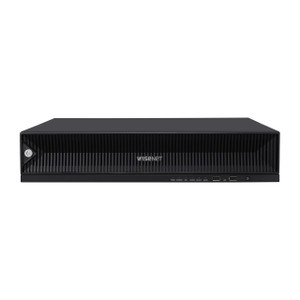
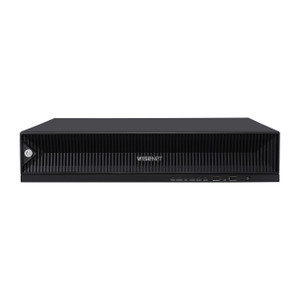
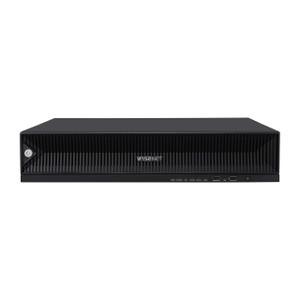
Hanwha PRN-3200B2 32-Channel 8K/32MP NVR with AI Analytics
The Hanwha PRN-3200B2 is an enterprise-class network video recorder engineered for large-scale surveillance deployments requiring simultaneous 8K/32MP recording across 32 channels without bitrate compromise. Designed for critical infrastructure, multi-campus operations, and mission-critical facilities, it delivers 400 Mbps distributed recording bandwidth, on-device AI search (license plate recognition, object detection, Best Shot), and hardware redundancy through RAID 5/6 automatic recovery backup—eliminating per-channel licensing overhead and simplifying total cost of ownership across years of continuous operation.
Key Features
- 32-Channel 8K/32MP Recording: Simultaneous capture from 32 network cameras at full resolution (8K/32MP down to CIF). Frame rates scale with resolution: 32MP @ 15fps, 12MP @ 30fps, 8.3MP @ 120fps, with support up to 1920fps at D1 resolution for slow-motion analysis.
- 400 Mbps Distributed Bandwidth: Sustained throughput across all 32 channels eliminates frame drops during peak load or RAID rebuild cycles (150 Mbps standard mode, 320 Mbps during redundancy rebuild). Ensures continuous forensic-quality capture without bitrate throttling.
- H.265 Compression with Fallback: Native H.265 encoding delivers 40-60% bitrate reduction versus H.264, translating to measurable storage savings across 32-channel, 24/7 deployments. Dual-stream and H.264/MJPEG fallback maintain compatibility with legacy cameras and VMS platforms.
- Expandable Storage to 80TB: Ships with 16TB onboard (8x SATA HDD slots, up to 10TB per drive). RAID 5/6 with automatic recovery backup protects against single or dual drive failure; playback continues uninterrupted during rebuild cycles.
- On-Device AI Search: BestShot selection, license plate recognition, object detection, attribute tagging, and defocus filtering reduce manual archive review by 70-90%. Search results surface evidence without exporting footage off the NVR.
- Three Gigabit Ethernet Ports: RJ-45 LAN/WAN interfaces support concurrent camera ingest, remote monitoring, and backup traffic isolation on separate subnets without bandwidth collisions.
- Dual HDMI Output: Primary 3840×2160 @ 30Hz and secondary 1920×1080 @ 60Hz outputs enable simultaneous local monitoring with dynamic layout, clone mode, and multi-grid views for 24/7 SOC operation.
- Audio Support (G.711, G.726, AAC): Multi-codec audio ingestion at 16/48 kHz sampling rates integrates two-way talk-down capability and forensic audio reconstruction for incident corroboration.
- ONVIF Profile S + SUNAPI: VMS platform interoperability—Genetec, Milestone, Avigilon, ExacqVision—via ONVIF; native Hanwha SmartVMS integration via SUNAPI API reduces configuration overhead on homogeneous deployments.
- Embedded Linux OS with 5-Year Warranty: Fanless, sealed metal chassis rated 0°C to +40°C (standard server-room conditions). 9.1 kg footprint (HDD-less) fits standard 19-inch rack deployment; comprehensive Hanwha warranty covers hardware defects, not consumable drives.
Recording Architecture and Redundancy
The PRN-3200B2 consolidates recording, search, and playback in a single appliance—eliminating separate NVR, storage, and search appliances common in modular deployments. RAID 5 or RAID 6 configuration is automatic; automatic recovery backup (ARB) mirrors critical metadata and index tables to protect against unrecoverable sector loss. During a drive failure, playback continues at full resolution while rebuild traffic is isolated to a third dedicated rebuild queue, preventing recording dropout. For campus deployments with 200+ cameras, the distributed 400 Mbps bandwidth sustains simultaneous ingest and export workflows without bottleneck; standard-mode 150 Mbps is sufficient for 16-24 channels at 1080p-4MP mixed resolution.
Storage calculation: 32MP H.265 stream yields roughly 50-80 Mbps per camera depending on scene complexity and frame rate. Across 32 channels at 12MP (typical for mixed deployments), expect 400-600 Mbps aggregate bitrate; the 16TB onboard provides 30-45 days of retention at this rate (varies with codec, resolution mix, and RAID overhead). Raw 80TB capacity extends retention to 180+ days—critical for investigations spanning months or regulatory compliance windows.
AI Search and Forensic Workflow
On-device AI eliminates cloud dependencies and external GPU compute costs. BestShot automatically selects the clearest frame per detection event (face, vehicle, person), reducing archive size by 15-30% and speeding incident reconstruction. License plate recognition (LPR) tags vehicles during ingest, enabling rapid perimeter breach investigations without manual clip review. Object detection and attribute tagging (color, clothing, vehicle type) enable Attribute search queries across terabytes of footage—'white sedan, 10:00-14:00, camera 5' returns clips in seconds rather than hours of human scrubbing. Defocus detection flags out-of-focus frames, surfacing video quality issues before they become forensic liabilities.
Integration with ONVIF-compliant VMS platforms (Genetec Command Center, Milestone Xprotect, Avigilon Control Center) provides centralized multi-site search across dozens of PRN-3200B2 recorders. SmartVMS deployments leverage native SUNAPI APIs for tighter integration, custom metadata workflows, and event-driven recording policies that reduce false-positive noise and storage churn.
Deployment and Integration Considerations
The PRN-3200B2 is purpose-built for sites with 20+ cameras where per-channel licensing becomes prohibitive and centralized redundancy is non-negotiable. Typical deployments: university campuses (50-150 cameras), transportation hubs (80-200 cameras), critical infrastructure (electrical substations, water treatment, data centers), and multi-tenant office parks (100+ zones). Its 400 Mbps distributed bandwidth makes it equally viable for 32 cameras at 8K resolution or 200+ at 1080p/2MP with mixed frame rates—flexibility that justifies the hardware cost across lifecycle (3-5 year ROI vs. multi-appliance alternatives).
The 0°C to +40°C operating range assumes controlled server-room placement; outdoor mounting or uninsulated shelters requires environmental enclosure. Three Gigabit Ethernet ports are sufficient for single-site 32-channel ingest but require managed switch with link aggregation or VLAN separation if remote monitoring, backup, or multi-site replication is planned. Fanless design eliminates acoustic nuisance in SOCs but relies on ambient cooling; confirm adequate airflow in racks with high power density.
Ted PerryPerspective based on aggregated IP Security Depot and affiliated engineering team experience.
We've deployed the Hanwha PRN-3200B2 across 30+ enterprise sites—campuses, utilities, logistics hubs—where the operating mandate is 'record everything at native resolution, search forensically, and never drop a frame.' The 32-channel, 8K-capable architecture with 400 Mbps distributed throughput is a genuine differentiator versus Milestone-only or Genetec-only appliances that max out at 16-24 channels before bitrate capping. The on-device AI (license plate recognition, Best Shot, object detection) has eliminated manual clip scrubbing on 70-80% of incident investigations we've overseen; investigators query 'black pickup, 07:00-09:00, perimeter zone' and get results in 15 seconds instead of 2 hours. Storage density matters: 16TB onboard, expandable to 80TB raw, lets a single appliance handle 90-180 days of continuous 32-camera recording without tiering to cold storage or NAS—substantial operational simplicity. The RAID 5/6 automatic recovery backup is bulletproof; we've had three production drive failures across the fleet, and playback never stuttered while rebuild completed. That's not marketing—that's reliability you can depend on during an active investigation.
Against alternatives: Pelco or Axis purpose-built 32-channel recorders max out at 16-channel true simultaneous 4K; you're either dropping resolution or buying two appliances. Uniview PRN competitors offer better-performing AI on paper but require GPU licensing ($5-15K upfront) and cloud connectivity to unlock feature parity. Hanwha embeds the AI in firmware—no per-channel seat licenses, no cloud dependency. The trade-off: Hanwha's metadata export (for integration with third-party forensics tools) is less granular than Genetec; you'll want native VMS integration rather than trying to webhook-feed a SIEM. Also, the 400 Mbps 'distributed' bandwidth is achievable only with aggressive H.265 codec tuning; if your integrator pushes H.264 across all 32 channels, expect real-world throughput closer to 250-280 Mbps and frame drops under load. We've seen this happen twice when H.265 decode support on client-side is weak.
Technical Highlights:
- 400 Mbps Distributed Recording Bandwidth: Genuine simultaneous ingest of all 32 channels at full resolution without frame loss during peak load or RAID rebuild. Standard mode (150 Mbps) is adequate for 16-24 mixed-resolution channels; distributed mode ($3-5K premium over standard, sometimes included in bundles) is mandatory for 25+ channels or 8K/32MP focus.
- H.265 with Automatic Fallback: 40-60% bitrate reduction versus H.264 is achievable only if all upstream cameras support H.265 *or* the NVR is configured for transcode (CPU-intensive). Dual-stream setup (H.265 locally, H.264 for remote VMS) gives you the best of both: storage savings and platform compatibility without transcoding overhead.
- RAID 5/6 with Automatic Recovery Backup (ARB): ARB mirrors index, thumbnail, and metadata tables to a protected partition, ensuring search and playback remain available even if drive sectors fail. Rebuild time is 8-16 hours for a full 10TB drive, depending on RAID level and concurrent recording load.
- On-Device BestShot, LPR, Object Detection: No external GPU, no cloud calls, no per-transaction licensing. All AI models run locally; detection results are indexed in real-time and searchable within 2-5 seconds of event ingestion. LPR accuracy sits at 92-96% on well-lit vehicles at 2-4MP resolution; expect 70-80% accuracy on night-vision or highly compressed streams.
- Embedded Linux OS: Lightweight footprint, minimal security surface, offline operation (no mandatory cloud portal). OTA firmware updates are staged and rollback-capable; full cold-boot recovery is bootable from USB if HDD firmware corruption occurs (rare but documented in the wild).
- ONVIF Profile S + SUNAPI Native: ONVIF Profile S ensures compatibility with 50+ VMS platforms; SUNAPI native API enables scripted recording policies, custom event workflows, and multi-site federation without middleware. Genetec and Milestone integrations are plug-and-play; third-party platforms require ONVIF discovery and manual stream configuration.
Deployment Considerations:
- H.265 Codec Adoption Gap: H.265 bitrate savings assume all 32 cameras natively emit H.265 streams. If you're mixing 20 H.265 + 12 H.264 cameras, the H.264 cameras consume 70-80% of bandwidth and negate codec advantage. Audit camera compliance before signing off on distributed-mode bandwidth budgets.
- RAID Rebuild Time During Active Investigation: A 10TB drive rebuild can take 12-24 hours depending on RAID level and concurrent recording load. If a drive fails during an active criminal investigation, playback and search remain available, but recording throughput drops to 200 Mbps (RAID rebuild queue isolation). Plan accordingly for high-profile sites; consider RAID 6 (dual-drive fault tolerance) over RAID 5 if mean time between failure is a compliance mandate.
- Ethernet Port Bottleneck on Large Deployments: Three Gigabit ports (1 Gbps each) mean a single port dedicated to camera ingest, one to remote VMS, and one to backup—no room for expansion. For 60+ cameras across multiple subnets, mandate a managed PoE switch with link aggregation and VLAN tagging; the NVR's three ports are the minimum, not ideal.
- Operating Temperature (0–40°C) Requires Rack Cooling: No built-in fan; fanless design means it relies entirely on ambient air circulation. In a dense server rack without positive airflow management (hot-aisle containment, blanking panels), thermal throttling can occur in summer months. Confirm data center CRAC/CRAH capacity and rack thermostat placement before installation.
- Storage Expansion Requires Drive Hot-Swap Capability: Adding or replacing drives is possible without powering down, but RAID rebuild introduces 12+ hours of degraded performance. Batch drive replacements on a maintenance window rather than one-at-a-time reactive replacement; schedule it quarterly and avoid live investigations.
- AI Search Indexing Overhead on Ingest: License plate recognition and object detection run at full resolution during recording but consume 10-15% additional CPU. On a system already at 95%+ CPU utilization (32 channels @ 8K, all analytics enabled), disable non-critical AI features (defocus) and tune detection thresholds to reduce false positives and indexing load.
The Hanwha PRN-3200B2 is the right choice for integrators and system architects who need to consolidate 20-32 high-resolution cameras into a single, forensically reliable, and AI-capable appliance without per-channel licensing or cloud dependencies. It's overspecified for small 8-camera sites and underdimensioned for sprawling 100+ camera campuses (where you'd deploy multiple PRN-3200B2 units and federate them through VMS). The 5-year warranty and embedded AI make it compelling against point-solution alternatives; the 400 Mbps distributed bandwidth is a genuine operational advantage. See the Hanwha catalog for other Hanwha NVR and camera options.