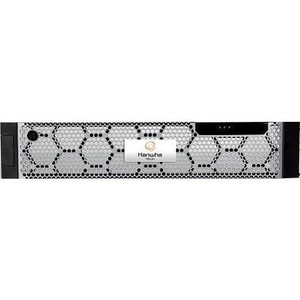
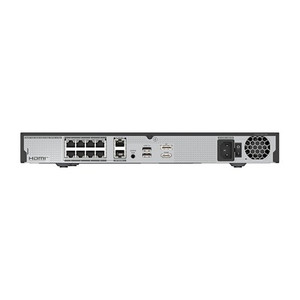
Hanwha WRR-P-S204W-160TB 12-Bay 2U Enterprise Recording Server
Overview
The Hanwha WRR-P-S204W-160TB is a 2U rackmount recording server built for mid-to-large surveillance deployments that need serious local storage headroom without stepping up to a full enterprise SAN. It ships with 160TB of raw storage (131TB usable after RAID overhead) across its bays and can scale to 240TB raw (200TB usable) as your camera count or retention window grows. This is a server-class recorder, not a consumer NVR — it runs Windows IoT Enterprise LTSC 2021 on an Intel Xeon 4410Y processor with 16GB of RAM, positioning it as a VMS host rather than a closed-box appliance. For integrators speccing a central recording platform for a distribution center, campus, or multi-building enterprise site, the WRR-P-S204W-160TB is built to sit in a server rack and run continuously for years.
Key Features
- 12 x 3.5" HDD Bays: Twelve hot-swappable bays give you the physical density to hit 160TB raw out of the gate and room to expand to 240TB raw as retention requirements grow — no forklift upgrade to a second chassis when you add cameras next year.
- 470 Mbps Recording Bandwidth: That's the real ceiling on how much simultaneous camera traffic this box can ingest and write to disk — plan your camera count and bitrate budget against this number before you oversubscribe the recorder.
- RAID 0/1/5/6 Support: RAID 5/6 buys you drive-failure tolerance without pulling the whole array offline, which matters when 12 bays of spinning disk means drive failure is a when, not an if. RAID 0 is available if raw throughput matters more than redundancy, though most commercial deployments will want 5 or 6 here.
- Dual 480GB SSD OS Drives in RAID 1: The operating system runs on a mirrored SSD pair separate from the recording array, so an OS drive failure doesn't take your video storage down with it — and SSD boot means faster service restarts after maintenance or patching.
- Intel Xeon 4410Y + 16GB RAM: Server-grade silicon gives this box the headroom to run VMS software, analytics workloads, and simultaneous playback/export without choking, unlike consumer NVRs built around embedded SoCs.
- 8GB NV Cache: Non-volatile write cache absorbs burst write loads and protects in-flight data against power interruption — a meaningful safeguard on a box writing continuous video across 12 drives.
- 4 x 1GbE Network Interfaces: Four NICs let you segment camera traffic, client/VMS access, and management or failover links onto separate physical ports instead of contending for one uplink — useful when you're running hundreds of Mbps of camera ingest alongside live client viewing.
- Redundant 800W Power Supply: Dual power supplies mean a single PSU failure doesn't take the recorder offline — feed each from a separate circuit or UPS for true redundancy in a 24/7 recording environment.
- Windows IoT Enterprise LTSC 2021: A long-term-servicing Windows build gives you a stable, patch-predictable OS foundation for running Hanwha's VMS or a third-party platform without the update churn of consumer Windows releases.
- Operating Range 10°C to 35°C: This is a controlled-environment server, not a field-hardened NVR — plan for a conditioned server room or rack closet, not an unconditioned equipment shed.
- 100-240 VAC Auto-Sensing Input: Deploys on standard commercial power in North America or overseas without a separate transformer.
Integration & Compatibility
As a Windows-based recording server, the WRR-P-S204W-160TB is built to run as a VMS host inside a broader network video recorders deployment, whether standalone or as one node in a multi-server architecture. The four 1GbE interfaces support the kind of network segmentation larger deployments need — isolating camera VLANs from client and management traffic. Pair it with Hanwha's camera and recording line for a single-vendor stack, and budget your PoE switches separately since this server itself is not a PoE injector — camera power is handled upstream. Before finalizing a bill of materials, run your camera count, resolution, and frame rate through a proper storage and retention planning pass against the 470 Mbps ingest ceiling and the 131TB usable capacity to confirm this chassis covers your retention window, and cross-check total camera bandwidth against a PoE and network planning guide if you're deploying it alongside a large camera rollout. WRR-P-S204W-160TB (often searched as WRR P S204W 160TB) is built around standard RAID and Windows server administration, so IT teams already running Windows Server infrastructure will find the management model familiar.
What's in the Box
Contact your sales engineer for exact accessory and rail-kit contents for this SKU.
Frequently Asked Questions
Q: How much storage does the WRR-P-S204W-160TB ship with?
A: It ships with 160TB raw storage across 12 x 3.5" bays, which works out to 131TB usable after RAID overhead. The chassis supports expansion up to 240TB raw (200TB usable).
Q: What operating system does the WRR-P-S204W-160TB run?
A: Windows IoT Enterprise LTSC 2021, running on an Intel Xeon 4410Y processor with 16GB of RAM and dual 480GB SSDs in RAID 1 for the OS.
Q: What's the maximum recording bandwidth on the WRR-P-S204W-160TB?
A: 470 Mbps of total recording bandwidth — size your camera count and bitrate settings against that ceiling.
Q: Does the WRR-P-S204W-160TB have redundant power?
A: Yes, it uses a redundant 800W power supply configuration and accepts 100-240 VAC input.
Q: What RAID levels does the WRR-P-S204W-160TB support?
A: RAID 0, 1, 5, and 6 are supported for the recording array, plus RAID 1 dedicated to the dual OS SSDs.
Q: What's the operating temperature range for the WRR-P-S204W-160TB?
A: 10°C to 35°C — this server is built for a controlled server room or rack environment, not an unconditioned outdoor enclosure.
The spec that jumps out on the WRR-P-S204W-160TB is the 470 Mbps recording bandwidth ceiling paired with 12 hot-swap bays — this tells you exactly how to size a camera load before you commit to the box. I've spec'd similar 2U platforms for distribution center rollouts, and the math is straightforward: divide 470 Mbps by your average per-camera bitrate and you have your realistic channel count, not a marketing number.
Technical Highlights:
- 160TB raw / 131TB usable, expandable to 240TB raw: Twelve 3.5" bays give you room to grow retention or camera count later without swapping chassis — plan your initial RAID level around how much of that 200TB usable ceiling you actually need on day one.
- Intel Xeon 4410Y with 16GB RAM on Windows IoT Enterprise LTSC 2021: Server-class compute means this recorder can host VMS software and handle simultaneous recording, live viewing, and export without the bottlenecks you'd hit on an embedded-SoC NVR.
- Redundant 800W PSU + dual 480GB SSD OS drives in RAID 1: Two independent failure points — power and boot storage — are both mirrored, which is what you want on a box that's the single point of failure for a site's video evidence.
Deployment Considerations:
- The 10C-35C operating range means this belongs in a conditioned server room or IT closet, not an unconditioned mechanical space or outdoor cabinet — factor that into your rack location planning early.
- Four 1GbE NICs are enough to segment camera, client, and management traffic, but at the top end of the 470 Mbps bandwidth spec you'll want to confirm your switch uplinks aren't the actual bottleneck before blaming the recorder.
This is the right recorder for a single-site enterprise deployment — a distribution center or multi-building campus — that needs 12-bay local storage and RAID 5/6 fault tolerance without standing up a separate SAN, and where the 470 Mbps ingest ceiling comfortably covers the planned camera count.