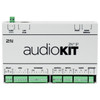
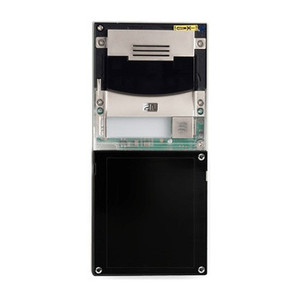
2N 01271-001 IP Verso Main Unit Intercom Station
The 2N 01271-001 is a network-based intercom main unit designed for distributed access control and door entry applications. Unlike all-in-one stations, this main unit is built around modularity — it provides the core intercom and control backbone while accepting optional camera modules, audio expansions, and sensor accessories as your deployment grows. This approach lets you avoid paying for integrated capabilities you may not need immediately while preserving the ability to add them later without hardware replacement.
Why Choose a Main Unit Architecture
Organizations deploying across multiple entry points — office complexes, campuses, parking facilities — often face a choice between buying fully-featured stations for every door (expensive, feature-bloat at small entrances) or installing stripped-down devices and managing them as orphans. The 01271-001 splits the difference. You get a standards-based IP intercom backbone that can function on its own or expand modularly. H.264 compression means audio and video streams (when camera modules are added) stay within typical office network bandwidth — roughly 1–3 Mbps per stream depending on resolution and frame rate, so a PoE switch can support multiple units without special provisioning.
Key Deployment Features
- Network-based architecture: Operates over standard IP, so it integrates into existing security management and access control systems without proprietary wiring. Centralized control across dispersed entry points reduces on-site complexity.
- Modular design: Main unit 01271-001 accepts compatible camera and sensor modules as retrofit — no forklift upgrade needed when a facility later decides a particular entrance needs video or motion detection.
- H.264 video compression: When paired with camera modules, H.264 cuts bandwidth compared to uncompressed streams — meaningful on congested networks or when recording continuously across many doors.
- Remote intercom and access control: Operators manage entry and voice communication from a centralized station or mobile application rather than staffing each door, reducing labor overhead.
- Flexible mounting platform: Design supports wall, pole, or architectural integration, so installation adapts to site conditions without custom enclosures.
- Integration-ready for existing security platforms: Standards-based IP approach means compatibility with established VMS, access control software, and alarm management systems — you are not locked into proprietary ecosystems.
Integration and Compatibility Considerations
The 01271-001 integrates with 2N IP cameras and modular accessories, allowing you to build a cohesive intercom ecosystem across a facility. It connects to centralized network video recorders for recording and archival when camera modules are installed. Standard PoE power delivery (exact wattage varies by configuration) keeps installation costs low — no separate power supplies at each door, assuming your network switches support the aggregate load. For integrators planning deployments, review your access control architecture guide to ensure the main unit's IP requirements align with your central management system and network topology.
Practical Constraints and Trade-offs
The main unit is not a complete solution by itself — it requires either a camera module for video entry or integration with an external access control panel for credential-reading capability. If your requirement is a single, compact, all-in-one door station with no future expansion, a fully integrated model may reduce component count. However, for phased rollouts or multi-entrance standardization, the modular approach avoids overspending at low-traffic doors and allows configuration adjustments post-deployment.
Frequently Asked Questions
Q: Can the 2N 01271-001 work without a camera module?
A: Yes. The main unit operates as a standalone intercom and control interface. Camera modules and other accessories are optional and can be added later if needed.
Q: What is the typical bandwidth requirement for the 01271-001 with an attached camera module using H.264 compression?
A: Bandwidth depends on resolution, frame rate, and scene complexity. H.264 typically ranges 1–3 Mbps, allowing multiple units on standard PoE-powered network infrastructure.
Q: Is the 01271-001 compatible with third-party access control systems?
A: The IP-based architecture supports integration with standards-compliant access control platforms. Verify compatibility with your chosen VMS or access management software before purchase.
Q: What mounting options are available for the main unit?
A: The flexible mounting platform supports wall, pole, and architectural mounting. Confirm exact bracket and template availability with the manufacturer for your specific installation scenario.
Q: Can the 01271-001 be upgraded with additional modules after initial installation?
A: Yes. The modular design allows camera and sensor modules to be added post-deployment without replacing the main unit, supporting phased expansion as facility requirements evolve.
Q: What is the warranty on the 2N 01271-001?
A: Warranty terms are determined by the manufacturer. Contact the seller or consult the product documentation for specific coverage details.
Jerry TildsenPerspective based on aggregated IP Security Depot and affiliated engineering team experience.
The 2N 01271-001 is engineered for integrators and facility managers who need modularity without the complexity of mixing vendors across a large deployment. The main unit's network-based architecture and modular socket design mean you can standardize on a single platform across dozens of entry points — some with video, some without — without wasting budget or creating maintenance silos. H.264 compression keeps bitrates practical (1–3 Mbps per stream), so a standard office PoE switch can support multiple doors simultaneously.
Technical Highlights:
- H.264 compression: Reduces per-stream bandwidth to 1–3 Mbps depending on resolution and scene complexity, allowing compact switches to serve many concurrent units without oversubscription.
- Modular socket design: Camera and sensor modules plug in post-deployment, avoiding the need to replace entire units if requirements evolve or budgets allow phased expansion.
- Network-based control: Operates over standard IP, integrating into centralized access and security management systems rather than relying on proprietary serial or analog circuits.
Deployment Considerations:
- The main unit is not self-contained — it requires either a camera module for video entry or integration with an external access control reader. Plan your module strategy before procurement to avoid gaps in your entry control workflow.
- Power budget scales with module count and bitrate. Verify your PoE switch capacity (typical 802.3af or 802.3at per unit) and confirm with the manufacturer if you plan high-resolution or multi-module configurations.
- Centralized management simplifies multi-site deployments, but rely on robust network infrastructure (PoE availability, IP routing, firewall rules for secure communication) or you risk scattered offline doors.
Ideal for multi-building campuses, corporate parks, and properties where standardized, scalable intercom infrastructure must grow over time without pulling equipment from the field. The 01271-001 main unit shines when you need flexibility and don't want to commit full feature sets to every door simultaneously.