

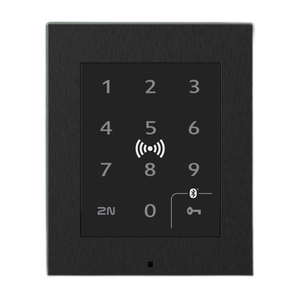
2N EMarine RFID Proximity Card 125 KHz, 01395-001
Usually Ships in 2-3 Weeks
Free shipping over $499


Manufacturer-verified compatible cameras, recorders, mounts, accessories, and licenses for this product. Adjust quantities and add the entire bundle to your cart in one click.
Questions about this product? Free pre-sales support from a senior specialist — product questions, compatibility checks, BOM quotes, price confirmation — typically answered within one business day. Need camera placement or system design work? Engineering time is $175 per hour (qty 1 = 1 hour). Hardware buyers get up to one hour ($175) credited back on their order.
The 2N 03036-001 is a networked 125kHz proximity card reader designed to integrate legacy card infrastructure into IP-based access control systems. Built around proven 125kHz technology and Wiegand output, it bridges traditional access control ecosystems with modern IP platforms without requiring card stock replacement or reader rewiring. Deploy it as a retrofit into existing Axis-based deployments or new-build multi-door control architectures where standards-based I/O matters.
The 03036-001 shines in retrofit scenarios where card stock is already deployed and replacement is not economically justified. The Wiegand output bridges to existing access control panels — even non-networked systems — without middleware. Dual inputs accept common door sensors (magnetic switches, request-to-exit buttons, mantrap sensors); dual relay outputs can trigger electromechanical strikes, mag-locks, or auxiliary notification devices. Because it's PoE-powered and IP-integrated, you eliminate the separate RS-485 wiring runs and 12V power supplies that older card readers demand.
In multi-door deployments, each reader output can be programmed independently within your Axis access control workflow. For example: Reader 1 on Door A triggers relay for that door's strike; Reader 2 on Door B can trigger a different strike plus an auxiliary alert output. The tamper switch provides a per-reader intrusion status — critical in high-security facility entries where reader removal signals a compromised access point.
The Wiegand output delivers card credentials (typically facility code + card ID) in real time to the Axis Door Controller or to any third-party panel that accepts Wiegand input. No proprietary software or vendor lock-in — standard 26-bit and 34-bit formats ensure portability. Tamper events and input state changes are logged with millisecond timestamps in your Axis access control management interface. Relay output activation and sensor input triggers are fully programmable within your access control policy, supporting complex workflows like temporary door unlock on fire alarm input or dual-card authentication at high-security checkpoints.
When migrating from a parallel legacy system (standalone card reader + separate NVR + manual log review), consolidating onto IP-integrated 125kHz readers cuts operational overhead: single platform for video, audio, credentials, and door control; centralized audit logs; no disparate password or credential databases to synchronize.
The 03036-001 supports standard Wiegand 26 and 34-bit card formats, ensuring compliance with widespread access control deployments. PoE 802.3af operation keeps power distribution simple and auditable. Integration with Axis IP security systems allows centralized credential and event logging for regulatory contexts (HIPAA facility access, PCI DSS server room entry, SOC 2 audit trails). No import restrictions apply — manufactured in China, sourced direct from the manufacturer or US channel partner, fully genuine product with factory warranty.

We've deployed the 2N 03036-001 across dozens of retrofit access control migrations — particularly in healthcare and corporate office environments where ripping out 500+ proximity cards and readers isn't feasible. The Wiegand output is the real enabler: it's not a proprietary 2N protocol, so you can pair this reader with a legacy Honeywell or Salto panel without translators, or feed it into a new Axis Door Controller for unified IP management. On a recent 12-door office complex upgrade, we migrated from a standalone card reader + DVR setup to Axis IP security in phases: swapped out three readers per week, never touched the card stock, and the legacy system kept running in parallel during transition. The tamper detection caught two unauthorized removal attempts during the project — which, frankly, vindicated the investment in monitored readers versus dumb card openers. That said, 125kHz is an older standard. If you're greenfield or replacing worn readers, seriously consider 13.56MHz or mobile credentials instead. But if your facility has 2,000+ cards in circulation and a budget constraint, this reader eliminates the replacement capex entirely.
Technical Highlights:
Deployment Considerations:
The 03036-001 is the right choice for facilities with existing 125kHz card infrastructure, limited retrofit budgets, and a need for standards-based I/O without proprietary vendor coupling. If you're upgrading to IP-based access control but can't justify card stock replacement, this reader delivers that bridge with minimal integration overhead. Explore the 2N product catalog for additional readers, controllers, and intercom solutions that may complement your access control strategy.

Manufacturer-verified compatible cameras, recorders, mounts, accessories, and licenses for this product. Adjust quantities and add the entire bundle to your cart in one click.

Outdoor 125 KHz RFID reader, IP68-rated, -20°C to 65°C operation

125kHz RFID reader module for 2N Helios and Axis access control

125kHz RFID intercom uniting access control and IP communication

Dual-frequency RFID reader for mixed-credential access control
Looking for more 2N products? Shop the full 2N catalog →
Support services and planning resources for commercial surveillance, access control, and infrastructure deployments.
Fixed scope • Fixed price