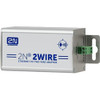
2N 01404-001 2Wire IP Converter Unit
Overview
The 2N 01404-001 is a practical accessory designed to extend IP device connectivity over existing two-wire infrastructure. If you're deploying IP intercoms or security cameras in buildings with legacy wiring already in place, this converter eliminates the need for expensive new cabling runs — a significant cost and disruption savings in retrofit scenarios. The unit bridges the gap between modern IP devices and older twisted-pair systems, making it useful for warehouse automation, access control, and intercom installations where structural changes are impractical or prohibitively expensive.
Key Features
- 100 Mbps data transmission: Delivers sufficient throughput for standard-definition and low-resolution IP camera streams, as well as intercom signaling and access control data. Higher bitrate 4K or multi-camera feeds may require bandwidth planning.
- Up to 400 meters transmission range: Covers extended distances on a single pair of wires — useful for sprawling warehouse floors or multi-building campuses. Range depends on wire gauge, termination quality, and electrical noise in the environment; actual performance should be verified on-site.
- RJ45 and terminal block connectors: Gives you flexibility to connect either directly to network switches and devices (RJ45 side) or splice into existing two-wire runs (terminal block side). Mixed connector approach reduces the need for intermediate patch panels.
- Powered via included power cord: Requires AC mains power; plan your installation to keep the converter near a power outlet or route power carefully in tight spaces. No PoE injection, so you'll still need separate power for the IP endpoint device.
- Compact form factor: Small enough to fit in wall cavities, equipment racks, or junction boxes without requiring dedicated enclosure space. Ideal for retrofits where real estate is constrained.
Integration & Compatibility
The 2N 01404-001 is designed to work with IP-based systems from the broader 2N IP camera and intercom line as well as any standard IP device that can be delivered over Ethernet. Because it operates at the data-link layer, compatibility with upstream network management systems (NVRs, access control platforms, or video management software) is transparent — the converter simply extends the cable run and doesn't interfere with protocol or application behavior.
Before deployment, verify that your two-wire infrastructure meets the electrical specifications for this converter. Corroded, damaged, or poorly terminated legacy cabling can significantly reduce range and throughput. If you're planning a larger retrofit across multiple buildings, consult the included installation guide to confirm your wire gauge and termination method.
What's in the Box
- 2N 2Wire IP Converter Unit (01404-001)
- Power cord
- Installation guide
Frequently Asked Questions
Q: Can I use the 01404-001 to convert analog CCTV cables to IP?
A: No. The 2N 01404-001 is designed to transport IP data (Ethernet frames) over two-wire pairs. It does not convert analog video signals. If you need to reuse coaxial CCTV infrastructure, you'll need a different solution such as balun converters or coax-to-IP gateways.
Q: What happens if my two-wire run is longer than 400 meters?
A: At distances beyond 400 meters, signal degradation and attenuation increase significantly. You may experience reduced throughput, intermittent connectivity, or complete loss of signal. For longer runs, consider deploying intermediate repeaters or switching to dedicated modern cabling (Cat5e or Cat6).
Q: Does the 01404-001 need PoE on the two-wire side?
A: No. The converter itself requires AC mains power via the included power cord. The two-wire side carries data only, not power. Your IP endpoint (camera, intercom, or access control device) still requires its own power supply, whether PoE from a switch on the Ethernet side or a separate power injector.
Q: Will this work with my existing NVR or access control system?
A: Yes, provided your NVR or system supports standard Ethernet/IP endpoints. The converter is transparent to higher-layer protocols and applications. As long as your endpoint device can reach your management system over the extended two-wire connection, there should be no compatibility issues. Test the connection before full deployment.
Q: Can I daisy-chain multiple 01404-001 units on the same two-wire pair?
A: Not recommended. Each converter pair consumes bandwidth and creates potential impedance and signal reflection issues. If you need to connect multiple endpoints, use separate two-wire runs (if available) or segment your installation with intermediate converters spaced far apart — but this complicates maintenance and troubleshooting.
Ted PerryPerspective based on aggregated IP Security Depot and affiliated engineering team experience.
The 2N 01404-001 is a legitimate time-saver for retrofit work in buildings where two-wire telephone or intercom cable is already run between buildings or through walls. If you're deploying a distributed IP intercom system or adding IP cameras to a warehouse with legacy infrastructure, this converter lets you avoid the cost and mess of pulling new Cat5e or Cat6. That said, it's not a silver bullet — the 100 Mbps throughput and 400-meter range are real limits you need to account for in your network design.
Technical Highlights:
- 100 Mbps throughput: Sufficient for one or two standard-definition IP camera streams or intercom/access control signaling, but not for high-bitrate 4K or multi-camera bundles. If you're daisy-chaining devices, bandwidth contention becomes a real issue quickly.
- 400-meter maximum range: Realistic under good conditions (clean twisted pairs, proper termination, minimal EMI). In noisy industrial environments or with older corroded wire, expect degradation at 250–300 meters. Always test before committing to a full rollout.
- AC power requirement: The converter needs mains power; you can't rely on PoE to power it. Plan your power routing and outlet placement during site survey. This also means the converter becomes a single point of failure if the AC line is disrupted.
Deployment Considerations:
- Inspect legacy two-wire runs for corrosion, damage, or splice points before installation. High-resistance connections will kill range and throughput fast.
- The 01404-001 does not provide power to the remote IP device; it only extends the Ethernet connection. Your endpoint (camera, intercom, or access control) must have its own power source or be powered via PoE from a switch on the Ethernet side of the converter.
- This is a point-to-point converter — one pair of units per two-wire run. If you need to add more endpoints, you'll need additional converter pairs and additional two-wire runs, or you'll need to accept shared bandwidth.
Deploy the 01404-001 for cost-conscious retrofits in office buildings, small warehouses, or multi-building campuses where existing two-wire infrastructure is in good condition and you're not expecting high-bandwidth, multi-camera feeds. For new construction or high-density surveillance, pull modern cabling instead.