Viking Electronics PRX-C 26-Bit Wiegand Proximity Card
Overview
The Viking Electronics PRX-C is a 125kHz, 26-bit standard Wiegand proximity card designed to pair directly with Viking's PRX-series readers — including the PRX-1, PRX-2, PRX-3, and PRX-5. If your access control deployment runs on the 26-bit Wiegand format (the most widely supported credential standard in commercial security), the PRX-C is a factory-matched credential that eliminates format compatibility guesswork. Available in standard card and ISO-thickness card variants, it also ships as a key fob (PRX-C-ISO and fob formats), giving integrators flexibility across cardholder types on the same reader infrastructure.
Key Features
- 26-Bit Standard Wiegand Format: The 26-bit Wiegand protocol is supported by virtually every commercial access control panel on the market. Deploying PRX-C credentials means you're not locked to a proprietary format — the cards will communicate cleanly with any Wiegand-compatible reader and panel, not just Viking hardware.
- 125kHz Operating Frequency: This is the standard low-frequency proximity band. Readers operating at 125kHz are extremely common in commercial and light-industrial deployments, and 125kHz credentials are reliable through typical wallet, badge holder, and light interference conditions that higher-frequency HF/NFC cards sometimes struggle with.
- Facility Code Range 2–255: With 254 usable facility codes, you can segment large multi-tenant or multi-site deployments so that card number sequences don't collide across buildings. A card from Building A won't accidentally grant access in Building B if you assign distinct facility codes per site.
- Card Number Range 1–65,535: Up to 65,535 unique card numbers per facility code provides ample credential capacity for enterprise campuses, multi-floor office buildings, and warehouse environments where hundreds or thousands of cardholders need individual assignments.
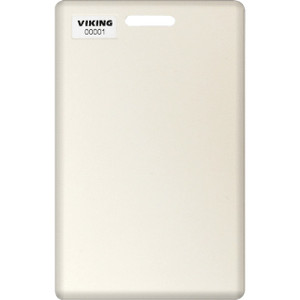
- Standard Card Dimensions (2.135" x 3.39" x 0.070"): CR80-standard footprint fits every standard badge holder, lanyard clip, and card printer on the market — no custom hardware needed for cardholder distribution.
- ISO Card Variant (2.124" x 3.368" x 0.032"): At roughly half the thickness of the standard card, the ISO variant is compatible with proximity card printers for photo ID and access credential on one card — useful in enterprise environments where a single badge needs to serve both ID and door access functions.
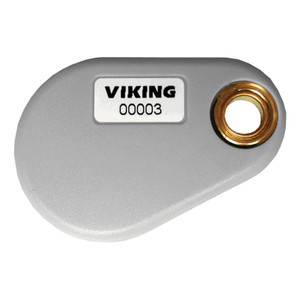
- Key Fob Option (1.5" x 1.2" x 0.15"): The compact fob format works for personnel who don't carry a badge wallet — maintenance staff, warehouse floor workers, and visitors who need temporary access without a full credential card.
- Non-Contact Operation: No physical swipe, no wear surface, no reader alignment required. Proximity read is reliable in high-traffic entry points where physical card wear would degrade swipe-style credentials over time.
Integration and Compatibility
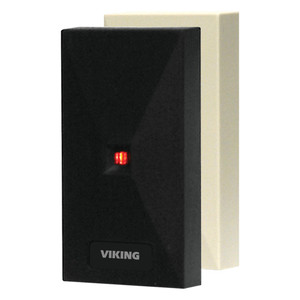
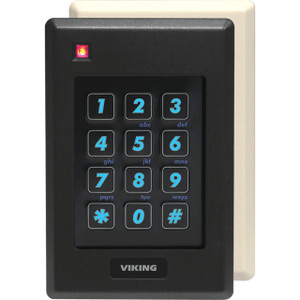
The PRX-C is verified compatible with the Viking access control PRX-1 (mullion-mount card reader), PRX-2 (single-gang card reader with keypad), PRX-3, and PRX-5 (long-range reader, up to 500 ft on shielded seven-conductor cable). Because it outputs standard 26-bit Wiegand data, it also integrates with third-party panels and readers that accept this format — which covers the majority of commercial-grade access control systems. For deployments using Viking Electronics entry solutions across multiple doors, maintaining a single credential format across the PRX family simplifies panel programming and cardholder management. If you're building out a broader proximity card reader infrastructure, confirm your panel's supported card number capacity before assigning facility/card number ranges.
Frequently Asked Questions
Q: What access control readers is the PRX-C compatible with?
A: The PRX-C is designed for use with Viking's PRX-1, PRX-2, PRX-3, and PRX-5 proximity card readers. Because it uses standard 26-bit Wiegand format at 125kHz, it is also compatible with any third-party reader or access control panel that supports the 26-bit Wiegand protocol.
Q: What is the difference between the PRX-C standard card and the PRX-C-ISO?
A: The standard PRX-C card measures 2.135" x 3.39" x 0.070" and is a traditional proximity card thickness. The PRX-C-ISO is thinner at 0.032" (vs. 0.070"), making it compatible with proximity card printers for combined photo ID and access credential applications.
Q: Is a key fob version available?
A: Yes. A key fob variant is available measuring 1.5" x 1.2" x 0.15" — suited for personnel who do not carry badge wallets, such as maintenance or warehouse staff.
Q: How many unique credentials can be issued on the PRX-C format?
A: The PRX-C supports facility codes from 2 to 255 (254 usable codes) and card numbers from 1 to 65,535 per facility code. This provides capacity for large multi-site deployments with distinct credential ranges per location.
Q: What frequency does the PRX-C operate on?
A: The PRX-C operates at 125kHz, the standard low-frequency proximity band used across the majority of commercial access control readers.
The PRX-C is one of those credentials that earns its place by being invisible — it just works. With a 26-bit Wiegand format at 125kHz and facility codes spanning 2–255, this card slots into nearly any existing commercial access control infrastructure without panel reprogramming or reader firmware updates. If you're expanding a Viking PRX-series deployment or standardizing credentials across a mixed-reader environment, the PRX-C (also searched as PRX C) removes the format negotiation entirely.
Technical Highlights:
- 26-Bit Wiegand Protocol: The most universally accepted credential format in commercial access control — compatible with Viking PRX-1/2/3/5 readers and the vast majority of third-party Wiegand panels without any configuration overhead.
- Facility Code Range 2–255: 254 distinct facility codes let integrators isolate credential namespaces across buildings or tenants — a card numbered 1042 in facility 10 does not register as valid in facility 11, even on the same panel infrastructure.
- Three Physical Form Factors: Standard card (0.070" thick), ISO card (0.032" thin — printer-compatible for photo ID overlay), and key fob (1.5" x 1.2") cover the full range of cardholder use cases without deploying a second credential technology.
Deployment Considerations:
- The ISO variant at 0.032" is compatible with standard proximity card printers — if your deployment requires printed photo IDs, specify PRX-C-ISO at order time rather than retrofitting after cards are issued.
- 125kHz proximity is a read-range technology, not a high-security encryption technology — it does not provide cryptographic card authentication. For deployments where cloning resistance is a hard requirement, evaluate higher-security credential formats (13.56MHz MIFARE, DESFire) instead.
For Viking PRX-series deployments in multi-tenant commercial buildings, light-industrial facilities, or campus environments where a single credential format must span dozens of doors and hundreds of cardholders, the PRX-C delivers the facility code segmentation and card number capacity to handle it cleanly.