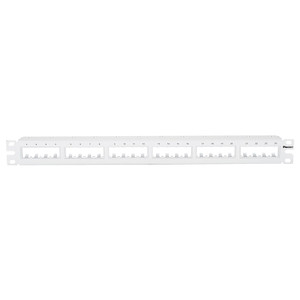
Panduit CPP24WBLY Mini-Com 24-Port Front-Access Patch Panel
The Panduit CPP24WBLY delivers modular patching density for structured cabling deployments where field flexibility and front-access serviceability drive install design. This 1U panel accepts up to 24 Mini-Com modules in an unshielded configuration, fitting 19-inch and 23-inch racks without adapters. Integrators working multi-phase rollouts or mixed-media networks gain pay-as-you-grow modularity—populate only the ports you need today, add modules as endpoints expand, and swap module types (copper, fiber, A/V) without replacing the entire panel. The front-access architecture keeps patch cords and module insertion on the working side of the rack, eliminating the cable-spaghetti reach-around that plagues rear-terminated panels in dense closets or against-the-wall installations.
Key Features
- 24-port capacity in 1 rack unit—high density for IDF and access-layer switching without consuming vertical rack real estate
- Modular Mini-Com architecture—field-populate with any combination of Cat5e, Cat6, Cat6A, LC fiber, or A/V modules as your infrastructure evolves
- Front-access design—all patching, module insertion, and cable management from the working side of the rack; no rear clearance required
- Universal rack compatibility—mounts in both 19-inch and 23-inch racks and cabinets with included hardware; common choice for telco and enterprise environments
- Cold-rolled steel construction—rigid 1.72-inch-tall chassis withstands repeated plug/unplug cycles and support bracket loading in permanent installations
- Integrated label field—adhesive label strips organize port identification without covering module numbers or obstructing patching workflow
- Black finish—matches standard rack aesthetics in IT rooms, broadcast facilities, and security equipment closets
- RoHS compliant—meets European and California restricted-substance regulations for spec-sensitive government and healthcare projects
The CPP24WBLY's Mini-Com modularity solves a recurring integrator problem: how to future-proof patching infrastructure when endpoint requirements shift mid-project or post-occupancy. Standard fixed-port panels lock you into a single media type—100% copper or 100% fiber—at rough-in. Months later, when the client adds IP cameras requiring PoE or upgrades a few links to 10G fiber, you're either adapter-hunting or ripping out the panel. The Mini-Com system eliminates that bind. Each port position accepts any Mini-Com module Panduit manufactures: shielded or unshielded copper jacks (Cat5e through Cat6A), LC or SC fiber adapters, HDMI or coax inserts for A/V distribution, even blank modules to maintain dust protection on unused positions. You stock modules, not entire panels, and field techs swap them with a snap-in tool-free motion—no punch-down, no epoxy, no send-back-to-depot if a port type changes. This modularity extends to phased deployments: wire management installers mount the empty panel during rough-in, low-voltage teams populate jacks as drops terminate, and IT adds fiber uplinks during switch cutover—all without scheduling conflicts or waiting for a fully-populated panel to ship. The result is a single SKU that adapts to mixed copper/fiber floors, test labs where port types rotate weekly, and retrofit projects where you're matching six different legacy terminations in one rack.
Front-access architecture matters most in space-constrained or production-critical environments. Rear-terminated panels assume you have 12–18 inches of clearance behind the rack for hands, patch cords, and module insertion—a luxury that evaporates in network closets with wall-mount racks, shipping container datacenters, or broadcast racks bolted into millwork. The CPP24WBLY brings every service point to the front: patch cord connections, module snap-in slots, and the label field all face the aisle. Cable management happens where you're already standing, patch cord dress stays visible for inspection and re-routing, and you never unrack equipment or pull the cabinet away from the wall to trace a link. This pays off during adds/moves/changes: swapping a failed jack takes 30 seconds with a spare module in hand, versus 15 minutes un-velcroing a rear bundle, reaching blind, and hoping you grabbed the right port. It also simplifies initial termination—horizontal cables enter from the rear as usual, but installers terminate to modules on a bench (controlled environment, proper seating, tester right there), then snap finished modules into the front of the panel during final trim. No crouching behind a rack with a punch tool and flashlight. Deploy this panel in security system IDFs feeding 40+ IP cameras per switch, campus network closets where MAC moves happen daily, or AV equipment rooms where HDMI and Cat6 patching share the same 24U rack—any scenario where rear access is impractical or patching changes are routine.
The 19-inch and 23-inch mounting versatility addresses a split you see in telco-heavy vs. enterprise-IT installations. Most corporate IT standardizes on 19-inch EIA racks; most carrier-grade and legacy telecom gear uses 23-inch ANSI racks. Integrators working hospitals, universities, or multi-tenant offices encounter both, often in the same building—19-inch in the server room, 23-inch in the MPOE where the carrier demarc lives. The CPP24WBLY ships with mounting hardware for both widths, so you stock one panel SKU instead of two, and field techs don't discover a width mismatch mid-install. Cold-rolled steel construction ensures the 1.72-inch-tall chassis stays rigid even when all 24 ports carry patch cords with 90-degree strain relief boots—no sagging center sections or screw-hole elongation after a year of plug churn. RoHS compliance becomes non-negotiable on federal, healthcare, and California state projects where procurement flags non-compliant materials during bid review; the CPP24WBLY clears that gate with documented conformance, eliminating the substitute-product scramble two weeks before substantial completion.