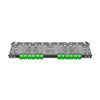
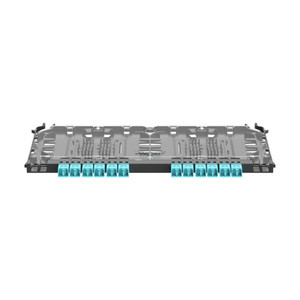
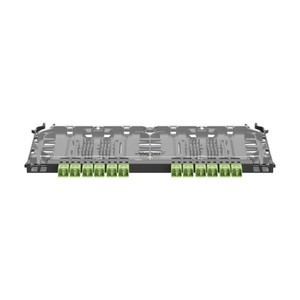
Panduit FDS9N-24-LAR 24-Fiber OS2 LC APC Front-Access Splice Cassette
Overview
The Panduit FDS9N-24-LAR is a 24-fiber single-mode (OS2) front-access splice cassette engineered for the Panduit FlexCore™ ODF and OSF enclosure platform. It terminates ribbon fiber to duplex LC APC connectors — the right cassette when your backbone uses ribbon cable and your active equipment demands LC APC interfaces for low back-reflection performance on long-haul or high-sensitivity optical links.
At 0.46 in (11.7 mm) tall and 11.53 in (292.8 mm) wide, the FDS9N-24-LAR slots directly into FlexCore ODF/OSF frames without adding rack unit overhead. With 24 fibers per cassette, a single 1U panel position can terminate a full 24-fiber ribbon in one organized unit — straightforward math for planning fiber optic cassette density in high-count backbone runs.
Key Features
- 24-Fiber OS2 Single-Mode Capacity: Handles a full 24-fiber ribbon in one cassette, keeping your termination count per rack unit high and your splice tray count low. OS2 (9/125 µm) is specified for premises and campus backbone distances where OS1 would also work — either way, you're covered for standard single-mode plant.
- LC APC Duplex Front Interface: LC APC connectors deliver angled physical contact terminations, reducing back-reflection below -60 dB — critical for passive optical networks, DWDM, and high-sensitivity transceivers where standard UPC connectors introduce too much reflected power. If your link budget doesn't require APC, consider the UPC variant instead.
- Ribbon-to-Duplex Splice Configuration: Ribbon fiber on one side, individual duplex LC tails on the other. This is the standard transition point in structured cabling builds where the backbone arrives as ribbon but distribution equipment uses discrete duplex ports. Eliminates individual splice trays for each fiber — 24 done in one organized cassette.
- Front-Access Design: Cassette opens from the front without removing the enclosure from the rack. On a live backbone panel, being able to access a splice without disturbing adjacent cassettes or pulling the enclosure is a real operational advantage during moves and adds.
- Polycarbonate Construction: The cassette body is polycarbonate — lightweight, dimensionally stable, and non-conductive. Appropriate for the controlled thermal environment of a data room or IDF closet where the FlexCore ODF/OSF system is typically installed.
- Standards Compliance — ISO/IEC 11801, ANSI/TIA-568-C.3, TIA-604-5 (FOCIS-5), TIA-604-10 (FOCIS-10): Meeting these structured cabling and connector interface standards means the cassette is qualified for enterprise premises cabling systems and is compatible with TIA/ISO-compliant audit and certification testing. RoHS 2002/95/EC compliance is also confirmed, which matters for any EU-destined infrastructure or corporate sustainability procurement requirements.
- IEEE 802.3 and ANSI T11.2 Compatibility: Verified compatible with Ethernet and Fibre Channel transport standards — relevant if you're deploying this in a SAN or high-speed Ethernet backbone context alongside network switches and storage fabric equipment, not just structured cabling runs.
- Compact Form Factor (0.46 in H × 11.53 in W): The thin profile means you can stack multiple cassettes in a FlexCore ODF without burning rack space. Plan your enclosure fill rate against the cassette height — at under half an inch, density is not the limiting factor.
Integration & Compatibility
The FDS9N-24-LAR is designed specifically for the Panduit FlexCore™ ODF and OSF enclosure family. Verify your enclosure model accepts the front-access splice cassette format before ordering — FlexCore ODF frames and FlexCore OSF panels have distinct cassette seat configurations. The unterminated (ribbon) side interfaces with 24-fiber ribbon cable; confirm your backbone cable count and ribbon configuration match before specifying quantities. For patch cord connection to active equipment, use LC APC-to-LC APC simplex or duplex patch cords — mixing APC and UPC connectors on the same link is a common field error that increases insertion loss and should be avoided.
For builds requiring a fiber optic cabling plan that includes both ribbon backbone and duplex distribution, this cassette eliminates the need for individual fusion splice trays, consolidating 24 splices into a single managed unit. Sold individually (Package Qty: 1); available in carton quantities of 10 for larger deployments.
What's in the Box
- 1x Panduit FDS9N-24-LAR FlexCore 24-fiber OS2 LC APC front-access splice cassette
Frequently Asked Questions
Q: Is the FDS9N-24-LAR compatible with all FlexCore ODF enclosures?
A: The FDS9N-24-LAR is designed for the Panduit FlexCore ODF/OSF enclosure platform. Verify your specific enclosure model accepts the front-access splice cassette format before ordering, as FlexCore ODF and OSF frames have distinct cassette configurations.
Q: What fiber type does the FDS9N-24-LAR support?
A: It supports OS1/OS2 single-mode fiber (9/125 µm). It is not rated for multimode use — if your backbone is OM3 or OM4, you need a multimode cassette variant.
Q: Why does the FDS9N-24-LAR use LC APC connectors instead of LC UPC?
A: LC APC (angled physical contact) connectors reduce back-reflection below -60 dB, making them the correct choice for passive optical networks, DWDM systems, and high-sensitivity transceivers. If your application does not require low back-reflection, a UPC variant may be more appropriate and avoids mating-incompatibility issues in mixed connector environments.
Q: Does the FDS9N-24-LAR (often searched as FDS9N 24 LAR) meet TIA structured cabling standards?
A: Yes. It complies with ANSI/TIA-568-C.3, TIA-604-5 (FOCIS-5), TIA-604-10 (FOCIS-10), ISO/IEC 11801, and the RoHS 2002/95/EC directive. It is also verified compatible with IEEE 802.3 and ANSI T11.2 (Fibre Channel).
Q: Can I mix APC and UPC patch cords on this cassette?
A: No. Mixing APC and UPC connectors on the same optical link introduces a physical mating mismatch that increases insertion loss significantly. All connections on a link using this LC APC cassette should use LC APC patch cords throughout.
Q: How many cassettes come in a package?
A: The FDS9N-24-LAR ships as a single unit (Package Qty: 1). Carton quantity is 10 units for volume procurement.
The FDS9N-24-LAR is the right cassette when your backbone arrives as 24-fiber OS2 ribbon and your active equipment demands LC APC interfaces — that ribbon-to-duplex transition in a single front-access unit is the whole point of this product. I specify this one specifically for PON distribution frames and DWDM patch positions where UPC back-reflection margins are too tight and individual splice trays would create a maintenance headache at scale.
Technical Highlights:
- LC APC Interface: Angled physical contact connectors are specified for <-60 dB back-reflection — required on passive optical networks and coherent DWDM links where reflected power at the transmitter causes measurable performance degradation. Don't substitute UPC here if your link budget requires APC.
- 24-Fiber Ribbon Termination: One cassette handles an entire 24-fiber ribbon, consolidating what would otherwise be 24 individual splice points into a single managed unit at 0.46 in height — high termination density without consuming rack space.
- Standards Compliance: ISO/IEC 11801, ANSI/TIA-568-C.3, TIA-604-5/FOCIS-5, TIA-604-10/FOCIS-10, plus IEEE 802.3 and ANSI T11.2 — this cassette passes both structured cabling and SAN/Ethernet transport qualification without separate certification work on your part.
Deployment Considerations:
- Confirm your FlexCore ODF or OSF enclosure accepts the front-access splice cassette format — not all FlexCore frames share the same cassette seat; ordering against the wrong enclosure type is the most common field error on this product family.
- The unterminated (ribbon) side requires field ribbon splicing; this is not a pre-terminated plug-and-play unit. Budget fusion splice labor and confirm your ribbon cable count is a multiple of 24 before specifying cassette quantities.
This cassette is a natural fit for enterprise campus backbone distribution frames and data center fiber patch positions on PON or DWDM infrastructure — specifically where LC APC is the required interface standard and ribbon cable is the backbone medium.