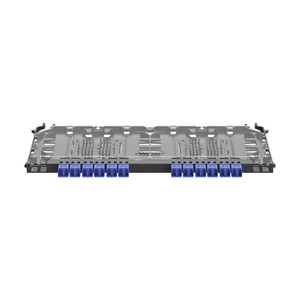
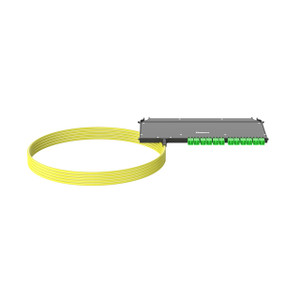
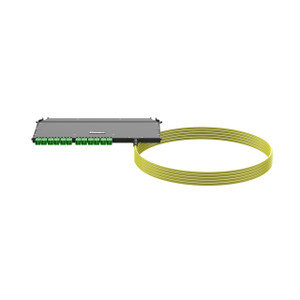
Panduit FDS9N-24-LAP FlexCore 24-Fiber OS2 LC APC Duplex Splice Cassette
The Panduit FDS9N-24-LAP delivers high-density fiber termination for front-access ODF and OSF enclosures. This cassette houses 24 single-mode OS2 fibers terminated with 12 LC APC duplex adapters on the front panel and ribbon pigtails on the rear, enabling rapid splicing and reduced cable congestion in MDA, IDA, and HDA installations. Angle-polished connectors minimize back-reflection for 10G/40G/100G datacenter backbone links, while the compact polycarbonate housing fits standard FlexCore chassis with tool-free insertion. Standard insertion loss performance ensures link budget headroom for long-distance campus and metro fiber runs.
Key Features
- 24 single-mode OS2 fibers in compact 11.7 mm × 292.8 mm cassette form factor for space-constrained racks
- 12 LC APC duplex adapters (front panel) with 8-degree angle polish for <-60 dB return loss on coherent optics and DWDM links
- Ribbon pigtails (rear) enable mass fusion splicing—terminate all 24 fibers in a single splice operation
- Front-access design allows connector cleaning, inspection, and patch cord changes without cassette removal
- Polycarbonate housing with keyed insertion prevents cross-connection errors in multi-cassette enclosures
- Standard insertion loss (≤0.5 dB per mated pair) maintains link budget for multi-span campus fiber builds
- Compliant with ISO/IEC 11801, ANSI/TIA-568-C.3, TIA-604-5 (FOCIS-5), TIA-604-10 (FOCIS-10), IEEE 802.3, ANSI T11.2 Fibre Channel
- RoHS 2002/95/EC certified for EU environmental compliance and corporate sustainability policies
- Compatible with Panduit FlexCore ODF/OSF chassis, high-density patch panels, and modular enclosure systems
- Black housing provides visual contrast for color-coded fiber management schemes in mixed-mode environments
FlexCore cassettes solve the core challenge of high-fiber-count terminations in space-constrained data centers and enterprise MDAs. The FDS9N-24-LAP uses a split architecture: factory-terminated LC APC duplex connectors on the front panel mate with patch cords to active equipment or cross-connect panels, while the rear presents 24-fiber ribbon pigtails for field splicing to incoming trunk cables. This approach isolates the labor-intensive, one-time splicing work inside the protected ODF enclosure, while keeping frequently accessed patch connections on the front for daily MAC (moves, adds, changes) operations. Ribbon pigtails align with mass fusion splicing workflows—a technician with a ribbon fusion splicer can terminate all 24 fibers in a single alignment and arc cycle, typically under 90 seconds, versus 20-30 minutes for 24 individual single-fiber splices using a standard fusion splicer. The time savings compound in high-fiber-count builds: a 144-fiber trunk breaks out to six FDS9N-24-LAP cassettes, requiring six ribbon splices instead of 144 single-fiber splices. Cable management improves as well—ribbon cables maintain fiber position and polarity across the entire link, reducing the risk of A/B reversal errors that cause transmit/receive mismatches.
The LC APC connector specification is critical for low-return-loss applications. The 8-degree angle polish on each ferrule directs reflected light into the fiber cladding rather than back into the core, achieving <-60 dB return loss compared to <-40 dB for standard PC (physical contact) or <-50 dB for UPC (ultra-physical contact) polish. This 10-20 dB improvement in return loss matters for coherent detection optics (100GBASE-LR4, 400GBASE-LR8), dense wavelength division multiplexing (DWDM) systems, and RF-over-fiber links where back-reflection degrades signal-to-noise ratio and bit error rate performance. Single-mode OS2 fiber supports 10GBASE-LR (10 km), 40GBASE-LR4 (10 km), 100GBASE-LR4 (10 km), and extended-reach variants with appropriate optics—critical for campus backbone links between buildings, metro fiber handoffs, and storage area network (SAN) extension. Standard insertion loss specification (typically 0.3-0.5 dB per mated connector pair, measured per TIA-568-C.3 Annex B) preserves link budget for multi-span builds. In a typical enterprise deployment with two connector pairs per link (patch cord to cassette at each end) plus two fusion splices (trunk to cassette pigtail), total insertion loss remains under 1.5 dB, leaving 7+ dB margin on a 10GBASE-LR budget (9.5 dB max) for aging, connector contamination, and future splices during cable route changes.
Datacenter and campus network architects use FlexCore cassettes to build scalable, modular fiber distribution points that adapt to changing port counts and technology migrations. In a typical three-tier structured cabling architecture (Main Distribution Area → Intermediate Distribution Area → Horizontal Distribution Area), the MDA houses high-fiber-count trunk cables (144F, 288F, or 432F) from the campus backbone or provider demarcation point. These trunks enter a FlexCore ODF or OSF enclosure mounted in the MDA equipment room, where individual 24-fiber ribbons break out to FDS9N-24-LAP cassettes. Each cassette's front panel provides 12 duplex LC connections to core switches, storage arrays, or IDA uplink patch panels, while the rear splices to one ribbon segment from the trunk. This modular breakout simplifies capacity planning: a 144-fiber trunk populates six cassettes (6 × 24F), supporting 72 duplex links. When demand grows, the remaining trunk fibers splice to additional cassettes installed in adjacent enclosure slots—no need to pull new outside plant cable until the trunk is fully utilized. Moves, adds, and changes happen at the patch cord level: migrating a server from 10G to 25G requires swapping the optic and patch cord, not re-splicing the permanent link.
The front-access design matters in equipment rooms where ODF enclosures mount above active racks, in overhead cable trays, or behind hot-aisle containment systems. Technicians can swap patch cords, inspect connectors with a fiber microscope, clean end-faces with IPA wipes or one-click cleaners, and troubleshoot link loss with a visual fault locator (VFL) or optical time-domain reflectometer (OTDR)—all without removing the cassette from the chassis or disturbing splice trays in the rear compartment. This front-access model contrasts with older breakout-box designs where all connectors mount on a removable module; any service requires sliding the entire assembly out, risking fiber kinks and accidental disconnections on adjacent links. The 292.8 mm (11.53 inch) width fits Panduit's 1U and 2U FlexCore chassis, which accept multiple cassettes side-by-side for modular density scaling. A 2U enclosure accommodates six FDS9N-24-LAP cassettes (144 fibers, 72 duplex ports) in the same rack space as a traditional 1U fiber patch panel with 24 duplex LC ports—a 3× density improvement that frees rack units for active equipment. LC APC is the de facto standard for single-mode datacenter and SAN links, ensuring plug-and-play compatibility with Cisco SFP+ LR/ER modules, Juniper QFX-series optics, Arista 100G QSFP28 transceivers, Brocade Fibre Channel HBAs, and Dell EMC storage array controllers.
The polycarbonate housing resists impact during installation, provides UL 94 V-0 or 5VA flame rating for plenum-adjacent spaces, and maintains dimensional stability across -40°C to +75°C operating range (typical for climate-controlled data centers and outdoor-rated OSF cabinets in campus pedestals). Keyed insertion slots prevent installing the wrong cassette type (e.g., LC UPC into an LC APC enclosure row, or multimode OM3 into a single-mode OS2 bank), reducing the risk of polarity mismatches and return-loss failures that cause intermittent link flaps. Each cassette ships with connector dust caps and cable tie-down points for strain relief on the ribbon pigtail—critical when slack management inside the ODF enclosure allows the cassette to slide partially out during service without pulling tension on fusion splice points. The black housing provides visual contrast in color-coded fiber management schemes: many installers use black cassettes for OS2 single-mode, aqua for OM3/OM4 multimode 50 µm, and orange for OM1/OM2 multimode 62.5 µm, simplifying visual inspection and reducing cross-connection errors during late-night maintenance windows.
Compliance with ISO/IEC 11801 (generic cabling for customer premises), ANSI/TIA-568-C.3 (optical fiber cabling components), TIA-604-5 (FOCIS-5 fiber optic connector intermateability for SC and LC), and TIA-604-10 (FOCIS-10 ferrule endface geometry) ensures the FDS9N-24-LAP meets global structured cabling standards, simplifying design acceptance and certification testing for multinational deployments in finance, healthcare, education, and government sectors. IEEE 802.3 (Ethernet) and ANSI T11.2 (Fibre Channel) compliance validates insertion loss and return loss performance against the physical layer specifications that 10GBASE-LR, 40GBASE-LR4, 100GBASE-LR4, and 16GFC/32GFC optics expect, reducing the risk of link budget margin violations that cause bit errors or link training failures. RoHS 2002/95/EC certification addresses European Union environmental mandates on hazardous substances (lead, mercury, cadmium, hexavalent chromium, PBB, PBDE), a requirement for IT equipment procurement in EU member states and a common line item in corporate sustainability and green building (LEED) policies. When spec'ing fiber infrastructure for new data center builds, enterprise headquarters campus networks, healthcare PACS (picture archiving) backbone links, or education research network upgrades, the combination of high-density termination (24 fibers per cassette), front-access serviceability, ribbon-splice time savings, and LC APC low-return-loss performance makes the FDS9N-24-LAP the logical choice for FlexCore ODF enclosures feeding 10G/40G/100G distribution switches, SAN fabric directors, and storage arrays. Ships in cartons of 10 cassettes with each unit individually packaged for controlled inventory release and staged installation across multi-phase network builds.