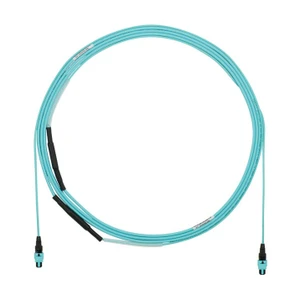
Panduit FSCR612Y 12-Fiber OM1 Indoor/Outdoor Riser Bulk Cable
Overview
The Panduit FSCR612Y is a 12-fiber OM1 multimode bulk cable from the Opti-Core™ family, built for indoor/outdoor transition runs where a single continuous cable needs to move from riser-rated building interiors to outdoor plant — without a mid-span splice or transition enclosure. With a 62.5/125µm core diameter and a riser (OFNR) flammability rating, this cable satisfies NEC plenum-alternative installations inside conduit while handling environmental exposure at building entry and exit points. If you're pulling fiber between IDF closets, from a main distribution frame (MDF) into a utility corridor, or through a riser shaft into a data room, FSCR612Y covers the application in a single pull.
The black-jacketed central-tube design keeps the 12 fibers compact and manageable during installation, reducing the risk of fiber damage during a long pull through conduit. Central-tube construction also means faster mid-span access when you need to break out individual fibers at a patch panel or splice closure — no layer-by-layer stripping of a loose-tube design.
Key Features
- OM1 Multimode (62.5/125µm): The 62.5µm core diameter supports legacy multimode transceivers and SFPs already deployed in your infrastructure — important when you're extending an existing OM1 plant rather than re-engineering around OM3/OM4. If you're running 100BASE-FX or legacy Gigabit links over short distances (up to 275m at 1Gbps), OM1 is the cost-effective fit. Note: if you're planning new 10GbE+ segments, OM3 or OM4 is the correct choice.
- 12-Fiber Count: Twelve fibers in a single jacket gives you enough strands for six duplex links — enough to terminate a small IDF or connect a mid-size camera head-end to a core switch with capacity to spare. Compared to single or quad-fiber assemblies, the 12-fiber count reduces conduit fill and pull labor when you need multiple circuits between two points.
- Riser (OFNR) Flammability Rating: The OFNR rating satisfies NEC 770 requirements for riser shaft installation, meaning you can run this cable vertically between floors inside a building without needing plenum-rated (OFNP) cable — as long as the run stays out of air-handling spaces. If any portion of your route crosses a plenum return-air ceiling, you'll need a plenum-rated alternative.
- Indoor/Outdoor Dual Rating: A single cable type that is listed for both indoor and outdoor use removes the requirement for a transition splice at the building entry point. On a campus surveillance run that enters a building through a conduit penetration, eliminating that transition splice means one less potential failure point and fewer hours in the field.
- 250µm Fiber Coating: The 250µm buffered fiber is the standard format for splice-and-fan-out terminations. It mates directly with common fiber fan-out kits and furcation tubing, so terminating at a patch panel or splice tray doesn't require special tooling beyond standard fiber prep tools.
- Opti-Core™ Sub-Brand: The Opti-Core™ designation identifies this as part of Panduit's structured cabling fiber line, which is engineered to integrate with Panduit's fiber optic systems — including patch panels, enclosures, and pre-terminated assemblies — for installations specifying end-to-end Panduit infrastructure.
- Sold Per-Unit (Package Qty 1): The package quantity of 1 means you're buying individual units rather than a bulk reel commitment, giving you flexibility to order exactly what a project requires without carrying excess inventory.
Integration & Compatibility
The FSCR612Y is compatible with standard OM1 multimode connectors (SC, LC, ST) and terminates using conventional epoxy-and-polish or pre-polished splice-on connector methods. The 62.5µm core aligns with OM1 transceivers operating at 850nm or 1300nm wavelengths. This cable is appropriate for integration with bulk fiber optic cable infrastructure including Panduit patch enclosures, splice trays, and structured cabling assemblies.
For network switch connections, verify that your SFP modules are rated for OM1 62.5µm — many newer SFPs are optimized for OM3/OM4 50µm fiber and may not perform to spec on a 62.5µm plant. Check your switch vendor's transceiver compatibility matrix before deploying on new segments.
Installation teams pulling this cable through outdoor conduit should verify that conduit sealing and weatherproofing is handled at entry points — the OFNR rating addresses flammability inside the building, not long-term submersion or UV exposure. For direct-burial or continuous outdoor runs, a separate outdoor-rated armored cable should be specified. Review your cable management infrastructure to ensure conduit sizing accommodates the central-tube jacket diameter.
Frequently Asked Questions
Q: What is the fiber core diameter of the FSCR612Y?
A: The FSCR612Y uses 62.5/125µm fiber (62.5µm core, 125µm cladding), which is the standard OM1 multimode specification. This is compatible with legacy multimode transceivers and SFPs designed for 62.5µm fiber.
Q: Can the FSCR612Y be installed in a riser shaft between floors?
A: Yes. The cable carries an OFNR (Optical Fiber Nonconductive Riser) flammability rating, which satisfies NEC 770 riser requirements for vertical runs between floors inside a building. It is not rated for plenum (air-handling) spaces — for those applications, specify an OFNP-rated cable.
Q: Is the FSCR612Y suitable for outdoor use?
A: The FSCR612Y is rated for indoor/outdoor use, meaning it can handle the transition from an outdoor conduit entry into an indoor riser run without a mid-span splice. It is not rated for direct burial or extended UV exposure without conduit. Long continuous outdoor runs should use an outdoor-rated armored or OSP cable.
Q: How many duplex fiber links does 12 fibers support?
A: Twelve fibers support six duplex links, since each duplex connection (transmit + receive) requires two fibers. This is sufficient for connecting six separate devices or running six full-duplex network segments between two termination points.
Q: Is the FSCR612Y compatible with 10 Gigabit Ethernet?
A: OM1 62.5µm fiber supports 10GbE (10GBASE-SR) at distances up to approximately 33 meters, which is significantly shorter than OM3 (300m) or OM4 (400m). For new 10GbE deployments, OM3 or OM4 cable is strongly recommended. The FSCR612Y is best suited for legacy Gigabit or Fast Ethernet OM1 plants.
Q: What connector types are compatible with the FSCR612Y?
A: The 250µm-buffered fibers in the FSCR612Y are compatible with all standard multimode connector types — SC, LC, and ST — using conventional termination methods including epoxy-and-polish or pre-polished splice-on connectors.
The FSCR612Y is the cable I reach for when a project has an existing OM1 62.5µm plant and the run has to bridge an outdoor conduit entry into a riser shaft without stopping for a transition enclosure. That indoor/outdoor dual rating combined with the OFNR flammability certification is the spec pairing that eliminates the transition splice — and on a 12-fiber run, that's a meaningful simplification in both labor and long-term fault risk.
Technical Highlights:
- 62.5/125µm OM1 Core: Matches legacy multimode infrastructure directly — no mode-conditioning patch cord needed when connecting to existing 62.5µm SFPs. Critical for extending an established OM1 plant cost-effectively.
- OFNR Riser Rating: Satisfies NEC 770 for vertical floor-to-floor runs inside conduit. Saves the cost and complexity of specifying a separate building-rated cable for the indoor segment of a campus run.
- 12-Fiber Central-Tube Construction: Six duplex circuits in a single compact jacket. Central-tube geometry speeds mid-span breakout — you're accessing the fiber bundle directly, not peeling through multiple loose-tube layers.
Deployment Considerations:
- Verify every SFP in the path is rated for 62.5µm OM1 fiber — many current-generation multimode SFPs are optimized for 50µm OM3/OM4 and will show elevated loss or link errors on a 62.5µm plant. Check the transceiver datasheet before pulling cable.
- The OFNR rating covers riser shafts but not air-handling (plenum) ceiling spaces. If any segment of your route runs through a return-air plenum, swap to an OFNP-rated cable for that section — mixing ratings in a plenum run is a code violation.
The FSCR612Y is the right specification for building-entry-to-IDF riser pulls on campuses with established OM1 infrastructure — particularly where a dual-rated cable eliminates a transition splice at the conduit penetration and the run terminates into a Panduit patch enclosure already on the rack.