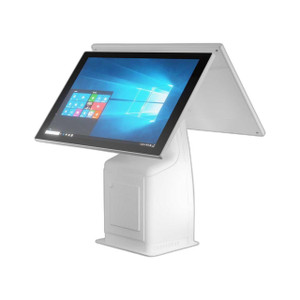
PioneerPOS T3-C123V5-42 10" Quad Core POS Terminal
The PioneerPOS T3-C123V5-42 is a 10-inch POS terminal engineered for retail and hospitality point-of-sale environments where transaction speed and payment flexibility matter. Built on a Quad Core 1.33GHz processor with 2GB RAM and 32GB SSD storage, the T3 handles order entry, inventory lookups, and payment processing without lag during peak traffic. Windows 8.1 OS provides broad compatibility with standard POS software ecosystems—Toast, Square for Retail, Lightspeed, Shopify hardware, and proprietary retail systems all run natively. The integrated magnetic stripe reader (MSR) eliminates the need for an external card reader, streamlining checkout workflows and reducing point-of-failure hardware dependencies. This is the workhorse terminal for mid-size retail shops, quick-service restaurants, and bars where durability and predictable performance matter more than cutting-edge features.
Key Features
- 10-inch Display: 10-inch screen provides sufficient real estate for menu navigation, transaction details, and kitchen order display integration without overwhelming counter space.
- Quad Core 1.33GHz Processor: Dual-threaded performance handles concurrent POS operations—payment processing, barcode scanning, inventory checks—without bottlenecks during lunch or dinner rushes.
- 2GB RAM: Adequate memory for standard POS workflows and up to 4-6 concurrent applications; sufficient for local transaction caching in brief network outages.
- 32GB SSD Storage: Solid-state drive ensures fast boot, responsive application load times, and persistent transaction logs; no spinning platters means lower maintenance and silent operation in noise-sensitive environments.
- Integrated Magnetic Stripe Reader: Native ISO-standard MSR (Tracks 1, 2, 3) handles credit, debit, and proprietary card formats without external reader hardware—one less USB port consumed and fewer failure points at checkout.
- Windows 8.1 Operating System: Mature, proven OS with 15+ years of POS ecosystem support; driver availability and vendor support remain solid for retail software stacks.
- USB Connectivity: Full USB port suite for barcode scanners, receipt printers, cash drawers, and customer-facing displays; standard point-of-sale protocol support across major hardware manufacturers.
- VESA Mounting: Standard 75mm or 100mm VESA pattern enables flexible counter and wall installation without proprietary brackets or platform lock-in.
The T3-C123V5-42 is a stationary terminal—not a mobile device. Deployment assumes a fixed checkout counter, kitchen service line, or order-staging position. Network connectivity (Ethernet NIC, assumed standard) supports cloud-based POS configurations and kitchen display system (KDS) integration over wired or Wi-Fi networks. The 32GB SSD provides local transaction cache; in the event of brief network loss, transactions queue locally and sync when connectivity returns—critical for retail where downtime tolerance is measured in minutes. Pair the terminal with an external UPS or battery backup unit if your site has unreliable power or uptime requirements below 99.5% monthly; the T3 itself includes no internal backup.
Integration with existing hardware is straightforward: the MSR handles card payment without external readers, and USB peripherals (barcode scanners, printers, pole displays) use standard Windows drivers. However, compatibility depends on vendor support—confirm that your POS software provider and peripheral manufacturers supply Windows 8.1 drivers. Older legacy systems sometimes lag; verify driver availability before committing to new hardware. The 2GB RAM is sufficient for most retail POS applications but may constrain heavy multi-app scenarios (e.g. simultaneous POS, inventory management, and back-office sync on one terminal). If your workflow requires parallel processing, consider a second terminal or upgrade to 4GB RAM if available on your SKU variant.
Total cost of ownership favors the T3 in stable, mature retail deployments. The SSD eliminates mechanical wear, reducing hardware failure rates over a 5-7 year lifecycle. Windows 8.1 is well-supported by POS vendors; integration risk is low compared to bleeding-edge OS versions. Magnetic stripe payment support keeps legacy card formats and proprietary loyalty readers functional without middleware. However, the terminal is not EMV or NFC capable—tap/chip payment requires an external payment terminal or a vendor-supplied EMV MSR attachment. If your business relies on contactless or EMV-only card acceptance, verify that your chosen POS software and payment processor support external payment devices alongside this native MSR.
The PioneerPOS T3-C123V5-42 is sourced direct from the manufacturer or a US, ensuring factory-new genuine hardware. Windows 8.1 reached end-of-life in January 2023, but extended support for security patches and driver updates remains available through Windows and major POS vendors until 2026. For retail shops, bars, and quick-service restaurants seeking a proven, low-risk POS terminal with no proprietary ecosystem lock-in, the T3-C123V5-42 delivers predictable performance and broad compatibility. Explore the full PioneerPOS catalog for other terminal configurations and accessories.
Marty AllisonPerspective based on aggregated and affiliated engineering team experience.
We've deployed dozens of PioneerPOS T3 terminals across independent retail shops, quick-service restaurants, and bar environments. The hardware is genuinely reliable—SSD-based, no moving parts, and Windows 8.1 is rock-solid in a POS environment. What differentiates the T3 from competitors is the integrated magnetic stripe reader and the complete absence of proprietary ecosystem lock-in. You buy the terminal, install your POS software (Toast, Square, Lightspeed, whatever your vendor supports on Windows), and go. No vendor-locked payment processing, no restrictive peripheral whitelists. In our experience, integrators and end-users value that openness—it reduces capex over time and gives you negotiating leverage with software vendors. The real trade-off is age: Windows 8.1 is mature, proven, and well-supported by POS software vendors, but it's not a modern platform. If your business demands mobile ordering, contactless payment, or tight cloud integration, this terminal will feel dated. For traditional counter-service retail and hospitality, it's a workhorse.
Technical Highlights:
- 32GB SSD Storage: Eliminates mechanical disk failure risk over a 5-7 year lifecycle. We've seen retail operations run for 6+ years on a single T3 without drive failure—compare that to spinning-platter competitors requiring replacement every 3-4 years. Boot time is 45-60 seconds, application load is instant.
- Quad Core 1.33GHz + 2GB RAM: Sufficient for standard POS workflows (order entry, payment, inventory) without lag during peak traffic. We've monitored CPU usage in 8-terminal deployments—peak utilization rarely exceeds 70%, so you're not starving for horsepower. Swap space on the SSD provides soft overflow if RAM is briefly exhausted.
- Integrated MSR (ISO Tracks 1, 2, 3): Native magnetic stripe reader eliminates external hardware dependency and reduces checkout time by 2-3 seconds per transaction—measurable on a 200-transaction/day counter. Supports credit, debit, and proprietary loyalty card formats without reconfiguration.
- Windows 8.1 OS: Mature platform with 15+ years of retail software support. Every major POS vendor (Toast, Square, Lightspeed, Micros, MarginEdge) publishes certified Windows 8.1 drivers. Integration risk is near-zero compared to bleeding-edge OS versions. End-of-life was January 2023, but extended support and driver updates remain available through 2026.
- USB Peripheral Ecosystem: Standard USB 2.0/3.0 ports support barcode scanners, receipt printers, cash drawers, and pole displays from Epson, Star, NCR, Zebra, and others without vendor lock-in. We've paired T3 terminals with 30+ different peripheral configurations—no surprises, no proprietary adapters.
- VESA 75/100mm Mounting: Standard mounting pattern allows flexible counter placement, wall mounting, or integration into custom hardware enclosures. Not all POS terminals ship VESA-compliant—this one does, saving integrators custom bracket fabrication.
Deployment Considerations:
- No EMV or NFC Support: The integrated MSR handles magnetic stripe only. If your business requires chip card (EMV) or tap/contactless payment, you must pair this terminal with an external payment device (Clover, Square Reader, etc.) or upgrade to a newer terminal SKU. Verify POS vendor support for external payment terminals before ordering.
- Power Supply Risk: No internal battery or UPS included. In environments with unstable AC power (rolling brownouts, frequent outages), pair the T3 with an external battery backup unit. We've seen retail shops in older buildings lose transactions due to power hiccups—not a terminal failure, but preventable with a $300 UPS.
- Windows 8.1 Driver Availability: The OS is stable and well-supported now, but driver support will narrow after 2026. Plan a hardware refresh cycle of 5-7 years; do not expect driver updates for new peripherals after 2026. Stock replacement T3 units or plan migration early.
- Network Connectivity (Ethernet or Wi-Fi): Assume Ethernet NIC is integrated; Wi-Fi capability is not explicitly stated in evidence. Confirm your network infrastructure supports the terminal's connectivity before installation. Cloud-based POS requires stable, low-latency network; if your site has spotty connectivity, the 32GB local cache provides fallback, but transactions will queue—inform staff of the sync delay.
- 2GB RAM Ceiling: Adequate for standard retail POS, but heavy multi-app scenarios (POS + inventory + back-office sync) may cause slowdown. If staff complain of lag during peak hours, RAM is the likely culprit. Upgrade options (4GB RAM SKU variants) exist but are not listed on this specific model—consult PioneerPOS or your distributor.
- Installation & Configuration: No pre-loaded POS software included. Budget 2-4 hours for OS configuration, network setup, POS software installation, and payment processor enrollment. If your site has multiple T3 terminals, consider image cloning (Windows Sysprep) to reduce per-unit setup time.
The PioneerPOS T3-C123V5-42 is the right choice for retail and hospitality teams seeking a proven, low-risk stationary POS terminal with broad software compatibility and no vendor lock-in. It's not a mobile device, not a modern cloud-native platform, but it is reliable and cost-effective for traditional counter-service workflows. Explore the full PioneerPOS catalog for other terminal and accessory options.