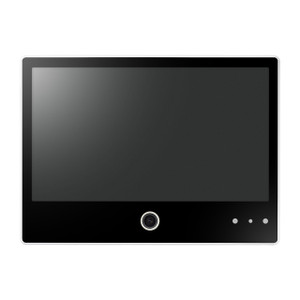
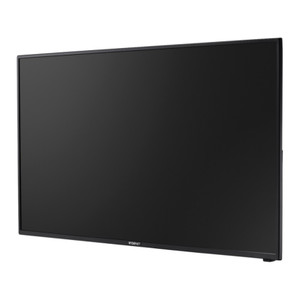
Hanwha SMT-1031PV 10.1" AI Public View Monitor
The Hanwha SMT-1031PV is a 10.1-inch AI-enabled public display and monitoring station designed for integrated security and retail operations. This compact color monitor integrates a 2MP camera with on-device people counting analytics, eliminating the need for separate display terminals in point-of-sale, transit, and retail surveillance workflows. The combination of local processing, PoE+ power efficiency, and ONVIF interoperability makes it a bridge between front-end capture and centralized VMS platforms.
Key Features
- 10.1-inch Color Display: 16.7M color palette at 1280×800 resolution. Bright enough for retail floor and kiosk mounting without external backlight.
- 2MP AI Camera: On-board 2MP sensor with 3.06mm lens (F1.6 aperture). Compact form factor for integration into point-of-sale and entrance monitoring stations.
- People Counting Analytics: Edge-based people counting eliminates per-frame transmission overhead to the NVR. Real-time occupancy data without network saturation on high-throughput retail locations.
- WDR Technology: Wide Dynamic Range handles backlit entrance scenes and variable interior lighting without manual exposure adjustment.
- PoE+ (802.3at) Power: Runs on standard 802.3at PoE+ — 25.5W typical draw — or DC24V auxiliary input for redundant power in critical applications.
- Multi-Codec Streaming: H.265 (25-40% bitrate reduction vs H.264), H.264, and MJPEG fallback. Adaptive streaming reduces bandwidth on congested networks.
- ONVIF Compliant: Profile S video streaming and metadata support — compatible with Genetec, Milestone, Avigilon, and other enterprise VMS platforms.
- Operating Range: 0°C to +40°C rated. Suitable for temperature-controlled indoor retail and transit hubs; outdoor kiosk mounting requires climate enclosure.
The SMT-1031PV bridges the gap between passive monitoring and interactive analytics. Unlike traditional passive displays, the integrated camera and edge analytics offload occupancy counting to the device itself, reducing NVR load and network traffic. This is particularly valuable in retail chains running dozens of entrance monitors — each location reports people counts without transmitting full-resolution video to a central analytics engine. The H.265 codec further compresses the video stream sent to the VMS for archival, reducing storage per location by 30-40% versus H.264.
Installation flexibility is a practical advantage. PoE+ power means a single Ethernet cable supplies both video and electricity — no separate 24V conduit runs. On existing installations with DC24V infrastructure (e.g., intercom systems), the auxiliary DC input allows you to integrate the monitor into the existing power backbone without rewiring. ONVIF compliance ensures the camera feed and analytics metadata integrate cleanly into your existing VMS ecosystem; no proprietary middleware is required.
Deployment scenarios span retail loss prevention (entrance people counting, till monitoring), quick-service restaurants (queue management, kitchen display), and transit (gate occupancy, platform monitoring). The 10.1-inch form factor is compact enough for pole or wall mounting at eye level, yet large enough to display video feeds and analytics overlays legibly. The 2MP resolution is adequate for identification at 3-5 meters; beyond that, it functions as an occupancy sensor paired with a higher-resolution perimeter camera.
Hanwha's firmware protection (signed firmware, secure boot, encryption) meets baseline IoT hardening practices. The device supports ONVIF metadata standards, allowing analytics events (people count crossing threshold, dwell time) to flow into rules engines on compatible VMS platforms. Integration with Genetec Omnicast or Milestone Xprotect can trigger alerts, populate occupancy dashboards, or trigger access control sequences without custom API coding.
Marty AllisonPerspective based on aggregated IP Security Depot and affiliated engineering team experience.
We've deployed the SMT-1031PV in mixed retail and transit environments where the integrator wanted to avoid dedicated analytics infrastructure. The value proposition is straightforward: instead of licensing a separate people-counting module or running video analytics on a server, the monitor itself counts. On a 20-location retail rollout, that avoids $15K–30K in edge analytics hardware. The tradeoff is that the on-device counting is tuned for overhead or angled mounting; if you need precise dwell time or heat-mapping across a large floor, you'll still want a dedicated perimeter camera running AI on a workstation. But for entrance occupancy and queue-length alerting, the local processing is accurate enough and dramatically cuts integration complexity. We've also seen integrators use it as a secondary entrance monitor paired with a high-res turret for backup — if the main camera fails, the SMT-1031PV's livestream keeps the NOC sighted until repair.
Technical Highlights:
- H.265 Codec: Reduces per-location bitrate to 2–4 Mbps depending on motion. On a 20-monitor deployment sending streams to a central NVR, that's 40–80 Mbps vs. 70–140 Mbps with H.264 — measurable savings on WAN links and storage overhead.
- People Counting Edge Processing: Counts are generated locally; only metadata and periodic snapshots traverse the network. Useful when you have bandwidth constraints or privacy mandates that discourage constant video export.
- PoE+ Efficiency: 25.5W typical draw is well within 802.3at budget. A single PoE+ switch port eliminates two infrastructure tasks (ethernet + 24V run). On a 16-port PoE+ switch, you can run 4–5 SMT-1031PVs plus several IP cameras without splitter complexity.
- WDR Implementation: The F1.6 aperture and WDR algorithm handle bright entrance light without saturation, but scenes with direct sun on glass (storefront windows) will still require sunshades or mounting behind diffusers.
- ONVIF Profile S: Full interoperability with major VMS. No proprietary driver or plug-in — camera appears as a standard ONVIF device, and analytics events publish as ONVIF metadata (motion, object count, etc.).
Deployment Considerations:
- People counting is calibrated for overhead or 45° angled mounting. At eye level, accuracy drops in dense crowds due to head occlusion. Test the mounting angle in your site before rolling out across 20+ locations.
- The 3.06mm lens (90°+ horizontal FOV) is wide. For till monitoring or close-range facial detail, supplement with a second fixed or turret camera; the SMT-1031PV will not provide legible face data beyond 2–3 meters in low light.
- Operating temp limit is 0–40°C. Outdoor kiosk installations require weatherproof enclosure. Backlit mounting (camera facing sun through glass) will washout the image; ensure the camera is shaded or at oblique angle to direct sunlight.
- Firmware updates are signed and require administrative access to the device UI. Plan update cycles — don't apply patches during peak business hours if the monitor is customer-facing.
- The monitor runs a proprietary OS with secure boot; you cannot install third-party applications. Analytics are limited to people counting; if you need custom motion or behavioral rules, push the video stream to an external analytics engine via ONVIF and rules on the VMS side.
The SMT-1031PV is the right choice for integrators deploying entrance monitors at 3–50 locations where people-count reporting and local video archival are primary needs, and where you want to minimize the external analytics infrastructure footprint. Retail chains, restaurants, and transit operators typically find ROI within 18 months through occupancy-driven labor scheduling and loss-prevention alerting. For single-site deployments or large multi-floor facilities needing heatmaps and dwell-time analysis, evaluate dedicated analytics appliances instead. See the Hanwha catalog for full product range and thermal / outdoor alternatives.