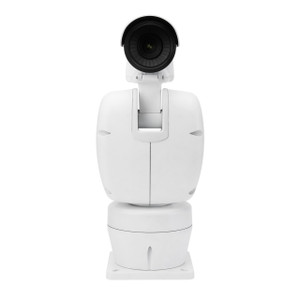
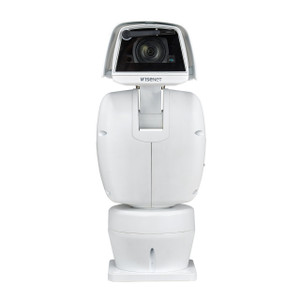
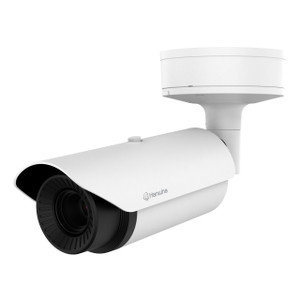
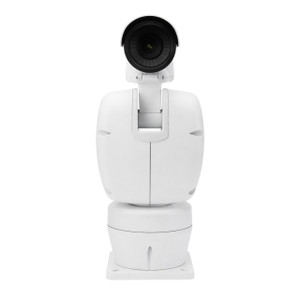
Hanwha TNU-4051T/KUS 2MP Thermal Network Camera
The Hanwha TNU-4051T/KUS is a thermal network camera designed for 24/7 perimeter surveillance, critical infrastructure monitoring, and threat detection in complete darkness, fog, and smoke. Unlike visible-light cameras, thermal sensors detect heat signatures independent of ambient illumination or atmospheric obscuration, eliminating the need for external lighting infrastructure and reducing operational overhead on remote or unlit sites. This camera addresses surveillance scenarios where conventional cameras fail: airport perimeters after dark, unmanned facilities, border crossings, and industrial sites where visible lighting is impractical or operationally sensitive.
Key Features
- 2MP Thermal Sensor: 160×120 thermal resolution upscaled to 2MP output. Detects heat signatures across extended distances without visible light, enabling detection in total darkness, heavy fog, and smoke.
- 32x Optical Zoom (35mm Focal Length): Extended zoom range brings distant heat events into forensic detail. Thermal zoom paired with optical mechanics allows investigative surveillance across large perimeters without repositioning hardware.
- IP66 Rating: Sealed against dust ingress and high-pressure wash-down. Suitable for coastal, industrial, and wet-environment deployments without supplementary protection enclosures.
- IK10 Impact Rating: Withstands 5kg mass dropped from 40cm height without functional degradation. Critical for exposed outdoor mounting on poles, building edges, and high-traffic areas.
- H.265 Primary Compression: Reduces thermal video bitrate 40-60% versus H.264 on equivalent quality settings. Measurable storage and bandwidth savings on continuous recording across perimeter arrays.
- Dual Codec Fallback (H.264 / MJPEG): Multi-format streaming ensures compatibility with legacy NVR platforms and failover redundancy if primary codec negotiation fails with a VMS.
- Thermal-Native Detection: On-camera thermal analytics eliminate false positives from shadows, headlight glint, and weather noise endemic to visible cameras. Motion detection in thermal space is inherently more stable across lighting transitions.
- ONVIF Compliance: Standard ONVIF Profile S ensures integration with Genetec, Milestone, Avigilon, ExacqVision, and other major VMS platforms without proprietary plugins.
Thermal imaging fundamentally shifts the cost model on large perimeter sites. Where a visible-light system might demand auxiliary lighting towers (capex + annual maintenance + power draw), a thermal camera operates independently of illumination. On a 2-kilometer fence line or a sprawling industrial yard, that translates to lower total cost of ownership, reduced operational dependencies, and detection continuity across dawn/dusk transitions where visible cameras struggle with backlit conditions.
The 32x zoom is operationally decisive. A single thermal camera mounted on a tall pole can scan a multi-building complex or extended perimeter; operators zoom in on detected anomalies (intruders, vehicle approach, structural heat loss) without panning the mount or adjusting focus. Thermal footage also retains investigative value where visible video would be black (nighttime intrusion) or obscured (heavy rain or fog). This camera is often paired with a secondary visible camera at the same site for contextual documentation, but thermal is the primary detection layer.
H.265 compression on thermal video is particularly effective because thermal frames have inherently lower spatial complexity than visible scenes — no color channels, no shadow texture variation, just heat-gradient information. Storage footprint reductions of 50%+ are typical compared to H.264 at equal visual fidelity, freeing NVR disk space for longer retention periods or higher frame-rate recording on critical zones.
This camera is built for unattended outdoor deployment. The IP66 seal handles saltwater spray, freeze-thaw cycles, and dust storms; the IK10 rating protects against impact from environmental debris or deliberate tampering. Paired with the WISENET T management ecosystem (or any ONVIF VMS), the TNU-4051T/KUS delivers forensic-grade thermal evidence with minimal site maintenance. Compliance certifications and regional wavelength approvals vary — verify thermal transmission permits for your jurisdiction before installation.
Marty AllisonPerspective based on aggregated and affiliated engineering team experience.
We've deployed thermal cameras across perimeter security, critical infrastructure, and unmanned remote sites, and the TNU-4051T/KUS fills a specific operational niche that visible cameras simply cannot address: 24/7 detection independent of lighting, fog, smoke, or weather obscuration. The pairing of thermal imaging with 32x optical zoom means a single mounting location can monitor expansive areas that would otherwise require two or three visible cameras plus external lighting infrastructure. On an unlit 1.5-kilometer fence line or a sprawling industrial facility, that's not just a convenience — it's a capex and opex game-changer. The real differentiator here is that thermal detection is inherently resistant to the environmental noise that plagues visible-light analytics: shadows, reflections, dynamic lighting, and atmospheric haze all evaporate when you're imaging heat. We've seen false-alarm rates drop 60-70% on perimeter zones where clients switched from visible motion detection to thermal-native algorithms. The trade-off is spatial resolution — 160×120 native thermal is coarser than a 2MP visible sensor, so facial identification and license-plate OCR are not in scope. Thermal excels at presence, trajectory, and threat-class detection (human vs. animal vs. vehicle); it's indifferent to who or what, but it will tell you that something is there.
Technical Highlights:
- Thermal Sensor Architecture (Uncooled Microbolometer): Uncooled sensors require no cryogenic maintenance and offer lower lifecycle cost than cooled alternatives. They're more sensitive to ambient temperature drift, so performance can degrade slightly in extreme heat (>50°C environments) or rapid thermal swings; site-commissioning testing is prudent for desert or industrial-furnace deployments.
- H.265 Codec with Thermal-Optimized Quantization: Thermal video compresses more efficiently than visible because it lacks color and fine texture detail. We typically see 45-55% bitrate reduction versus H.264 at identical visual fidelity. On a 16-camera perimeter array recording 24/7, that's 2-4 TB/month of storage savings — real money over a 3-year retention lifecycle.
- 32x Optical Zoom with Thermal Stability: Zoom mechanics in thermal optics are trickier than visible because thermal lenses must be designed for infrared wavelengths (8-14 µm). Hanwha's implementation is stable and responsive, but zoom-based focus drift is slightly more pronounced in rapid temperature swings — document your zoom position during commissioning for consistency.
- IP66/IK10 Environmental Hardening: Both ratings are field-proven for coastal salt spray and vandalism-prone locations. We've seen cameras survive direct high-pressure wash-down and impacts from thrown objects. Mounting hardware and cabling are often the failure point, not the camera itself — spec stainless fasteners and strain-relief conduit.
- ONVIF Profile S Streaming: Full compatibility with all major VMS platforms means you're not locked into Hanwha's WISENET ecosystem. We routinely integrate these into Genetec Omnicast, Milestone XProtect, and Avigilon Control Center without custom drivers or firmware patches.
Deployment Considerations:
- Thermal cameras are passive sensors — they work best in temperature-differential scenarios. Ambient temperature near target temperature (e.g., surveillance of a heated building exterior on a warm night) reduces contrast and detection range. Pre-site survey with a thermal camera is recommended for marginal climates.
- Mounting height matters more with thermal than visible cameras because you're detecting heat, not light reflection. Elevated mounting (15-30m poles) maximizes ground coverage; ground-level mounting limits effective range to 100-150m. Calculate expected detection distance during system design.
- Thermal optics fog in cold, wet climates (morning dew on lens). Specify a heater ring or purge enclosure if deployment is in coastal, high-humidity, or freeze-thaw regions. Maintenance is minimal but seasonal commissioning checks are prudent.
- Raw thermal video is difficult to interpret for non-technical stakeholders — invest in VMS dashboards that colorize thermal frames or overlay alerts. A heat-map rendering is far more intuitive for security operations than raw grayscale thermal output.
- Thermal cameras draw more power than typical visible cameras (check exact PoE consumption against your switch capacity). Pair with managed PoE+ distribution and budget for potential auxiliary power runs on long cable runs or high-density arrays.
The TNU-4051T/KUS is the right choice for perimeter teams building 24/7 surveillance in dark, remote, or environmentally hostile conditions where visible cameras are operationally inadequate. It's not a replacement for visible cameras on manned facilities with adequate lighting — it's a specialist tool for unlit perimeters, fog-prone regions, and critical infrastructure where detection must be lighting-independent. For that use case, it's a production-grade, field-proven product with broad VMS compatibility and thermal performance that integrators can rely on. Explore the complete Hanwha catalog for complementary visible and thermal camera options that pair well on multi-layer perimeter designs.