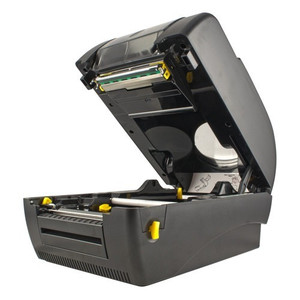
Wasp 633808404055 Thermal Transfer Label Printer
The Wasp 633808404055 (WPL304) is a desktop thermal transfer label printer built for point-of-sale, asset tagging, shipping, and receiving workflows in small-to-medium operations. It prints at 203 dpi up to 4 inches per second on labels up to 4.17" wide, with support for roll media up to 5" outside diameter — enough capacity for a full shift without frequent reloads.
Overview
This is a dual-mode printer: it handles both direct thermal (no ribbon needed) and thermal transfer (ribbon-based) printing, which means you can switch between low-cost thermal labels for temporary use and transfer-printed labels for durability without changing hardware. The 200 MHz 32-bit processor runs 8 MB SDRAM and 4 MB Flash memory, upgradeable to 4 GB via SD card slot if you need to store custom label templates or logos locally. Connectivity spans Ethernet, USB, serial, and parallel — a deliberate choice for integration into legacy warehouse management systems, older POS terminals, and modern network environments without adaptation. The footprint (10.16" L × 7.95" W × 6.81" H) is the smallest in the Wasp 4-inch format line, a real advantage if your label station shares desk space with other equipment.
Compatibility
The WPL304 works with any system that can send print jobs via Ethernet (raw socket or standard network printing), USB, serial (RS-232), or parallel (Centronics) — this includes legacy WMS software, modern cloud-based inventory platforms, and POS systems from the 1990s through today. The 110-meter ribbon capacity on notched 0.5-inch core supports standard barcode ribbon formats across multiple suppliers, avoiding lock-in. No proprietary connectors or media requirements.
Installation Notes
Double-walled clamshell design simplifies media loading and reduces jamming risk. The printer draws power via standard AC input and occupies minimal counter or wall space. Ethernet and USB are plug-and-play; serial and parallel connections require standard cables (not included) if your legacy system mandates them. Set label width and length in firmware or driver software — no physical adjustments needed for different label sizes within the 4.17" maximum.