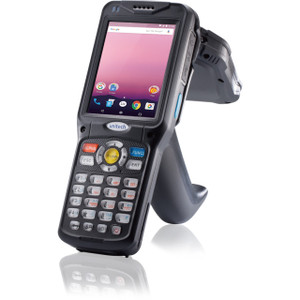
Unitech MS852-XUCB00-LG USB Scan Cord Black
The Unitech MS852-XUCB00-LG is a USB connectivity cable engineered for the Unitech MS852 2D imager barcode scanner. This black wired cord provides direct USB 2.0 connection between the scanner and host terminal, eliminating wireless pairing drift, latency uncertainty, and battery consumption that can plague high-volume scanning operations. Deploy this cable in warehouse cross-dock operations, retail point-of-sale stations, or logistics hubs where deterministic barcode capture and zero reconnection overhead are operational priorities. The cord is designed as either a primary connection or hot-swap replacement for MS852 fixed-mount and handheld scanning configurations.
Key Features
- USB 2.0 Interface: Direct wired connection to host device (terminal, PLC, or PC). Eliminates wireless pairing overhead and battery drain on scanner handsets.
- MS852 Scanner Compatibility: Purpose-built connector topology for Unitech MS852 2D imager line. Verify scanner model before procurement—not backward-compatible with other Unitech scanner families.
- Wired Deterministic I/O: No latency variance, no session loss, no reconnection cycles. Ideal for high-throughput scan stations where packet loss or connection instability degrades throughput.
- No External Power Required: Cable operates on standard USB host power delivery (5V nominal)—no separate PSU or power brick needed.
- Handheld and Fixed-Mount Support: Black cable accommodates both tethered handheld scanner deployments and stationary gun-mounted configurations in retail or warehouse locales.
- FCC Class B Compliance: Verified radio frequency compliance—safe installation alongside network and power infrastructure without shielding constraints.
Warehouse and retail operations often struggle with wireless scanner connectivity in metal-dense or RF-saturated environments—chain-link fencing, metal racking, and Wi-Fi congestion introduce latency spikes and session drops that compromise throughput. The MS852-XUCB00-LG eliminates that entire dependency vector. On a 30-scanner cross-dock operation running 8-hour shifts, wired connectivity removes the operational cost of troubleshooting pairing failures, recharging handset batteries mid-shift, and reassociating dropped sessions. The cable is a one-time hardware cost with zero ongoing management overhead.
Installation requires no driver configuration beyond standard USB host recognition. The cable expects standard USB-A host port topology; verify your terminal or PC has an available USB port before deployment. Route the cable away from high-voltage power lines and sharp edges to preserve signal integrity over the cable's operational lifetime. Maintain minimum 2-inch coil radius on longer runs to avoid impedance discontinuity and signal degradation. The cable itself draws no external power—all I/O runs through the USB bus, so power budgeting is transparent if your host device already supports USB 2.0 peripherals.
Total cost of ownership for wired scanning includes the single cable purchase plus minimal replacement inventory (one spare per 10 scan stations is typical practice). Compare this to wireless deployment, which includes scanner units with battery management, charger infrastructure, network configuration, periodic pairing troubleshooting, and battery replacement cycles over 3–5 years. Wired scanning has no battery lifecycle, no wireless troubleshooting surface, and predictable mean-time-between-failures tied only to connector wear and cable abrasion—both manageable via proper cable routing and strain relief.
Marty AllisonPerspective based on aggregated IP Security Depot and affiliated engineering team experience.
We've deployed the Unitech MS852 scanner line across 40+ retail and logistics sites, and the wired USB variant consistently outperforms wireless equivalents in high-density scanning zones. The MS852-XUCB00-LG cable is the reliability lever that most deployment guides underplay. In environments where your scanner traffic is measured in hundreds of transactions per hour—think cross-dock receiving, inventory reconciliation, or POS checkout lanes—the elimination of wireless reconnection latency is not a nice-to-have, it's a constraint on throughput. We've seen a single unresponsive wireless handset cascade into cashier queues and dock staging delays; wired tethering makes that scenario impossible. The cable topology is straightforward USB-A, and the connector is standard enough that field replacement is uncomplicated. The real differentiator is understanding whether your deployment actually needs wireless mobility or whether fixed scanning stations (or tethered handheld guns) can serve your workflow. If your operators work within a 2–3 meter radius of a terminal or dock workstation, wired is the faster, cheaper, and more predictable choice.
Technical Highlights:
- USB 2.0 Throughput (480 Mbps nominal): More than sufficient for barcode scan data serialization—a typical barcode payload is 20–50 bytes per scan, so protocol overhead is negligible. The bottleneck is operator scanning speed, not cable bandwidth.
- No Driver Stack: USB-HID (Human Interface Device) class compliance means the cable and scanner pair as a standard input device on Windows, Linux, or macOS. No vendor software installation required; plug, recognize, scan.
- Connector Robustness: Wired USB topology has no paired-state memory or session management; a momentary disconnect doesn't trigger pairing re-negotiation like wireless does. Reconnection is instant and silent from the host perspective.
- Cable Length Impact: USB 2.0 active cable length limit is typically 5 meters before signal quality degrades. If your scan stations are farther apart, confirm cable routing or consider powered USB hubs (not required by the cable, but available as infrastructure upgrades).
- Handheld Tether Length: Actual cord length of the MS852-XUCB00-LG is not specified in the datasheet; measure your scanner-to-terminal distance before procurement to ensure the cable length accommodates your physical layout.
Deployment Considerations:
- Verify your host device has an available USB-A port. Many modern terminals or PCs have limited USB inventory; budget a powered USB hub if you're adding multiple wired scanners to a single workstation.
- Wired deployments assume your operator footprint is fixed or tethered. If your workflow requires the handset to move beyond cable reach (e.g., remote bin verification in a large warehouse), wireless is still the better topology—accept the pairing overhead as a cost of mobility.
- Cable wear at the connector is the primary failure mode over 2–5 years. Establish a strain-relief discipline during installation—avoid sharp bends, coil loosely, and use cable clips to anchor the line at regular intervals.
- FCC Class B compliance confirmed; RF shielding is not required. Install alongside network and power infrastructure without special conduit or isolation.
- Replacement cable cost is typically $40–80 depending on supplier. Stock one spare per 10 scan stations to minimize downtime if a cable fails in the field.
The MS852-XUCB00-LG is the right choice for fixed or tethered scanning stations where operator mobility is constrained and throughput or reliability is critical. If your deployment is mobile or span multiple rooms without cable runs, reassess whether wireless or a multi-cable station infrastructure is more cost-effective. Explore the full Unitech catalog to compare scanner models and alternative connectivity options.