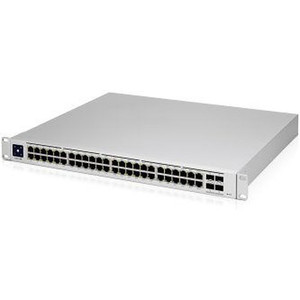
Ubiquiti USW-ULTRA 8-Port Gigabit PoE++ Network Switch
Overview
The Ubiquiti USW-ULTRA is a compact eight-port Gigabit network switch purpose-built for distributed edge deployments where space and power efficiency directly impact total cost of ownership. With a 16 Gbps switching fabric and non-blocking 8 Gbps throughput, the USW-ULTRA (often searched as USW ULTRA) delivers predictable, deterministic performance for access-layer and branch aggregation roles without the overhead of a full-sized chassis. The device operates entirely on PoE input (50–57V DC), drawing only 9W at idle—eliminating the need for dedicated AC infrastructure at remote sites, temporary installations, or warehouse edge locations. Its polycarbonate housing supports desktop, wall-mount, and magnetic-mount deployment, adapting to confined equipment spaces or rapid deployment scenarios common in facility expansions or modular warehouse automation environments.
Key Features
- PoE++ Input and Output: Accepts PoE++ (802.3bt Class 4) input and can source up to 42W of PoE++ output per port, or 16W with PoE+ input. This eliminates cascading power supplies—a single upstream PoE source can power the switch and simultaneously deliver power to multiple downstream IP cameras, access points, and powered sensors. Particularly valuable in warehouse automation where powered PTZ cameras or access-control readers sit beyond convenient AC outlets.
- 16 Gbps Switching Capacity: Non-blocking 8 Gbps throughput ensures that all eight Gigabit ports can operate at line rate simultaneously without internal congestion. Meaningful for aggregating traffic from multiple UniFi access points or concurrent video streams in a surveillance consolidation point.
- 12 Mpps Forwarding Rate: Translates to rapid packet processing—important when handling bursty traffic from motion-triggered camera uploads or synchronized access-control events across multiple readers.
- 256 VLAN Support: Enables logical network segmentation without external tagging appliances. Common in multi-tenant warehouse or retail deployments where video traffic, access control, and guest Wi-Fi must remain isolated on a single physical switch.
- Extended Operating Temperature (−30°C to 60°C): Operates reliably in uncontrolled or outdoor-adjacent environments—loading docks, outdoor equipment closets, or uninsulated warehouse sections where indoor AC is unavailable or cost-prohibitive. No thermostatically controlled enclosure needed.
- Gigabit Auto-Negotiation on All Ports: All eight ports support 10M, 100M, and 1G auto-detection. Backward compatible with legacy Cat5e cabling or older powered devices, reducing the burden of complete infrastructure replacements in retrofit deployments.
- NDAA Compliance and CE/FCC/IC Certifications: Satisfies U.S. federal procurement restrictions (Section 889) and international regulatory alignment, eliminating certification delays for government contracts or prime-contractor integrations.
- Ethernet-Only Management via UniFi Controller: No CLI, no serial console, no out-of-band management required. Configuration and real-time monitoring occur entirely through the UniFi Controller software running on the management network. Reduces IT overhead in branch deployments or temporary sites with minimal on-site technical staff.
Integration & Compatibility
The USW-ULTRA integrates natively into Ubiquiti's Ubiquiti ecosystem, discovering and reporting through the UniFi Controller alongside UniFi access points, gateways, and other managed devices. It functions equally well as a standalone network switch, supporting any IEEE 802.3bt-compliant powered device (PoE++ cameras, dual-antenna access points, industrial sensors). VLAN tagging allows multi-tenant or departmental network segmentation. All eight ports operate as standard Gigabit interfaces; there is no dedicated uplink port, so plan trunk capacity accordingly if aggregating multiple switches upstream.
Installation Considerations
The USW-ULTRA ships as a bare device without an AC/DC adapter. If AC-powered operation is required, source a separate 50–57V DC power supply meeting the device's input specification—critical to verify voltage range to avoid hardware damage. The compact footprint (203 × 76 × 33 mm; 320 g) accommodates wall mounting, equipment rack rails, or magnetic placement beneath metal desks or cable trays. Ensure the PoE source feeding the switch can supply sufficient wattage if you intend to power downstream devices at full capacity (up to 42W per port × 8 ports theoretical maximum). Verify your upstream PoE switch or PSE can sustain the aggregate load.
When to Choose a Different Model
If you require stackable switching fabric, redundant power inputs, or greater than 8 ports, consider a larger model in the Ubiquiti UniFi switch family. If your deployment demands non-PoE powered operation without sourcing an external DC supply, a traditional AC-powered access switch may simplify provisioning. For environments requiring PoE planning across dozens of powered devices, consult a full power-budget analysis before committing to edge-powered architectures.
Frequently Asked Questions
Q: Can the USW-ULTRA power itself from a standard PoE+ switch?
A: PoE+ (802.3at) supplies maximum 30W, but the USW-ULTRA specifications indicate it requires PoE++ input (50–57V DC). A standard PoE+ source (48V nominal, limited wattage) may not reliably power the switch. Use PoE++ or a dedicated 50–57V DC power supply.
Q: What happens if I connect the USW-ULTRA to 57V input and try to output 42W per port to eight devices simultaneously?
A: The switch would need to source 336W total—far exceeding typical PSE capacity. Plan for realistic load distribution: if powering eight devices at full wattage, you need external power supplementation or a dedicated high-capacity upstream PoE source. The spec describes capability, not guaranteed simultaneous delivery across all ports.
Q: Is the USW-ULTRA NDAA Section 889 compliant?
A: Yes. The product specifications confirm NDAA compliance, satisfying federal procurement restrictions on Chinese-origin hardware in U.S. government contracts.
Q: Does the USW-ULTRA support Spanning Tree Protocol (STP) or loop prevention?
A: The provided specifications do not explicitly list STP or RSTP support. Confirm with the UniFi Controller documentation or contact the manufacturer for advanced switching protocol details if redundant topology is a requirement.
Q: Can I manage the USW-ULTRA without a UniFi Controller?
A: No. The device requires the UniFi Controller software for device discovery, configuration, and monitoring. There is no standalone CLI or web interface. If you need standalone switching without controller dependency, choose a different product line.
Q: What is the maximum cable run length from the USW-ULTRA to a powered device?
A: Standard Gigabit Ethernet supports 100 meters (328 feet) per IEEE 802.3. PoE delivery range may be reduced if total cable resistance approaches the PSE's power-delivery limits. Plan runs under 100 meters and verify PSE wattage if devices are at cable extremities.
Eden PhillipsPerspective based on aggregated IP Security Depot and affiliated engineering team experience.
The USW-ULTRA delivers genuine engineering value where space and power are constraints—particularly in edge deployments where a full-sized switch introduces unnecessary complexity or cost. The PoE++ input architecture is elegant: you can often power the switch from an upstream PoE source and simultaneously deliver power downstream, eliminating one layer of power conditioning in the field. That matters. It's not a flashy specification, but it directly reduces cable runs and component density at remote sites.
Technical Highlights:
- 9W Idle Power Draw: At branch or warehouse edge locations running 24/7, this translates to roughly 79 kWh annually per unit—negligible compared to AC-powered switches. In multi-site deployments across 10–20 locations, the cumulative operational cost delta becomes material.
- 42W PoE++ Output per Port: Eliminates the need for separate PSE injectors or powered devices in many access-point and camera deployments. One upstream PoE++ source powers the switch and cascades power downstream—valuable in retrofit scenarios where running additional AC to the equipment closet is cost-prohibitive.
- 16 Gbps Switching Fabric / 8 Gbps Non-Blocking: Non-blocking operation at Gigabit means no internal contention. Relevant if you're consolidating 4–5 simultaneous HD video streams or high-frequency access-control events. Don't assume this is overkill for 'small' deployments—warehouse automation and retail expansion often surprise you with bandwidth requirements after go-live.
- −30°C to 60°C Operating Range: Uncontrolled environments are the norm for edge infrastructure. No thermostat-controlled cabinet required. Loading docks and outdoor equipment closets become viable switch locations without thermal hardening.
Deployment Considerations:
- PoE++ Source Dependency: The USW-ULTRA itself requires PoE++ input—it will not reliably operate on PoE+ alone. Audit your upstream PSE infrastructure before ordering. Many existing UniFi switches support PoE++ output, but older or legacy infrastructure may force you to source a dedicated DC supply, which reintroduces the power-infrastructure cost you were trying to avoid.
- No Standalone CLI: Absolute controller dependency is a gotcha if you're integrating into a heterogeneous environment or need failover-friendly configuration. If the UniFi Controller is unavailable, the switch continues forwarding (it's a dumb L2 device in that state), but you cannot make configuration changes without the controller returning online. Plan controller redundancy accordingly.
- Eight-Port Density: Eight ports is adequate for typical wireless aggregation (3–4 access points) or small video consolidation, but it exhausts quickly in high-density access scenarios. Count your powered endpoints realistically before committing.
Position the USW-ULTRA in branch offices, temporary warehouse expansion zones, or retail remote locations where AC power is scarce and space is confined. It excels in greenfield UniFi deployments where controller infrastructure is already planned. Skip it if your deployment demands multi-controller failover or non-UniFi ecosystem management.