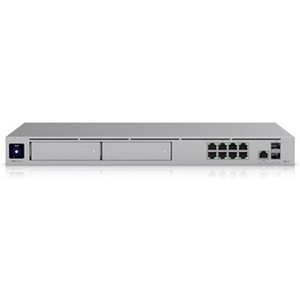
Ubiquiti UDM-SE UniFi Dream Machine Security & Routing Appliance
Overview
The Ubiquiti UDM-SE is a consolidated security and networking appliance that merges gateway, switching, and UniFi OS console functionality into a single 1U rack-mount form factor. Built on a quad-core ARM Cortex-A57 processor clocked at 1.7 GHz, the UDM-SE functions as the central management and routing platform for branch offices, small campuses, and distributed multi-site architectures where unified threat detection and administrative control matter. It draws 50W during normal operation (excluding PoE output) and accepts universal AC input from 100–240V at 4.4A maximum, operating across -10 to 40°C — accommodating both controlled data center environments and temperature-variable edge deployments. The aluminum CNC and SGCC steel enclosure measures 442.4 × 43.7 × 285.6 mm (17.4 × 1.72 × 11.25 in) and weighs 5 kg (11 lbs), designed for standard server rack mounting with supplied SGCC steel brackets.
Key Features
- 3.5 Gbps IPS Routing Throughput: Delivers stateful firewall and intrusion prevention inspection without choking on legitimate traffic — realistic for branch deployments where encrypted traffic (TLS 1.3, WireGuard) dominates and deep packet inspection would otherwise create bottlenecks. This is an honest ceiling, not marketing peak; size your client load and uplink bandwidth accordingly.
- 10G SFP+ Uplink Port: Decouples the appliance from Gigabit constraints and gives you a credible path to 10G fiber without a complete hardware refresh. Dormant until you actually need it, but eliminates the forced-upgrade scenario when branch throughput grows.
- 2.5GbE RJ45 Management Port: Separates administrative traffic from production data paths, reducing risk of management channel saturation during high-load conditions. Typical for enterprise-grade appliances; keeps your console access responsive even when the PoE switch is fully loaded.
- Integrated Gigabit PoE Switch: Powers downstream UniFi access points, switches, and cameras (802.3af and 802.3at support) without requiring a separate powered switch. Simplifies cabling, reduces rack space, and lowers per-unit power draw compared to splitting duties across multiple appliances.
- 240W AC/DC Power Supply: Sufficient power budget for concurrent operation of the routing engine (50W baseline) and substantial PoE delivery across connected UniFi infrastructure. Adequate for 8–12 PoE+ devices running simultaneously, depending on per-port consumption.
- Local UniFi OS Console: Runs UniFi OS natively on the appliance, so you can manage and monitor the site independently or federated with a central UniFi Cloud Gateway. No external controller required; branch offices operate autonomously during WAN outages while remaining integrated when connectivity returns.
- NDAA Compliance & Regulatory Approvals: Clears Section 889 restrictions (no Huawei, ZTE, Kaspersky components) and carries CE, FCC, IC, and Anatel certifications. Eliminates compliance risk for federal contracting, state/local government integrations, and public-sector network builds.
- ±15kV/±8kV ESD Protection: Electrostatic discharge tolerance (air and contact) reduces susceptibility to field damage during transport, unpacking, and installation — meaningful when moving appliances between racks or reterminating patch cables in high-static environments.
Integration & Deployment Context
The UDM-SE anchors Ubiquiti UniFi ecosystem deployments where localized threat detection and unified device management are required. It connects via the 2.5GbE port to an upstream network (WAN or campus core) and distributes PoE to downstream UniFi switches and access points via the integrated Gigabit switch. In federated architectures, multiple UDM-SE appliances operate as distributed edge nodes, each running a local UniFi OS console while synchronizing policy and user databases via a central controller. The 10G SFP+ uplink accommodates future scaling without appliance replacement — a practical advantage in organizations with 3–5 year technology refresh cycles.
For organizations evaluating PoE power budgets and routing throughput, the UDM-SE consolidates roles that would otherwise require separate gateway, PoE switch, and management appliances. This consolidation translates directly to reduced power consumption, fewer network ports consumed, smaller rack footprint, and simplified administrative access — all measurable cost factors in branch and campus deployments.
Installation & Physical Considerations
Mount the UDM-SE in a standard 1U rack slot using the supplied SGCC steel brackets. Connect the 2.5GbE management port to your upstream network, and reserve the 10G SFP+ port for future high-speed uplink requirements (it remains dormant and unpowered until cabled with an active transceiver). Ensure adequate airflow around the aluminum enclosure for passive thermal dissipation; blocked ventilation will cause thermal throttling and performance degradation. All mains power must be 100–240V AC within the -10 to 40°C operating envelope; verify circuit capacity before installation, particularly if the appliance will be co-located with other 50W+ devices in a compact cabinet.
Frequently Asked Questions
Q: Is the UDM-SE compatible with non-Ubiquiti IP cameras and switches?
A: The UDM-SE routes and inspects traffic for any ONVIF-compliant device. However, only Ubiquiti UniFi cameras, access points, and switches receive native integration via UniFi OS — direct adoption, automatic provisioning, and unified alerting. Third-party devices function as standard network clients and require manual VMS configuration.
Q: What happens to local management if the WAN fails?
A: The UDM-SE runs UniFi OS locally on the appliance, so all site-level management, device provisioning, and monitoring continue independently. Policy and firmware updates for connected devices may be delayed until WAN connectivity returns, but active operations (routing, PoE delivery, firewall rules) are unaffected by upstream failures.
Q: Can the UDM-SE handle 10 Gbps sustained throughput?
A: No — the 3.5 Gbps IPS routing throughput ceiling reflects the processor's real-world capacity under stateful inspection. If your site routinely exceeds 3.5 Gbps of inspected traffic, consider a larger Ubiquiti security appliance or evaluate a bypass/load-balancing architecture. The 10G SFP+ uplink itself can carry full line rate, but traffic routed through the UDM-SE will be capped at 3.5 Gbps.
Q: Does the UDM-SE include an SFP+ transceiver?
A: No — the 10G SFP+ port is socket-only. You must source a compatible SFP+ transceiver (multimode or singlemode LC, depending on your uplink fiber) separately. This allows flexibility (choose your fiber type and vendor) but adds a line item to your bill of materials.
Q: How much PoE power can the UDM-SE deliver to downstream devices?
A: The 240W AC/DC power supply allocates roughly 190W for PoE delivery after the appliance's 50W baseline consumption. This accommodates 8–12 PoE+ (30W) devices or a mix of PoE (15W) and PoE+ (30W) devices. Exact headroom depends on whether you're also running local recording, storage, or external services on the appliance.
Q: Is the UDM-SE suitable for outdoor or harsh-environment deployments?
A: The UDM-SE is rated for -10 to 40°C operating temperature and has no IP rating (intended for climate-controlled environments). For outdoor or non-temperature-controlled sites, you would need to install it in an insulated enclosure or heated/cooled cabinet. Do not expose it to direct rain, condensation, or dust without additional protection.
Ted PerryPerspective based on aggregated and affiliated engineering team experience.
The UDM-SE strikes a deliberate balance between throughput ceiling and operational footprint. The 3.5 Gbps IPS routing number is honest — it respects the quad-core ARM processor's constraints and doesn't fluff the spec sheet. What matters is sizing: if your branch averages 1–2 Gbps of inspected traffic with peaks under 3 Gbps, the UDM-SE is appropriately matched. If you're regularly pushing 5+ Gbps, this appliance will become a bottleneck and you need to audit whether IPS inspection is required for that volume or whether you can bypass inspection for certain traffic classes.
Technical Highlights:
- Dual-port uplink design (2.5GbE + 10G SFP+): The 2.5GbE RJ45 handles your immediate WAN or campus uplink without forcing a fiber investment. The 10G SFP+ sits ready for future growth without a hardware refresh — you just source a transceiver and cabling when bandwidth demands justify it. This is pragmatic: branch deployments often have 2–3 year planning horizons, and adding 10G fiber support mid-cycle becomes expensive or impossible with a single fixed uplink.
- Integrated PoE switch + UniFi OS console: Eliminates two separate appliances (PoE switch and cloud controller). Real-world impact: saves ~25W of power, reclaims 2U of rack space, and reduces administrative login surfaces. In a 10-site deployment, that's 250W annual power savings and simplified commissioning across all branches.
- 240W power budget: Adequate for the appliance's 50W baseline plus 8–12 PoE+ devices running simultaneously. If you're planning to power 15+ downstream devices, you'll need a separate PoE+ injector or switch — factor that into your topology planning.
Deployment Considerations:
- No outdoor rating: The UDM-SE is -10 to 40°C, no IP rating. If your rack is in an unheated warehouse or equipment shelter, you need a climate-controlled cabinet or outdoor-rated housing. Don't assume "data center appliance" means field-ready.
- SFP+ transceiver not included: The 10G port is socket-only. Budget $200–400 for a compatible transceiver and fiber runs if you're planning to activate that uplink. Multimode LC transceiver (500m) is cheaper than singlemode (10+ km) if your core is co-located.
- IPS throughput is the real ceiling: The appliance can route 10G traffic on the SFP+ uplink without inspection, but the moment you enable IPS on that traffic, throughput drops to 3.5 Gbps. Understand your inspection requirements before committing — not all traffic needs deep packet inspection.
Position the UDM-SE for branch offices or small campuses where consolidated routing, local threat detection, and autonomous management matter — sites with 10–50 endpoints, moderate WAN utilization (sub-3 Gbps peak), and a requirement for NDAA compliance or regulatory air-gapping. If you're building a 100+ node branch network, scale to a larger chassis-based appliance or architect with redundant UDM-SE units in active-passive failover.