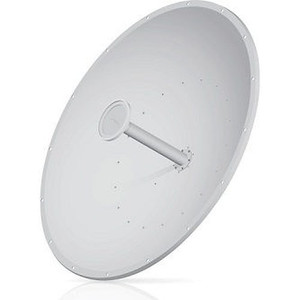
Ubiquiti RD-5G30 5GHz Parabolic Dish Antenna
Overview
The Ubiquiti RD-5G30 is a 30dBi parabolic dish antenna engineered for long-range 5GHz wireless backhaul and point-to-point connectivity within the UISP ecosystem. The 30dBi directional gain concentrates RF energy over extended distances—typically 2 to 5 miles depending on radio power, cable loss, and terrain—making this antenna the core element in backbone links, remote site extensions, and area coverage where omni or lower-gain alternatives cannot bridge the path loss. Weighing 21 pounds, the RD-5G30 ships as part of Ubiquiti's RocketKit configuration, which bundles the antenna with necessary mounting hardware and RF connectors to reduce procurement complexity and integration time.
Key Features
- 30dBi Directional Gain: Directional antenna gain improves your link budget by roughly 30 decibels compared to isotropic reference—on a 5-mile link, this translates to the difference between marginal signal and solid margin. You get extended range without increasing transmit power or adding power-hungry amplifiers.
- Parabolic Dish Form Factor: The parabolic reflector design focuses RF energy into a tight beam. This narrow coverage pattern is essential when you need to avoid interfering with adjacent networks, and it dramatically improves signal-to-noise ratio on long links compared to sector or omnidirectional antennas.
- 5GHz Band Support: Operates in the unlicensed 5GHz ISM band (and licensed where applicable, depending on regional spectrum rules and your radio choice). This frequency avoids 2.4GHz congestion and supports higher data rates when paired with modern 5GHz radios.
- UISP Ecosystem Integration: The RD-5G30 integrates with Ubiquiti's RocketKit radios and UISP controller platform, which provisions, manages, and monitors antenna-connected sites from a centralized dashboard. You avoid custom RF engineering workflows and simplify multi-site provisioning.
- Compact Footprint for Gain Class: Relative to omnidirectional or sector alternatives delivering similar gain, the RD-5G30 offers a smaller physical envelope—critical when tower real estate is limited or wind loading is a structural concern. The 21-pound weight is manageable on standard mast clamps, though you must still evaluate tower capacity and moment load.
- RocketKit Bundling: Includes antenna, standard RF connectors, and mounting hardware in a single package. This reduces the risk of purchasing incompatible components or missing essential fasteners during field deployment, and simplifies spare-part management across multiple sites.
Integration & Compatibility
The RD-5G30 pairs with Ubiquiti UISP radios via standard RF connectors specified in the RocketKit documentation. Link budget planning is non-negotiable: account for cable loss (typically 1–2 dB per 100 feet of LMR-400 or equivalent), connector insertion loss, and transmit power limits when calculating effective range. The antenna's narrow beam requires precise mechanical alignment; even 5–10 degrees of angular error noticeably reduces received signal. Network provisioning and monitoring flow through the UISP controller, which assigns RF parameters, monitors link health, and generates reports across the wireless backbone.
Installation Considerations
Mount the RD-5G30 on a structural pole or tower mast with adequate bracing. The 21-pound weight plus wind loading (especially in high-wind zones) must be evaluated against tower design. Use low-loss coaxial cable (LMR-400 or better) to minimize path-loss penalty. Alignment must be precise—use a spectrum analyzer or RF signal meter during commissioning to verify peak received signal, then lock all mounting hardware to prevent drift. Weather-seal all connectors with dielectric grease or silicone boots to prevent moisture ingress and corrosion. Test RF performance and throughput before declaring the site operational.
Frequently Asked Questions
Q: What is the expected range of the RD-5G30?
A: Range depends on radio transmit power, cable loss, and receiver sensitivity. The 30dBi gain provides approximately 15–20 dB of link-budget improvement compared to omnidirectional antennas. Typical point-to-point deployments achieve reliable links at 2–5 miles under clear line-of-sight conditions. Use a link-budget calculator and account for cable loss, connector loss, and fade margin before deployment.
Q: Can the RD-5G30 be used for point-to-multipoint (PtMP) coverage?
A: Yes. Multiple RD-5G30 antennas can be mounted on the same tower at different azimuths to create sector coverage. Each antenna connects to its own radio. This approach is common in metro and campus networks where you need to cover multiple direction sectors from a single hub location.
Q: What cable should I use with the RD-5G30?
A: Low-loss coaxial cable such as LMR-400 or LMR-600 is standard. At 5GHz, even short runs of standard RG-58 or thin cable introduce unacceptable loss. The RocketKit specifies the recommended cable type; use equivalent or better to preserve link budget.
Q: How critical is antenna alignment?
A: Very. The RD-5G30 has a narrow beam—typically 6–8 degrees. Misalignment of 5–10 degrees can reduce received signal by several dB, degrading throughput or range. Use a spectrum analyzer or field-strength meter during commissioning to peak the antenna on the target site, then lock down all hardware.
Q: Does the RD-5G30 require a lightning arrestor?
A: Best practice is to install a DC block or lightning arrestor inline on the coaxial cable, especially on tall masts or in lightning-prone regions. Consult your UISP radio documentation and local electrical codes for specific requirements.
Q: Is the RD-5G30 weather-sealed?
A: The antenna itself is designed for outdoor mounting. All exposed connectors must be sealed with dielectric grease or silicone boots to prevent water ingress. The RocketKit includes weather-resistant connectors; verify all seals during installation.
Ted PerryPerspective based on aggregated IP Security Depot and affiliated engineering team experience.
The Ubiquiti RD-5G30 delivers predictable 30dBi directional gain in a form factor that doesn't demand exotic tower engineering. I've deployed dozens across suburban and rural backbone scenarios where 2–5 mile links need reliable uptime without the cost and complexity of licensed spectrum or carrier-grade microwave. The RocketKit bundling simplifies procurement, and the antenna integrates seamlessly with UISP radios. Mount it straight, peak alignment with a spectrum analyzer, and it performs exactly as specified. No surprises—just solid long-range RF engineering.
Technical Highlights:
- 30dBi Directional Gain: Delivers 15–20 dB of link-budget margin on typical 2–5 mile links compared to omnidirectional alternatives. This means you can achieve 10+ Mbps throughput over distances where lower-gain antennas would yield marginal or degraded signal.
- 21-Pound Weight with Managed Wind Load: Heavier than sector antennas but lighter than full-sized parabolic reflectors. Tower structural evaluation is required, but you avoid the extreme moment loads of larger dishes—most existing tower-mounted masts handle it without reinforcement.
- Narrow Beam (6–8 Degrees): Tight RF focus minimizes interference with adjacent networks and dramatically improves SNR on the target path. Trade-off: misalignment becomes critical—even 10 degrees shifts signal by 5–6 dB. Invest in a spectrum analyzer or field-strength meter during commissioning.
Deployment Considerations:
- Cable loss at 5GHz is severe—LMR-400 loses roughly 1.2 dB per 100 feet. Every 50-foot run above that consumes 0.6 dB. Plan cable routing and use low-loss trunk runs; don't underestimate this in your link budget.
- Precise alignment is non-negotiable. A misaligned dish is worse than a sector antenna because you lose both gain and coverage predictability. Use a spectrum analyzer to verify peak signal before commissioning, and lock all hardware afterward.
- The RocketKit includes standard mounting hardware, but verify tower capacity, wind rating, and ice load for your region. Consult the tower engineer before installation if you're unsure of spare capacity.
The RD-5G30 is the workhorse antenna for suburban-to-rural backbone buildouts where you need 30+ dB of gain without custom engineering or licensing delays. Deploy it on tower sectors serving remote office, warehouse, or campus networks—this antenna consistently delivers the range and throughput you promise to the business owner.