


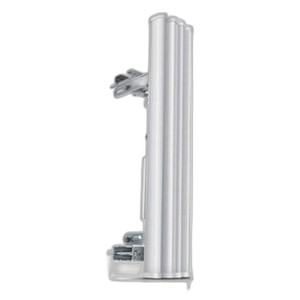

Product images are provided for reference and may not represent the exact model, configuration, or included
components.
Overview
SKU:
AM-5G17-90
Condition:
New
Availability:
Usually ships in 24 hours
Warranty
Manufacturer Warranty
Ubiquiti AM-5G17-90 5GHz AirMax BaseStation,17dBi,90 deg,roc
Ubiquiti AM-5G17-90 5GHz Sector Antenna Overview The Ubiquiti AM-5G17-90 is a 5GHz sector antenna engineered for point-to-multipoint airMAX deploymen…

Ubiquiti AM-5G17-90 5GHz AirMax BaseStation,17dBi,90 deg,roc
$86.99
Your recommended setup
Review items below — quantities update pricing automatically.
Item
Qty
Status
Price
Optional Add-Ons recommended
Services optional
Bundle Summary
Bundle Subtotal:
$0.00
Optional Add-Ons:
$0.00
Services:
$0.00
Total:
$0.00
Overview
SKU:
AM-5G17-90
Condition:
New
Availability:
Usually ships in 24 hours
Warranty
Manufacturer Warranty
Description

Ubiquiti AM-5G17-90 5GHz Sector Antenna
Overview
The Ubiquiti AM-5G17-90 is a 5GHz sector antenna engineered for point-to-multipoint airMAX deployments requiring directional coverage across a 90-degree horizontal plane. Manufactured in China and weighing just 0.350 lb, this antenna integrates within Ubiquiti's UISP Wireless ecosystem for scalable outdoor broadband and backhaul networks. The 17 dBi gain specification delivers focused RF energy to service remote subscriber locations, reducing unnecessary radiation in non-target directions and improving signal quality at distance.
Key Features
The sector form factor makes the AM-5G17-90 ideal for base station mounting where a single radio must serve clients across a defined azimuth wedge. The 17 dBi gain balances coverage distance with beam width, allowing integrators to position this antenna on tower or pole infrastructure without excessive sidelobe bleed into adjacent sectors. At 5GHz operation, the antenna supports modern 802.11ac and 802.11ax waveforms, enabling capacity-dense deployments in licensed and unlicensed spectrum bands. Its lightweight construction simplifies mechanical load calculations and reduces wind loading on support structures.
Deployment Scenarios
Common applications include rural broadband delivery, where three or four AM-5G17-90 antennas mounted orthogonally on a single base station can serve a 360-degree coverage footprint. The antenna is suited for backhaul aggregation points feeding regional networks, as well as enterprise campus links where directional gain suppresses co-channel interference. The 90-degree radiation pattern accommodates both dense urban multi-sector setups and sparse rural deployments with wider per-sector client distribution.
Network Integration
The Ubiquiti AM-5G17-90 connects via standard N-type connectors to airMAX radios and base station hardware within the UISP Wireless product line. Impedance matching and low VSWR ensure efficient power transfer across 5GHz frequency bands. Network planning software can model coverage using the antenna's published gain and pattern data, allowing engineers to predict service area boundaries and optimize sector orientation before field installation.
Installation Notes
Mount the AM-5G17-90 on horizontal or vertical mast structures using provided bracket hardware. Ensure clear line-of-sight to client locations and avoid metal obstacles within the main lobe. Connectorize to radios using low-loss cable runs, and seal all connections to prevent moisture ingress. Verify antenna orientation for intended coverage before final tightening of mounting hardware.
Marty Allison, Infrastructure Architect
"The Ubiquiti AM-5G17-90 remains a workhorse in regional broadband networks where cost-per-sector and mechanical simplicity matter. The 17 dBi gain delivers adequate range for most rural point-to-multipoint topologies, and the lightweight design keeps tower loading predictable. I recommend it for startups and regional carriers building their first UISP Wireless clusters; just confirm your radio power budget and cable loss before committing to deployment distances beyond 3–5 km."
Specifications
Form Factor:
Sector Antenna
Product Family:
UISP Wireless
Country of Origin:
CN
Weight:
0.350 lb
Have Questions?
Ask an Expert.
RELATED PRODUCTS


System Design, Deployment & Technical Support
Support services and planning resources for commercial surveillance, access control, and infrastructure deployments.
Fixed scope • Fixed price
System Design Assistance
- Get help validating product compatibility
- Coverage requirements
- Storage planning and deployment architecture before you buy.
Deployment & Configuration Support
- Access fixed-scope support for rollout planning
- User setup guidance
- Migration and system standardization across single-site or multi-site deployments
Guides, Tools & Calculators
- PoE requirements
- Storage retention
- Camera selection and deployment methodology