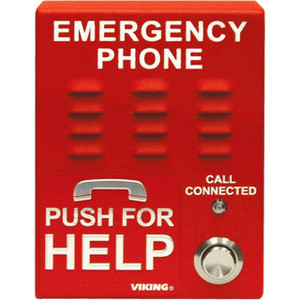
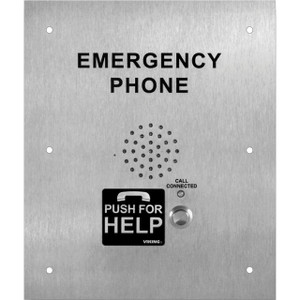
Viking Electronics E-1600A-BLT2-EWP Two-Button ADA Emergency Tower Phone with EWP
Overview
The Viking Electronics E-1600A-BLT2-EWP is a surface-mount emergency tower phone engineered for ADA-compliant outdoor and harsh-environment deployments where reliability under extreme conditions is non-negotiable. Built in high-visibility yellow steel with a red powder paint finish, this unit pairs a two-button dialer interface with a high-power LED strobe/beacon and an integrated voice announcer — giving you both visual and audible alerting in a single self-contained enclosure. It stores up to five emergency numbers, two central station numbers, and three non-emergency numbers, so a single device handles the full call-routing matrix typical of campus, parking structure, or industrial facility installations.
The E-1600A-BLT2-EWP is telephone line powered, meaning it draws no local AC or PoE — the line itself carries the current. In utility corridors, remote parking decks, or outdoor perimeter locations where running a separate power circuit is impractical or cost-prohibitive, this architecture eliminates a conduit run and a panel slot. It is one fewer failure point during a power outage, when emergency call capability matters most.
Key Features
- Enhanced Weather Protection (IP66-Rated EWP): The EWP variant uses internally-sealed push button switches, foam rubber gaskets, and sealed connections to meet IP66 standards — direct water jets and dust ingress won't compromise operation. If your installation site sees driven rain, pressure washing, or coastal humidity, the base model is the wrong choice; this variant handles all of it.
- Operating Range -30°F to 170°F: That's a genuine arctic-to-industrial-process range. Most competitive units top out at 140°F or floor at -4°F. If the enclosure sees direct sun exposure in a hot climate or sits in an unheated outdoor booth in northern winters, the thermal envelope of the E-1600A-BLT2-EWP covers it without a heater kit.
- Up to 100% Humidity Tolerance: Combined with the IP66 enclosure, this rating means condensation-heavy environments — car washes, covered loading docks, cold-storage facility entrances — won't cause corrosion or contact failure over time.
- High-Power LED Strobe/Beacon: The integrated LED strobe provides visual confirmation that a call has been initiated, critical in high-noise environments where a caller may not hear audio feedback, and essential for ADA compliance in locations frequented by hearing-impaired individuals.
- 16-Second Voice Memory: The on-board voice announcer plays a pre-recorded message when the phone is activated — directing callers to state their emergency, confirm the location, or wait for a response. Sixteen seconds is enough for a clear, multi-sentence prompt without the caller having to listen through unnecessary instructions under stress.
- Five Emergency + Two Central Station + Three Non-Emergency Numbers: The dial plan accommodates a full tiered response structure: primary and backup emergency dispatch, a central monitoring station, and department or non-emergency lines. This avoids deploying a secondary device for non-emergency contact options.
- Two-Button Interface: Simplified activation reduces caller hesitation — one button initiates an emergency call, the other handles a secondary function. In panic or low-light situations, fewer buttons means faster correct activation.
- Telephone Line Powered: No local power circuit, no UPS requirement for the phone itself. The line-powered design keeps the device operational during AC outages as long as the CO or PABX continues to supply loop current — a meaningful reliability advantage in emergency infrastructure.
- Steel Enclosure, 5.25" x 4.0" x 2.0": At under three inches deep, the surface-mount profile fits flush against a post, wall, or pedestal without protruding into pedestrian paths. The compact footprint simplifies ADA clearance compliance around the mounting surface.
Integration and Compatibility
The E-1600A-BLT2-EWP connects to standard analog telephone lines (POTS) and is compatible with on-premises PBX systems that supply a standard analog loop-current port. Programming the five emergency numbers, two central station numbers, and three non-emergency numbers is handled through the unit's internal dialer — no IP configuration, no network provisioning. For facilities that have migrated to VoIP infrastructure, confirm your FXS gateway or ATA supplies adequate loop current before deploying; line-powered devices require a minimum sustaining current that some ATA ports do not provide under load. The unit is surface-mount only — flush or recessed installs are not supported by this model.
The Viking emergency phone line integrates with central monitoring platforms via standard POTS dial-out, making it compatible with virtually any central station receiver that accepts DTMF or pulse-dial signaling. For facilities already running access control infrastructure, the tower phone can be co-located at controlled entry points to provide voice escalation when card access fails or is denied.
Frequently Asked Questions
Q: Is the E-1600A-BLT2-EWP suitable for outdoor installation in freezing climates?
A: Yes. The rated operating temperature runs from -30°F to 170°F, which covers the thermal range of nearly all North American outdoor deployments including northern Canada and high-altitude sites. No supplemental heater is required within that range.
Q: What does the EWP designation mean, and does it change the installation process?
A: EWP stands for Enhanced Weather Protection. This variant uses foam rubber gaskets, internally-sealed push button switches, and sealed connections to meet IP66 ingress protection standards. Installation is surface-mount only; the sealing is internal, so no additional weatherproofing of the enclosure itself is needed, but conduit entry points should still be sealed per standard practice.
Q: How many phone numbers can the E-1600A-BLT2-EWP store, and what types?
A: The unit stores up to ten numbers total: five emergency numbers, two central station numbers, and three non-emergency numbers. This covers primary and backup dispatch routing, monitoring station reporting, and departmental non-emergency contacts from a single device.
Q: Does this phone require a separate power supply or battery backup?
A: No. The E-1600A-BLT2-EWP is telephone line powered and draws all operating current from the connected analog telephone line. There is no AC power requirement and no local battery. The device remains operational during facility power outages as long as the telephone line or PBX continues to supply loop current.
Q: Can the voice announcer message be customized?
A: Yes. The unit includes 16 seconds of programmable voice memory, allowing a custom announcement to be recorded for site-specific instructions, location identifiers, or response prompts.
Q: Is this model ADA compliant?
A: The E-1600A-BLT2-EWP is described as ADA compliant. The two-button interface, high-power LED strobe/beacon for hearing-impaired users, and voice announcer all support ADA emergency communication requirements. Confirm mounting height and clearance requirements per your local ADA guidelines during installation.
The spec that stands out to me on the E-1600A-BLT2-EWP is the operating temperature floor of -30°F combined with the IP66 EWP build — that combination is genuinely rare at this price tier. Most analog emergency phones either skimp on the cold-weather floor or offer a basic IP54 splash rating, not a fully gasketed IP66 enclosure. For outdoor deployments in northern climates or industrial environments where the unit may see pressure washing, this pairing matters.
Technical Highlights:
- IP66 EWP Sealing: Internally-sealed switches, foam rubber gaskets, and sealed connections — this isn't a weatherproof housing slipped over a standard unit, it's a redesigned internal assembly. That distinction matters for long-term reliability in wet or dirty environments.
- Telephone Line Powered: Zero local power infrastructure required. For remote parking structures, perimeter gates, or utility access points where running an AC circuit or PoE cable adds cost and conduit runs, line-powered operation is the deployment-deciding spec.
- 10-Number Dial Plan (5 Emergency / 2 Central Station / 3 Non-Emergency): The depth of the dial plan is underappreciated. Most campus deployments need primary dispatch, a backup number, a monitoring station, and at least one facilities line — this covers all four with room to spare, so you're not adding a secondary device or a complex IVR upstream just to handle routing.
Deployment Considerations:
- Surface-mount only — confirm your pedestal or wall surface is plumb and structurally sound before ordering. There is no flush-mount or recessed option in this model; the 2.0-inch depth protrudes from the mounting surface and must clear ADA reach-range and obstruction requirements.
- Telephone line powered means you must verify loop current at the FXS port if connecting to a VoIP gateway or ATA. Some budget ATAs drop below the sustaining current threshold under load, which will cause intermittent or failed activation — test before finalizing the rough-in design.
The E-1600A-BLT2-EWP is the correct specification for outdoor emergency call stations at transit hubs, university perimeter paths, industrial plant entrances, and covered parking structures where IP66 weather resistance, ADA compliance, and power-outage survivability all have to be checked off simultaneously — and where the simplicity of a two-button, line-powered analog interface is a feature, not a limitation.