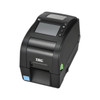
TSC TH220-A001-0001 Thermal Transfer Label Printer
The TSC TH220-A001-0001 is a thermal transfer label printer engineered for warehouse, logistics, and supply chain environments where label durability and uptime matter. It combines 203 dpi print resolution with dual-method capability—both direct thermal and thermal transfer—allowing you to choose the right label stock and ink combination for your specific application. Wi-Fi connectivity streamlines deployment without requiring dedicated network cabling, reducing installation friction on the warehouse floor.
Key Features
- 203 dpi Print Resolution: Produces sharp, machine-readable barcodes and clear text across label widths that fit shipping labels, inventory tags, and asset-tracking applications. This resolution balances readability for scanning equipment with acceptable print speed for typical warehouse throughput.
- Dual Print Method (Direct Thermal & Thermal Transfer): Direct thermal eliminates the need for ribbon inventory when label durability isn't critical—useful for short-shelf-life shipping labels. Thermal transfer with ribbon preserves label legibility in demanding warehouse conditions, preventing thermal fade on labels exposed to heat, humidity, or sunlight. This flexibility means you're not locked into a single consumable supply chain.
- Wi-Fi Connectivity: Eliminates the need for drop cables to every printer location. You gain placement flexibility to position the unit closer to pack stations or sorting lines, reducing label transport time and physical network infrastructure. Standard label design software supporting thermal printer command languages integrates with this unit.
- Label Media Compatibility: Accommodates standard label stock, supporting the widest range of label sizes and materials in the warehouse space. This prevents the need for separate printers per label format.
- Network Integration: Ethernet-like simplicity via Wi-Fi means integration with existing warehouse management systems (WMS) and label printing workflows without specialized drivers or proprietary network protocols—assuming your WMS supports generic thermal printer command sets.
- Warehouse-Ready Design: Built for shift-work environments where printers run continuously and handle variable label demand. Thermal transfer method particularly useful in facilities where labels survive repeated handling, moisture exposure, or temperature swings.
Integration & Compatibility
The TH220-A001-0001 (often searched as TH220 A001 0001) works with standard label design applications that output to thermal printer command languages. Wi-Fi allows straightforward network setup without additional network hardware, though you should verify your warehouse WLAN coverage extends reliably to the printer location—dead zones or signal dropout can cause print job delays. Confirm your label design software exports to the correct command protocol before purchase.
When to Choose a Different Model
If you need significantly faster print speeds or larger label widths than the TH220-A001-0001 supports, consider a higher-capacity variant within the TSC thermal printer family. If your facility requires Bluetooth or mobile device printing for handheld operations, look for TSC models with built-in Bluetooth chipsets. For ultra-high-resolution requirements (300+ dpi) or specialized label features, review TSC's full thermal label printer lineup to identify models with those specifications.
Deployment Considerations
Thermal transfer operation requires ribbon inventory management—factor ribbon cost and reorder cycles into your consumable planning. Direct thermal mode lets you skip ribbon management but only on compatible label stock. Verify your label supplier stocks both direct thermal and thermal transfer media if you plan to use both methods. Test label design output before full rollout to confirm command language compatibility and print quality with your specific label materials.
FAQ
Q: What's the difference between direct thermal and thermal transfer on the TSC TH220-A001-0001?
A: Direct thermal uses heat from the print head to darken specially coated label material—no ribbon needed, simpler operation, but labels fade over time if exposed to heat or sunlight. Thermal transfer uses a ribbon to transfer ink onto label material, producing durable labels that resist fading. Choose direct thermal for short-shelf-life labels; use thermal transfer for labels that need to survive warehouse handling and environmental exposure.
Q: Can I print from my mobile device or handheld scanner using the TH220-A001-0001?
A: Not directly—the TH220-A001-0001 uses Wi-Fi for network connectivity, not Bluetooth. You'll need to send print jobs through a PC or server on the same network running your label design software. If mobile printing from handheld devices is critical, check the TSC catalog for models with integrated Bluetooth support.
Q: What label widths and sizes does the TH220-A001-0001 support?
A: The printer accommodates standard label media. For exact width, length, and thickness specifications, refer to the product datasheet. Verify your label supplier can provide both direct thermal and thermal transfer stock in your required dimensions before purchase.
Q: Do I need special software to design labels for the TH220-A001-0001?
A: Any label design software that exports to thermal printer command languages (ZPL, CPCL, or equivalent) will work. Common platforms include Bartender, NiceLabel, and TSC's own label design tools. Test your software's thermal printer drivers with the TH220-A001-0001 before full deployment to ensure output quality and command language compatibility.
Q: Is the TH220-A001-0001 suitable for 24/7 continuous printing?
A: Yes—thermal printers are designed for warehouse duty cycles. However, thermal transfer operation generates ribbon waste that must be managed, and extended runs increase consumable consumption. Monitor ribbon levels and plan reorder timing based on your typical print volume.
Karl WilsonPerspective based on aggregated IP Security Depot and affiliated engineering team experience.
The TSC TH220-A001-0001 is a solid workhorse for any warehouse or fulfillment operation that needs to push out consistent label volume without chasing mechanical reliability issues. The 203 dpi resolution is adequate for most barcode and QR code applications—don't expect to print tiny, dense barcodes at readable distance, but standard shipping label barcodes and inventory tags scan cleanly across a typical scanning distance.
Technical Highlights:
- Dual Print Method: The ability to toggle between direct thermal and thermal transfer is a genuine operational advantage. Direct thermal shines when you're printing 1,000 short-shelf-life shipping labels a day and ribbon costs add up. Thermal transfer takes over when labels need to survive warehouse floor handling, ambient humidity, or package exposure. You're not locked into a single consumable economy.
- Wi-Fi Connectivity: Eliminates cable runs to the printer location, which saves installation labor and gives you real flexibility in pack station layout. Just verify Wi-Fi coverage is stable at the target location—printer dropout is frustrating. Standard thermal printer command language support means your existing label design software (Bartender, NiceLabel, etc.) integrates without surprises.
- 203 dpi Sweet Spot: This resolution trades off sharpness against speed and consumable efficiency. Adequate for Code128 and QR codes at typical warehouse scanning distances (12–18 inches). If you're printing tiny, high-density barcodes or require microscopic text for compliance labels, consider a 300+ dpi variant.
Deployment Considerations:
- Thermal transfer requires active ribbon inventory management—empty ribbons mid-shift are a showstopper. Plan consumable reorder cycles into your procurement workflow, and keep spare ribbon on-site.
- Direct thermal label stock is cheaper per unit than thermal transfer material, but only direct-thermal-coated labels work in direct mode. Confirm your label supplier stocks both variants if you plan to use both methods. Mixing them up results in blank labels and wasted time.
- Wi-Fi reliability is critical—if your warehouse WLAN has dead zones near the planned printer location, you'll face dropped jobs or timeouts. Test coverage before final placement. Ethernet would be more robust, but this model doesn't offer that option.
Best deployment fit: Multi-shift fulfillment centers and warehouse operations where label variety is high (mix of shipping labels, inventory tags, and asset tracking) and you need the operational flexibility to choose between speed (direct thermal) and durability (thermal transfer) without changing hardware. If your facility runs a single label type 24/7 at high volume, a purpose-built direct thermal or dedicated thermal transfer printer might be more cost-efficient.