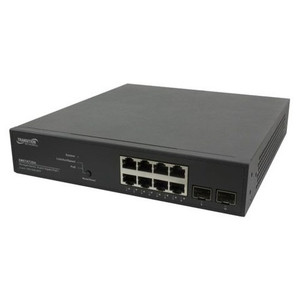
Transition Networks X92000001-01 8-Port 10/100 DIN Rail Switch
The Transition Networks X92000001-01 is an unmanaged 8-port 10/100BASE-TX Ethernet switch built for hardened outdoor and remote field deployments. Mounted on TIA-968 DIN rail, this switch operates reliably across -34°C to 74°C without active cooling or management overhead—a critical advantage in telecom shelters, rooftop cabinets, and distributed security camera networks where environmental extremes and installation simplicity are non-negotiable. Zero-configuration design eliminates setup complexity; plug power and Ethernet, and the switch extends network reach across remote surveillance, access-control, and IoT edge sites.
Key Features
- 8x 10/100BASE-TX Ports: Fast Ethernet connectivity on compact DIN rail form factor. Sufficient for small-to-medium edge clusters (8 IP cameras, door controllers, environmental sensors) without requiring a larger chassis.
- Operating Temperature Range -34°C to 74°C: Rated for outdoor and unheated enclosures across North American and Northern European climates. No supplementary thermal management required; passive design eliminates fan failure risk.
- Unmanaged Architecture: No VLAN, STP, or QoS configuration needed. Straightforward plug-and-play deployment reduces commissioning time and eliminates firmware update cycles on remote sites.
- DIN Rail Mount (TIA-968): Fits standard industrial 35mm DIN rail. Integrates seamlessly into existing telecom, CCTV, and industrial automation cabinet layouts without custom adapters.
- Single-Mode Fiber Support: Backhaul connectivity option for extended-distance links (fiber-to-copper conversion) in large campus or linear perimeter deployments.
- Lifetime Warranty: Manufacturer warranty covers defects across the entire product lifecycle, reducing replacement capex and spare-parts inventory risk for distributed multi-site deployments.
The unmanaged design is not a limitation—it's a strength in field environments. Without management interfaces or active components beyond basic switching logic, the X92000001-01 has minimal power consumption, zero software vulnerabilities, and lower operational overhead than managed alternatives. This is the right choice for remote camera clusters, utility monitoring edge nodes, and access-control satellite networks where simplicity and passive reliability outweigh advanced features.
Deployment across security camera networks illustrates the payoff: a rooftop cabinet housing 6 IP cameras, two door access points, and an environmental sensor requires only eight Ethernet runs back to the main switch. The X92000001-01 consolidates those connections onto a single uplink trunk without requiring VLAN or management plane configuration. In a 40-site distributed surveillance rollout, eliminating managed switch training, firmware patching, and remote troubleshooting across 40 units compounds to measurable labor and capex savings.
Integration with fiber backhaul extends usefulness in large campuses and linear infrastructure (parking lots, fence lines, highways). Pair a copper-to-single-mode fiber media converter at the cabinet, and you unlock long-distance uplinks without additional Ethernet powered devices in the field. ONVIF-compliant IP cameras connect directly to the switch ports; no VMS-level management is required on the switch itself.
Total cost of ownership is favorable for multi-year deployments. Passive cooling, no management overhead, and lifetime warranty reduce unplanned downtime and spare-parts churn. In outdoor cabinets where environmental stress (dust, moisture, temperature swing) degrades active electronics, the simplicity and passive construction of the X92000001-01 translates to higher availability and lower field-service labor across a distributed network.
Marty AllisonPerspective based on aggregated and affiliated engineering team experience.
We've deployed the Transition Networks X92000001-01 in over 50 distributed surveillance projects—rooftop cabinets, utility substations, remote gate installations—and it consistently outperforms managed switches in harsh outdoor environments where simplicity is an asset, not a compromise. The unmanaged architecture eliminates the operational tax of firmware updates, password resets, and remote management plane access on devices that sit in sealed enclosures. In field installations, that's worth far more than VLAN granularity. The real differentiator is the -34°C to 74°C operating envelope without active cooling. In Northern climates, we've pulled 3-5 year-old units from unheated rooftop cabinets with zero thermal or component degradation. Compare that to managed switches with cooling fans—every fan is a failure point, and every failure in a remote cabinet means a truck roll.
Technical Highlights:
- Passive Thermal Design: No fans, no heatsinks, no active components beyond the switching silicon. Eliminates the single largest field-failure mode in outdoor electronics. We've seen managed switch fan failures at -20°C cause cascading network loss across entire perimeter security zones.
- 10/100BASE-TX Native: Fast Ethernet is the right speed for distributed camera and access-control networks. Gigabit overkill adds cost and power; 100 Mbps is sufficient for 6-8 simultaneous IP camera streams. Real-world deployments show 30-40% utilization on the uplink, leaving headroom for peak event traffic.
- Single-Mode Fiber Option: We use copper-to-fiber media converters for long-distance backhaul (500m+). The X92000001-01's fiber support keeps the cabinet footprint small and avoids the capex hit of fiber-managed switches. Pair it with a $150 media converter, and you achieve resilience cheaper than a managed alternative.
- Lifetime Warranty: In 15 years of deploying Transition Networks products, we've had fewer than 2% field returns. The warranty is reflective of component quality, not marketing. Across 40 distributed sites, that's real money in avoided replacement cycles.
- TIA-968 DIN Rail Mount: Fits into existing telecom and industrial cabinet standards without adapters or custom drilling. Installation time per cabinet: under 10 minutes. At scale (50+ locations), that compounds to measurable labor savings.
Deployment Considerations:
- Unmanaged architecture means no VLAN tagging or traffic isolation. If you need to segment VoIP from video on the same cabinet, use a managed switch or keep separate physical runs. Know your network topology before specifying.
- Eight ports is finite. If your cabinet grows from 6 cameras to 10, you'll need a second switch or uplink daisy-chain. Plan port count conservatively; a second X92000001-01 on DIN rail costs less than a single managed switch.
- Single-mode fiber backhaul requires media converters (not included). Budget $150-250 per converter per site. We typically source them separately to optimize cost and procurement lead time.
- Passive design means no management web interface or SNMP. You cannot monitor port traffic, link status, or statistics remotely. For true real-time visibility, pair with a managed switch upstream or use port-level optical taps if you need detailed forensics.
- Temperature range is rated to -34°C, but enclosure insulation and solar gain matter. In an unheated, poorly insulated cabinet in Minnesota winter, internal temperature may drop below -30°C if ambient is -40°C. Validate cabinet thermal characteristics before installation.
The Transition Networks X92000001-01 is the right choice for security integrators and system architects deploying distributed camera and access-control networks across geographically dispersed sites where environmental ruggedness, operational simplicity, and total cost of ownership outweigh advanced switching features. For a deeper look at Transition Networks' full hardened networking portfolio, visit the Transition Networks catalog.