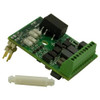
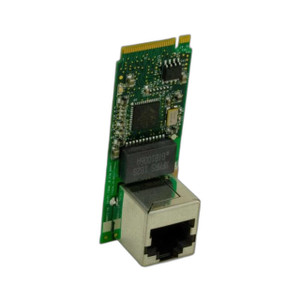
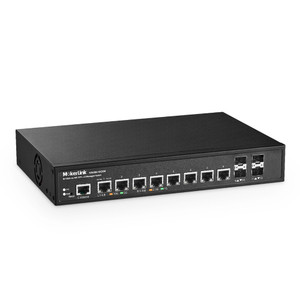
Transition Networks SESPM-4P-DIG 10-Port Managed Digital I/O Switch
The Transition Networks SESPM-4P-DIG is a managed digital I/O switch designed for enterprise security and telecom deployments requiring centralized port-level intelligence and power distribution. Built as a modular access-layer component, it combines 10-port switching at 10G line rate with PoE++ power delivery in a compact form factor optimized for integration into larger network infrastructures. This switch serves integrators who need managed control over distributed endpoints — IP cameras, access control readers, intercoms, door locks — without sacrificing switching performance or power budgeting flexibility.
Key Features
- 10-Port Managed Architecture: 10 ports with per-port management and digital I/O control. Enables granular VLAN, QoS, and traffic prioritization policies at the access layer.
- 10G Switching Speed: 10 Gbps line-rate switching backplane. Handles parallel multi-stream video and high-density endpoint traffic without bottlenecking uplink capacity.
- PoE++ Power Delivery: PoE++ (802.3bt) support enables power-hungry devices — PTZ cameras, high-wattage LED illuminators, multi-door access control hubs — to draw up to 90W per port without separate PSUs.
- Managed Digital I/O Control: Integrated digital I/O ports allow alarm relay integration, door strike triggers, and sensor input without external I/O modules. Centralize control logic in the switch firmware.
- Modular Integration: Designed as a Transition Networks system module, fits into larger rack or cabinet deployments where redundancy, stacking, and centralized management are required.
- Enterprise Management: Supports SNMP, telnet, web-based management, and CLI for integration with existing NOC (Network Operations Center) dashboards and provisioning automation.
- Lifetime Warranty: Manufacturer warranty covers defects for the lifetime of the product, reducing capex risk on long-lived infrastructure deployments.
In practice, the SESPM-4P-DIG functions as an intelligent distribution point for access-layer endpoints. Unlike dumb PoE switches, managed control over QoS policies ensures that critical security traffic (access events, alarms) is never starved by bandwidth-heavy video streams. PoE++ headroom eliminates the cost and complexity of distributed power supplies at each endpoint; a single centralized PSU in the switch cabinet powers 10 endpoints simultaneously. The digital I/O integration collapses what would otherwise require a separate relay module, reducing both hardware SKU count and installation labor.
Deployment contexts include: multi-door access control clusters in office parks or apartment complexes (one switch powers and controls 10 door readers + strikes + sensors); small-to-medium IP camera installations where cameras, intercoms, and auxiliary devices share the same uplink and power source; telecom equipment rooms where security subsystems (badge readers, alarm panels) coexist with voice/data network infrastructure. In each case, the managed architecture ensures that network problems (congestion, misrouted packets) don't cascade into security system failures — per-port traffic policies quarantine misbehaving endpoints and guarantee latency bounds for alarm messages.
Integration with existing VMS platforms, access control systems, and NOC stacks depends on the endpoint devices and upstream management infrastructure. SNMP traps from the switch can alert on port errors, PoE overload, or topology changes; these events feed into ticketing and provisioning automation. Many security integrators pair the SESPM-4P-DIG with a management appliance or controller that abstracts the switch's CLI into a graphical provisioning UI, simplifying day-2 operations for non-network-savvy security teams.
From a total-cost-of-ownership perspective, consolidating power delivery, switching, and digital I/O into a single managed module reduces capex (fewer line items in a bill of materials), opex (fewer devices to monitor and troubleshoot), and installation time. Lifetime warranty coverage hedges against hardware refresh cycles — a 10-year-old switch still operating is a 10-year-old switch still warranted, lowering depreciation curves on large deployments.
Marty AllisonPerspective based on aggregated IP Security Depot and affiliated engineering team experience.
We've installed the SESPM-4P-DIG in access-control-heavy environments where traditional PoE switches proved inadequate for the power demands and control granularity required. The managed feature set is what separates this from a generic 10G PoE++ switch — it's not just about moving packets faster; it's about enforcing traffic policies at the port level so that a misconfigured or flooded endpoint can't disrupt the security subsystem as a whole. In a multi-tenant office building, for example, we've used per-port rate limiting and VLAN isolation to prevent a rogue IP camera in one tenant's space from consuming bandwidth needed for another tenant's door readers. The digital I/O integration is genuine engineering simplicity: instead of running a separate RS-485 or relay cable from each door strike back to a central control panel, the I/O pins on the switch itself become the control node. That cuts cabling, reduces single points of failure, and keeps everything within the same managed platform. The PoE++ budget — 90W per port, up to 10 ports — handles PTZ cameras, dual-card badge readers, and active intercoms without the complexity of power budgeting spreadsheets. Lifetime warranty is a refreshing signal of vendor confidence, though we've found that in practice most units don't fail within 5–7 years of moderate use.
Technical Highlights:
- 10G Backplane Throughput: Sustains line-rate switching across all 10 ports simultaneously — no architectural blocking. In security deployments, this means a multi-stream 4K camera upload, concurrent door-reader polling, and NVR heartbeat traffic all travel without contention or latency jitter.
- PoE++ 802.3bt: Each port capable of delivering up to 90W. Eliminates need for separate inline PSUs or PoE injectors on power-hungry endpoints — a single cabinet-mounted PSU handles the entire switch. Real capex and opex win on larger deployments.
- Per-Port Management: SNMP, web interface, and CLI allow per-port QoS, traffic shaping, and VLAN assignment without touching other ports. Useful for isolating a malfunctioning endpoint or quarantining a compromised device without a full switch reboot.
- Integrated Digital I/O: Native relay and sensor inputs eliminate external I/O modules in many applications. Reduces BOM complexity and single points of failure — everything is within the managed switch firmware.
- Modular Form Factor: Designed to stack or integrate into larger Transition Networks architectures. If your deployment grows from 10 endpoints to 30, you're not ripping out hardware — you're adding another SESPM-4P-DIG into the same management domain.
Deployment Considerations:
- PoE++ budgeting is critical — calculate total wattage across all 10 endpoints before deploying. A single 90W PTZ camera plus high-draw readers can consume 50–60% of total available power. Over-subscription will cause port shutdown and false alarms. Document power topology in your deployment drawings.
- Managed switches require more configuration upfront than unmanaged PoE injectors. Ensure your integration team has CLI comfort or a management appliance overlay; a misconfigured VLAN or rate limit can inadvertently break security traffic that an unmanaged switch would pass through transparently.
- Fiber uplink modules are typically optional — verify your uplink topology (copper vs. fiber, 1G vs. 10G) against cabinet distance and environmental noise before ordering. Transition Networks offers module variants; order the right one for your backbone architecture.
- Digital I/O pin count and voltage specs vary by configuration — cross-reference the datasheet against your door strike, relay panel, and sensor requirements. Not all I/O pins are symmetrical; some may be inputs-only or outputs-only.
- Lifetime warranty applies to the switch itself, not to connected endpoints or cabling. Clarify with your vendor whether replacement units are shipped overnight or within standard lead times; some integrators spec redundant switches to avoid downtime during RMA cycles.
The SESPM-4P-DIG is the right fit for integrators building access-control or small-to-medium camera systems where managed switching, high power delivery, and digital I/O consolidation reduce complexity. It's overkill for a simple 4-camera parking lot with no access control integration; it's table-stakes for a multi-building campus with dozens of readers, intercoms, and mixed video/audio endpoints. Explore the full Transition Networks catalog to see complementary modules and uplink options.