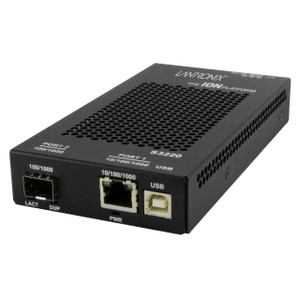
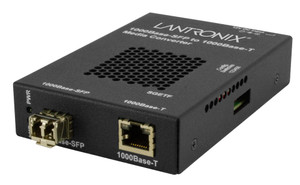
Transition Networks S3220-1040-NA Gigabit Copper-to-Fiber Media Converter
Overview
The Transition Networks S3220-1040-NA is a compact media converter that bridges copper and fiber connectivity in industrial network deployments. It converts 10/100/1000BASE-T Ethernet signals to single SFP fiber interfaces, enabling distance extension and protocol conversion in mixed-media backbone infrastructure. This is the right choice when you need to span distances beyond copper's practical limits—typically 100 meters for standard twisted pair—without replacing your existing switch or router infrastructure.
Key Features
- Gigabit Copper-to-Fiber Conversion: Supports 10/100/1000BASE-T on the RJ-45 side and standard SFP fiber modules on the opposite interface. This means you can reuse SFP transceivers you already own or select them independently based on your fiber run distance (multimode for short hops, single-mode for long distance). No proprietary module lock-in.
- Industry-Standard SFP Module Slots: Accepts any standards-compliant SFP transceiver. Flexibility matters when you're replacing failed hardware or scaling to different fiber types without swapping the entire converter.
- Industrial Temperature Range Operation: Operates reliably across wide temperature swings, making it suitable for unheated equipment rooms, field installations, outdoor cabinets, and environments with variable climate control. This eliminates the need for temperature-regulated enclosures in many deployments.
- Passive Bidirectional Conversion: Works transparently in both directions—copper-to-fiber or fiber-to-copper—without requiring asymmetric configuration. Simplifies troubleshooting and allows flexible placement in your network topology.
- Compact Form Factor: Small physical footprint minimizes rack or cabinet space consumption. In dense equipment rooms where every inch matters, this translates to cost savings on enclosure size and real estate.
- Legacy and Modern Network Integration: Compatible with any standard 10/100/1000BASE-T switch, router, or network interface card. Works alongside newer fiber-based backbone infrastructure without requiring firmware updates or compatibility negotiations.
Integration and Compatibility
The S3220-1040-NA works with any Gigabit Ethernet switch or routing equipment that provides RJ-45 connectivity. Simply connect a standard Ethernet cable from your switch port to the RJ-45 side of the converter, insert your chosen SFP module into the fiber slot, and connect your fiber patch cable. No power supply needed if your switch or inline power source supports powered RJ-45 connections; otherwise, verify external power requirements against your installation plan. Check that your fiber infrastructure (strand type, connector style) matches your selected SFP transceiver specifications.
When to Choose a Different Model
If you need multiple simultaneous copper-to-fiber conversions in a single chassis, consider a managed media converter chassis from the Transition Networks family that supports stacked modules. If your deployment requires dual SFP ports (redundant fiber paths) for failover, look for dual-fiber converter variants in the same product line. For PoE injection or power-over-fiber requirements, confirm those features are supported in the specific SFP module and converter you select—not all SFP-based converters pass PoE transparently.
Deployment Considerations
Media converters are entirely passive from a network perspective—they don't introduce latency, add hops to your routing table, or require IP addresses. This makes them ideal for transparent distance extension. However, they do not perform any protocol translation beyond the physical layer, so expect to manage SFP transceivers as separate line items in your inventory and budget. Always verify SFP module wavelength and distance rating before installing; mismatched optics will result in link failures that are hard to diagnose if you're not expecting them.
Frequently Asked Questions
Q: Does the Transition Networks S3220-1040-NA require power?
A: The converter itself operates passively and requires no external power supply. However, verify with your specific installation whether the RJ-45 side expects powered connectivity or inline power from the switch.
Q: Can I mix multimode and single-mode SFP modules in the same deployment?
A: Yes. The S3220-1040-NA accepts any standard SFP module. Use multimode for campus-distance runs (typically up to 2 km) and single-mode for longer distances (up to 40+ km). Each converter can only hold one SFP at a time, so a single unit cannot mix modes simultaneously.
Q: Is the S3220-1040-NA compatible with legacy Ethernet equipment running only 10/100 Mbps?
A: Yes. The converter supports 10, 100, and 1000 Mbps on the RJ-45 side, so it will auto-negotiate and operate at whatever speed your legacy equipment requires.
Q: What fiber connector types does the S3220-1040-NA support?
A: The converter uses standard SFP modules, which determine connector type (SC, LC, MTRJ, ST, etc.). The SFP slot itself is connector-agnostic—compatibility depends on your chosen transceiver module, not the converter.
Q: Does the S3220-1040-NA pass PoE (Power over Ethernet) from copper to fiber or vice versa?
A: No. The converter does not support PoE passthrough. If you need to power PoE devices across a fiber run, you must inject PoE on the copper side before the converter or use a separate PoE extender/repeater on the fiber side.
Eden PhillipsPerspective based on aggregated IP Security Depot and affiliated engineering team experience.
The Transition Networks S3220-1040-NA (often searched as S3220 1040 NA) is a workhorse converter for bridging copper and fiber in hybrid network backbones. What matters here is transparent operation—it doesn't introduce routing loops, doesn't consume an IP address, and doesn't require management overhead. You plug it in and it works. This simplicity is why it shows up in warehouse automation networks, security infrastructure refreshes, and industrial site expansions where you need to extend beyond the 100-meter copper limit without rearchitecting the entire switching fabric.
Technical Highlights:
- Passive Gigabit Conversion (10/100/1000BASE-T to SFP): No firmware, no configuration. The converter automatically negotiates the link speed on the copper side and presents a clean SFP interface on the fiber side. Reduces mean time to deployment and mean time to repair—if a converter fails, you swap it in under five minutes.
- Industrial Temperature Range: Operates across wide environmental swings without thermal management. Equipment rooms in older warehouses or outdoor cabinet sites often lack climate control—this converter won't become a bottleneck or failure point due to temperature stress.
- SFP Module Agnosticity: Accepts any standards-compliant SFP transceiver, multimode or single-mode, any wavelength. You control fiber distance and cost by selecting the module independently. Swap modules as your fiber infrastructure evolves without replacing the converter.
Deployment Considerations:
- PoE does not pass through the S3220-1040-NA. If your copper run carries PoE to powered devices on the far end, you must inject PoE downstream of the converter on the fiber side or use a separate PoE repeater. This is a hard constraint—plan around it.
- SFP transceiver selection is a separate purchase decision. Budget for module cost and maintain spares. Mismatched optics (wrong wavelength, wrong distance rating) will create link failures that aren't immediately obvious—verify SFP specs before field deployment.
Deploy the S3220-1040-NA when you're extending a copper backbone to a fiber segment, consolidating equipment rooms across a campus, or integrating older Gigabit switches into a modern fiber infrastructure. It's not a replacement for managed media converter chassis when you need redundancy or cross-connect flexibility, but for point-to-point fiber bridges, it's transparent and reliable.