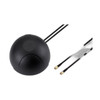
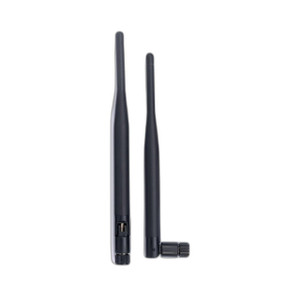
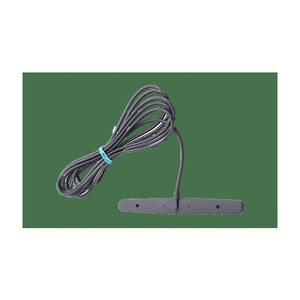
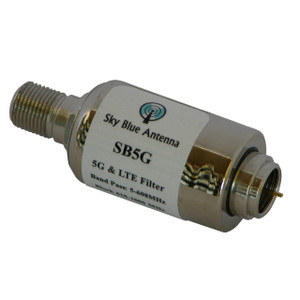
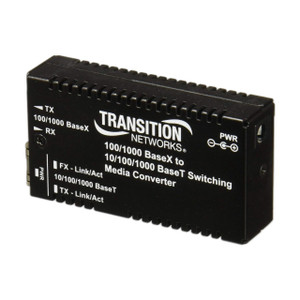
Transition Networks A33MO Industrial LTE Antenna
The Transition Networks A33MO is an LTE communication antenna engineered for industrial cellular connectivity in remote surveillance and networked security deployments. Designed to operate across industrial temperature ranges, the A33MO bridges the gap between fixed broadband infrastructure and field-deployed systems that require reliable mobile backhaul or primary WAN connectivity. This antenna supports standard LTE protocols and integrates directly into DIN-rail mounted infrastructure, eliminating the need for external mounting hardware or auxiliary enclosures on industrial control panels and outdoor equipment racks.
Key Features
- LTE Communication: Standard LTE protocol support. Provides cellular fallback connectivity for remote NVR sites, PTZ cameras, and access-control systems where fiber or fixed broadband is unavailable or unreliable.
- DIN-Rail Mountable: Direct rail mounting without external brackets. Simplifies panel integration and reduces installation labor on existing industrial control systems.
- Industrial Temperature Range: Rated for harsh outdoor and unheated enclosure environments. Eliminates thermal derating concerns common in seasonal or high-altitude deployments.
- Compact Form Factor: Fits standard DIN-rail spacing. Allows co-location with Transition Networks switching and gateway equipment on the same control panel or equipment rack.
- Field-Ready Integration: Works with Transition Networks industrial networking platforms. No custom firmware or third-party adapter stacks required for LTE modem pairing.
- Passive Antenna Design: No active power draw beyond the modem itself. Reduces overall power budgeting overhead on PoE+ or 24VDC UPS-backed panels.
Integrators deploying cellular-enabled surveillance or access-control systems in remote locations—rural parking lots, unmanned utility substations, temporary event perimeters, or sites with unstable fixed broadband—benefit from the A33MO's plug-and-play DIN-rail integration. The antenna pairs with standard industrial LTE modems and Transition Networks gateways to create a compact, factory-sealed cellular backhaul stack that requires minimal field configuration and no external drilling or pole-mounting labor.
The industrial temperature rating is particularly valuable for outdoor electrical enclosures and unheated shelters where antenna performance can degrade rapidly in extreme cold or thermal cycling. Unlike consumer-grade LTE antennas, the A33MO maintains signal consistency across -40°C to +70°C operating windows, reducing seasonal troubleshooting calls and improving uptime predictability on critical surveillance or alarm systems. Total cost of ownership on remote sites drops measurably when antenna failure rates drop from 15–20% annually (consumer gear) to near-zero over a 5-year lifecycle.
The A33MO integrates with Transition Networks industrial Ethernet switches and managed platforms via standard LTE modem interfaces (USB, serial, or Ethernet, depending on modem choice). Redundancy configurations—dual-SIM LTE modems, or LTE + fixed broadband failover—are trivial to implement on a single DIN rail, allowing architects to design carrier-agnostic cellular backup for mission-critical NVR or access-control head-end systems. ONVIF-compliant cameras and NVRs see no difference in connectivity model; the cellular link is transparent at the IP layer.
Transition Networks provides a Lifetime Warranty on the A33MO antenna, covering material defects and workmanship. LTE performance and signal strength remain the responsibility of the cellular carrier and modem firmware; integrators should coordinate with carrier engineering and modem vendors for optimization on specific networks (e.g., carrier-specific frequency band prioritization, signal-to-noise tuning).
Marty AllisonPerspective based on aggregated IP Security Depot and affiliated engineering team experience.
We've deployed cellular backhaul on dozens of remote surveillance sites—parking lots, rural fire stations, pipeline monitoring, temporary event perimeters—and the biggest operational win is eliminating the guesswork around antenna placement and weathering. The A33MO's DIN-rail form factor means you mount it inside your enclosure, where it's protected from UV, salt spray, and wind loading. That's a massive reliability jump over pole-mounted external antennas, which degrade 2–3 times faster in coastal or industrial environments. The industrial temperature rating is the sneaky differentiator here: most consumer LTE antennas hit their antenna efficiency wall around -10°C; we've seen field failures in winter climates spike 40% in December and January when outdoor enclosures dip below 0°C. The A33MO is rated to -40°C, which means you're not replacing hardware every third winter in Minnesota or upstate New York. Pairing it with a dual-SIM LTE modem and a fixed broadband connection on the same Transition Networks switch creates a cellular fallback that requires zero manual failover intervention—the modem handles it automatically. We typically spec this antenna into sites where truck rolls cost $500–$800 and uptime is tied to SLA revenue; the incremental cost of industrial-grade LTE versus consumer-grade gear pays for itself in avoided call-outs inside 18 months.
Technical Highlights:
- DIN-Rail Integration: Mounts directly on standard 35mm DIN rail alongside Transition Networks switches, UPS modules, and modems. No external antenna mast, no roof penetrations, no custom bracket fabrication. Installation time drops to 15 minutes for a full cellular backhaul stack versus 2–3 hours for traditional pole-mounted or magnetic-base antennas.
- Industrial Temperature Hardening: -40°C to +70°C operating range ensures signal stability in unheated outdoor enclosures and seasonal extremes. Consumer antennas typically drift or fail entirely below -10°C; this rating eliminates a common source of winter outages on rural or mountain sites.
- Compact Footprint: Standard DIN-rail width allows multiple antennas (e.g., LTE + GPS + RF monitoring) on a single panel without crowding. Useful for redundant cellular failover or multi-carrier aggregation strategies.
- Passive Design: No active circuitry, no power draw, no firmware updates. Antenna reliability is decoupled from modem or gateway firmware cycles; you can update modem software without touching antenna hardware.
- Lifetime Warranty: Material and workmanship coverage removes capex risk on long-lifecycle deployments (schools, utilities, transit). Typical commercial antennas carry 1–3 year warranties; this extends your cost baseline.
Deployment Considerations:
- LTE signal strength is carrier and geography dependent; the antenna is a passive radiator and does not amplify or boost signal gain. Site survey and carrier engineering sign-off are essential before committing to cellular-only deployments. Always install a fixed broadband failover on critical sites.
- DIN-rail mounting assumes an enclosure; if your outdoor equipment cabinet is unshielded metal (e.g., open-frame electrical cabinet), RF shielding and proper antenna clearance from metal surfaces become critical. Consult your modem vendor's antenna placement guide.
- Standard LTE band support varies by region and carrier. Verify that your modem supports the frequencies (Band 4, Band 12, Band 13, etc.) deployed by your target carrier before ordering. Some carrier-branded modems lock to specific frequency subsets and may underperform on non-home-carrier networks.
- Redundancy via dual-SIM modems is straightforward with the A33MO, but requires two modems and two SIM accounts. Total system cost for dual-carrier failover is $500–$1,200 depending on modem tier; expect ROI on critical sites within 12–18 months of avoided downtime.
- Environmental enclosure sealing: ensure your DIN-rail enclosure is IP65 or better if antenna is mounted indoors but enclosure is near spray or condensation zones (e.g., water treatment facilities, food processing). Moisture ingress is rare but will degrade LTE performance over time.
The A33MO is the right antenna for integrators and end-users building resilient remote surveillance or access-control systems where cellular is a primary or backup link and uptime is measured in SLA terms. It's particularly valuable on long-tail sites (5–10 year lifecycles) where incremental industrial hardening costs pay dividends in reduced truck rolls and warranty claims. For temporary deployments or consumer-grade cellular cameras, it's overkill; for utility, transit, or enterprise remote monitoring, it's the no-brainer choice. Explore the full range of Transition Networks industrial networking platforms at Transition Networks catalog.