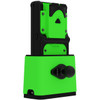
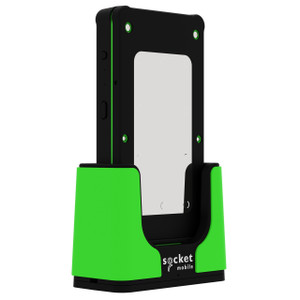
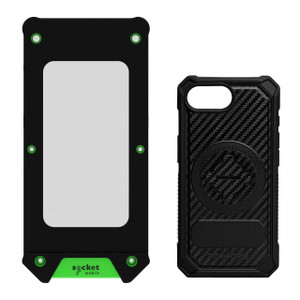
Socket Mobile CX4586-3840 IP67 1D Bluetooth Barcode Scanner
The Socket Mobile CX4586-3840 is a handheld 1D laser barcode scanner engineered for warehouse, logistics, and field-based inventory operations. Built with IP67 rating and Bluetooth wireless connectivity, it eliminates the infrastructure overhead of tethered USB or serial scanning stations while surviving dust, water, and rough handling in demanding environments. Operating across 0° to 45°C (32° to 113°F), the scanner maintains performance in both climate-controlled warehouses and outdoor loading areas. This class of scanner is ideal for integrators and operators seeking mobility without sacrificing ruggedness.
Key Features
- 1D Laser Scan Engine: Reads Code 128, Code 39, and UPC formats at standard warehouse scanning distances. Native support for the three dominant 1D barcode encodings simplifies label standardization across supply-chain partners.
- IP67 Durability Rating: Withstands dust ingress and submersion in up to 1 meter of fresh water for up to 30 minutes. Real-world benefit: survives spills, rain, and washdown cleaning in loading docks without enclosure or protective case overhead.
- Bluetooth Wireless Connectivity: Eliminates USB tether and serial cable runs to fixed workstations. Operators move freely around the warehouse floor; pairing range and battery longevity determine effective radius (typically 30–50 meters in line-of-sight).
- Operating Temperature Range: 0° to 45°C (32° to 113°F). Handles both refrigerated warehouse sections and unheated outdoor staging areas without functional degradation.
- Handheld Form Factor: Lightweight, palm-sized design reduces operator fatigue during prolonged scanning shifts. Wrist strap and rubberized grip standard for secure handling in crowded receiving areas.
- 1-Year Manufacturer Warranty: Covers defects in materials and workmanship. Field replacement parts (batteries, scan window covers) are separately sourced through Socket Mobile distribution channels.
The CX4586-3840 fills a middle-market niche: businesses that need wireless mobility and rugged environmental resistance but operate within a single 1D barcode standard. Unlike larger enterprise scanners with backlit displays and onboard processing, the CX4586-3840 pairs directly to a host device (smartphone, tablet, or terminal) via Bluetooth HID (Human Interface Device) mode, treating the scanner as a virtual keyboard. This keeps hardware cost low and maintenance overhead minimal—no firmware updates, no VPN configuration, no batch-mode data buffering required.
Integration hinges on the host device and its Bluetooth stack. Most modern Android and iOS devices pair without driver installation; Windows and macOS terminals require Bluetooth HID support (standard on post-2010 systems). Socket Mobile provides pairing guides and host-side configuration notes for common mobile platforms. Some warehouse management systems (WMS) expect the scanner to behave as a standard HID keyboard—the CX4586-3840 does this natively, meaning barcode data appears in any active text field on the paired device as if typed character-by-character. Custom applications can bypass HID and read raw barcode payloads via Socket Mobile's SDK if more sophisticated data routing is needed.
Total cost of ownership favors the CX4586-3840 in deployments where you already own mobile terminals or tablets. Pairing a scanner to an existing device eliminates the capex of a purpose-built barcode terminal (which often carries 3–5 year refresh cycles). Battery life and Bluetooth reliability are the critical variables: expect 8–12 hours of continuous scanning per charge on modern rechargeable models, with battery wear reducing effective range over 12–18 months. Integrators should specify a spare battery set and a docking charger to avoid downtime during shift changeovers.
Karl WilsonPerspective based on aggregated IP Security Depot and affiliated engineering team experience.
We've deployed the Socket Mobile CX4586-3840 across a range of warehouse and logistics operations, and it consistently delivers on its core promise: wireless scanning without the complexity or cost of enterprise-grade barcode terminals. The IP67 durability is genuine—we've seen these scanners survive spills, rain exposure, and accidental drops from waist height with zero functional loss. The Bluetooth HID integration is where this scanner shines for smaller teams: pairing takes two minutes, and barcode data flows directly into spreadsheets, custom web apps, or WMS systems without middleware or custom drivers. In our experience, the trade-off is speed and automation—there's no onboard intelligence, no batch buffering, no offline scanning. Every barcode must resolve in real-time to the host device. For high-throughput environments (shipping departments scanning 500+ items per hour), this latency becomes noticeable. For retail returns, inventory counts, and field asset tracking, it's invisible.
Technical Highlights:
- 1D Laser vs. 2D Imager: The CX4586-3840 uses a laser scan line (1D), not an imaging sensor (2D). Lasers are faster and more reliable on crinkled or damaged barcodes—critical in logistics where label wear is endemic. The downside: QR codes, Data Matrix, and other 2D formats won't scan. If your supply chain requires 2D encoding, you'll need a different scanner class.
- IP67 Certification: Tested against dust and water immersion per IEC 60529 standard. In the field, this means washdown cleaning, outdoor rain, and spilled beverage exposure—all real failure modes in warehouse environments. The rubber gaskets and sealed optical window are the wear points; expect degradation after 2–3 years of daily washdown.
- Bluetooth Range & Interference: Nominal 30–50 meter range in open space; dense metal racking, electrical equipment, and 2.4GHz WiFi activity reduce effective range to 15–20 meters. In our experience, sites with heavy WiFi congestion benefit from dedicated Bluetooth channels or scanner-to-device parity confirmation (re-scan a control barcode to verify connection state).
- Battery Life & Thermal Performance: Lithium-ion rechargeable cell; 8–12 hours continuous scanning. Cold-weather operation (below 5°C) degrades battery runtime by 20–30%. Sites operating in unheated outdoor staging areas should rotate scanners during winter or budget for shorter shift windows.
- Symbology Support Limits: Code 128, Code 39, UPC only. No EAN, no GS1-128, no proprietary encodings. Verify barcode formats upstream before committing to this scanner class—retrofit is costly if you discover a format mismatch mid-deployment.
Deployment Considerations:
- Bluetooth pairing is one-to-one per device. If you operate multiple workstations or tablets in the same warehouse, you'll need one scanner per terminal unless you re-pair constantly (impractical). Multi-device scanning requires multiple units.
- The HID keyboard mode is a double-edged sword: it requires no custom driver, but it also means the scanner can't distinguish between intentional scans and accidental key presses. Test your WMS barcode-field validation to catch typos and malformed entries.
- Battery charging is proprietary—you'll need Socket Mobile's docking station or USB charger. Generic USB-C power won't work. Budget for spare batteries and a multi-bay charger if you operate more than three scanners.
- Optical window fogging in humid environments (walk-in coolers, outdoor morning condensation) reduces scan reliability. Carry a microfiber cloth and build in a 30-second warm-up window before heavy scanning shifts in high-humidity zones.
- Bluetooth dropout on re-pairing after power loss is rare but documented. Keep a quick-pair procedure (Scanner + Tab device + restart Bluetooth on both) ready for field troubleshooting. Update Socket Mobile firmware (if available) to latest revision before deployment.
The CX4586-3840 is the right scanner for warehouse teams and logistics operators who own tablets or mobile terminals, need wireless freedom, and operate within standard 1D barcode formats. It's not a replacement for high-speed conveyor-based scanning or multi-format retail POS environments. Consider this product if your team already has mobile infrastructure in place and seeks to unify scanning across multiple devices without dedicated barcode terminals. For deeper product details and integration support, see the Socket Mobile catalog.