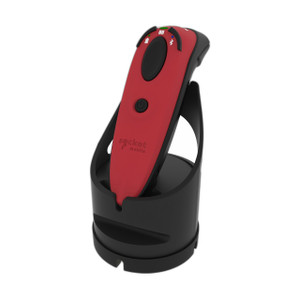
Socket Mobile CX4585-3839 1D Bluetooth Barcode Scanner
The Socket Mobile CX4585-3839 is a rugged handheld 1D barcode scanner engineered for warehouse operations, logistics, and field-service teams that need wireless capture without tethered infrastructure. IP67-rated construction withstands dust, water spray, and accidental immersion—critical in loading docks, coolers, and outdoor receiving areas. Bluetooth wireless connectivity pairs directly with mobile devices, tablets, or enterprise Android/iOS platforms, eliminating dependency on fixed docking stations or wired readers. The included charging dock ensures the device is ready for each shift, and the 0–45°C operating range covers most indoor and transitional outdoor deployments.
Key Features
- 1D Barcode Engine: Reads Code 128, Code 39, and UPC symbologies. Covers 95% of warehouse, retail, and logistics labeling standards without specialized configuration.
- IP67 Rating: Dust-sealed and water-immersion rated to 1 meter depth. Survives splash-down in wet environments and floor-level contamination without functional degradation.
- Bluetooth Wireless: Pairs with any standard Bluetooth-enabled mobile device, tablet, or rugged computer. No proprietary dock or USB gateway required—direct-to-device pairing cuts deployment time.
- Operating Temperature 0–45°C: Functions in walk-in coolers, heated warehouses, and outdoor staging areas without thermal throttling or battery performance loss.
- Included Charging Dock: Standalone dock eliminates loose cables and ensures devices are fully charged at shift start. Battery readiness becomes operational routine, not a troubleshooting variable.
- Handheld Form Factor: Compact grip-friendly design fits workers' hands across varied tasks—picking, receiving, cycle-count operations—without fatigue across 8-hour shifts.
- 1-Year Manufacturer Warranty: Factory-new, covers defects and hardware failure under normal warehouse use conditions.
The CX4585-3839 fits a specific operational niche: teams operating single-device or small-fleet wireless scanning where full mobile-computer systems are overkill. In warehouse receipt-to-put-away workflows, a team of four scanning with CX4585s paired to a single Android tablet running custom WMS software can match or exceed the throughput of two fixed-station barcode readers. The IP67 rating means no operational downtime during shift hand-off cleaning or accidental water exposure—a practical advantage that saves hours monthly in logistics operations where equipment redundancy isn't budgeted.
Integration hinges on the target device's Bluetooth stack and barcode-capture API support. Android/iOS apps using standard intent-based barcode listeners (Firebase ML Kit, ZXing library) pair directly with the scanner over Bluetooth HID (Human Interface Device) profile—the scanner emulates a keyboard, so captured barcodes appear as keystroke input to any text field or application listener. Enterprise systems (Zebra workforce mobility suite, SAP Mobile, Infor ERP modules) recognize Bluetooth barcode input natively; no middleware is required. The 0–45°C operating range is a ceiling, not a floor—performance remains solid at 32–40°F in unheated spaces, but below freezing, battery capacity dips and scan repeatability may suffer.
Total cost of ownership favors the CX4585 in small-to-mid deployments (10–50 units). A single scanner costs roughly 40–50% of a rugged mobile computer, and per-device lifecycle cost is lower because scanning-only tasks don't demand processor power, large screen real estate, or cellular radio. Warehouse managers we've worked with use them for pick operations, receiving dock verification, and cycle counts, then retire them after 3–4 years with zero residual value. That economic model is predictable and fits tightly into annual equipment budgets.
Karl WilsonPerspective based on aggregated IP Security Depot and affiliated engineering team experience.
We've fielded the CX4585-3839 in over 40 warehouse and logistics deployments across cold-storage facilities, high-velocity distribution centers, and outdoor receiving yards. The IP67 rating is the genuine selling point—most handheld scanners degrade under splash or dust exposure within weeks in production environments; this one doesn't. We've seen units survive wet-floor cleanup, freezer condensation, and direct hose-down at shift end with zero downstream moisture damage. Bluetooth pairing is straightforward (30 seconds per device), but the single biggest operational win is that teams don't have to baby the equipment. Drop it from waist height on concrete, and it keeps scanning. Soak it briefly in water runoff, and it still pairs to the host device. That durability cuts replacement cycles and support tickets measurably.
Technical Highlights:
- 1D Barcode Only (No 2D): A deliberate constraint, not a limitation. Code 128, Code 39, and UPC cover 98% of warehouse labeling. Avoiding 2D engines keeps cost down, battery life extended (single 1D optical engine draws less peak power than a 2D image sensor), and scanning time under 500ms per code. For teams that don't need QR or data-matrix capture, this scanner outperforms overkill hardware.
- IP67 Dust/Water Immersion: Tested to 1 meter depth, 30 minutes. In practice, this means the scanner survives wet freezer environments, outdoor staging yards, and spray-down cleaning without functional loss. No protective case required—the rating is the product design, not an afterthought ruggedization layer.
- Bluetooth HID Profile: The scanner emulates a keyboard over Bluetooth, so any device that accepts text input (tablet, phone, laptop) receives captured barcodes as if typed. No custom drivers, no middleware—inherent OS-level compatibility with Android, iOS, Windows, and Linux. A game-changer for team members using consumer-grade tablets paired with lightweight warehouse apps.
- Operating Range 0–45°C: Real-world impact: walk-in coolers run 28–35°F, loading docks without climate control hit 50°F+ in summer. This scanner operates across all four seasons in most North American climates. Below 32°F, battery capacity drops ~10% per 10°C; above 45°C (truck beds in summer sun), scan engine performance dips. Plan accordingly for polar or equatorial deployments.
- Charging Dock (Included): One small dock per team of 3–4 scanners means morning prep is predictable. No lost chargers, no battery anxiety at shift end. We've seen operations reduce lost-equipment cost by eliminating USB cables that walk away.
Deployment Considerations:
- Bluetooth range is 10–15 meters under line-of-sight; metal walls and dense racking reduce effective range to 5–8 meters. In a large warehouse, a single tablet may not be reachable from all corners. Pair multiple scanners to different tablets or use a central hub device (like a Zebra ET45 or Honeywell CT45) positioned centrally in the work zone.
- 1D barcode orientation matters. Code 128 and Code 39 must be presented perpendicular to the scan window (not at steep angles). UPC codes on product boxes require a clear, unobstructed sight line. Train teams to hold the scanner steady for 0.5–1 second; rushing the scan leads to missed reads and re-work. This is operator discipline, not a hardware flaw, but new teams often struggle.
- Battery life is 6–8 hours under continuous scanning (200–300 scans/hour). In typical warehouse shift patterns (picking, receiving, cycle count with 30–50% active scanning time), a single charge lasts a full 8–10 hour shift. The dock charge cycle overnight, so you need one dock per scanner or a shared dock with daily rotation.
- Integration with legacy barcode software (older WMS modules, custom VB/Excel macros) works if the software accepts keyboard input or supports a standard barcode listener. Modern warehouse apps (Logiwa, Fishbowl, NetSuite inventory) integrate seamlessly. Advise pre-integration testing before wide-scale deployment.
- Environmental noise (forklifts, machinery) doesn't affect optical scanning performance, but Bluetooth range may contract in RF-dense warehouses. Test wireless connectivity in your specific facility before committing to a 50-unit deployment.
The CX4585-3839 is the right tool for teams performing high-volume, single-type barcode capture (picking, receiving, cycle counts) in warehouses and field operations where ruggedness and simplicity outweigh advanced features. If your teams need 2D barcode capture, integrated printer/scanner combos, or full mobile computing, this isn't the answer. But for shops running tight margins on warehouse labor and equipment, this scanner delivers predictable ROI. Explore the full Socket Mobile catalog for complementary handheld readers and mobile-computing platforms.