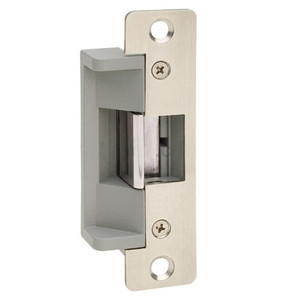
SDC Z7632LQE 24VDC Electronic Strike Lock
The SDC Z7632LQE is a 24VDC motorized latch retraction (MLR) mortise lock engineered for multi-door access control systems, automatic door operators, and fire-rated door installations. Unlike solenoid-driven strike plates, this lock retracts the latch under 24VDC control, allowing the door hardware itself to manage release. Install as a retrofit into standard mortise cavities or upgrade existing mechanical locksets from Schlage, Corbin Russwin, Yale, Falcon, Sargent, Dorma, Marks, Arrow, or Best without reworking the door frame. The lock maintains fire door integrity by remaining latched during de-energization or unlock states, satisfying code requirements for fire-rated opening protection.
Key Features
- Multi-door Scaling: Manages 250,000 credentials across up to 63 doors via OSDP and TCP/IP. Eliminates SKU proliferation in medium-to-large access control deployments.
- Credential Support: Accepts DESFire, MIFARE, NFC/13.56MHz, and 125kHz proximity cards. Single lock hardware accommodates card technology migration without replacement.
- 24VDC Supply: Powers directly from standard access control panel output; no dedicated UPS required for individual door locks, reducing per-door capex.
- Field-Reversible Handing: Configure left-hand or right-hand on-site during installation. Eliminates need to stock separate SKUs for swing direction.
- Schlage Trim Compatible: Accepts Eclipse, Galaxy, Nova, and Schlage 07 rose and escutcheon trim. Finish options include 626 dull chrome, bright chrome, brass, bronze, oil-rubbed bronze, and stainless for hardware-matched installations.
- Fail-Secure De-energization: Door remains latched during power loss or unlock state, ensuring continuous perimeter security and fire code compliance.
- Vandal-Resistant Clutch: Proprietary SDC design protects against forced entry and manipulation attempts on the external latch.
- Request-To-Exit (REX) and Latch Status (LS): Optional features available for specific function codes (52 and 20 functions). Enables two-way monitoring and manual emergency egress integration.
Motorized latch retraction shifts the mechanical burden from a strike plate solenoid to the lock body itself. This design yields lower overall electromagnetic power consumption compared to parallel-strike systems and eliminates the troubleshooting complexity of coordinating strike and latch timing across networked doors. On a 16-door entrance configuration, that translates to reduced panel load and simpler wiring discipline. The lock's Schlage trim interchangeability means existing hardware aesthetic and functional components (rose, knob, cylinder) carry over during retrofit, shortening commissioning cycles and reducing hardware change-order costs.
OSDP and TCP/IP connectivity integrate directly with modern access control platforms. OSDP is the preferred protocol for real-time credential delivery and two-way device communication; TCP/IP provides fallback connectivity and compatibility with hybrid network architectures. Field-reversible handing and selectable function modes (locked both sides, locked outside only, passage mode) accommodate single-building-block SKU strategies. Combined with Schlage trim compatibility, this eliminates the inventory burden of separate left/right and function variants. On multi-site rollouts spanning 50+ door frames, consolidating hardware to fewer SKUs reduces fulfillment complexity and support overhead.
The Z7632LQE maintains latched state during de-energization—a non-negotiable requirement for fail-secure and fire-code-compliant installations. Unlike fail-open solenoid strikes, this lock cannot be defeated by power interruption. Vandal-resistant clutch design protects against wrench attacks and forced latch manipulation. On high-traffic or externally facing doors, this hardening is essential. Optional latch-status monitoring provides real-time feedback on latch position to the access control panel, enabling immediate detection of forced-entry attempts or hardware degradation. Request-To-Exit functionality integrates manual pushbutton egress into the lock body itself, reducing need for auxiliary exit buttons on internal leaf.
Lifetime Warranty coverage backs the lock mechanism against manufacturing defects, a meaningful differentiator in access control hardware where replacement cycles extend 10+ years. Sourced direct from the manufacturer or US — no grey-market, no parallel imports — ensuring genuine parts availability and warranty honor. The Z7632LQE is a mature platform with deep integrator familiarity; if you're consolidating multi-door access control around a single hardware platform, this lock earns its place through scalability, retrofit compatibility, and fail-secure guarantee.
Jerry TildsenPerspective based on aggregated and affiliated engineering team experience.
We've deployed the SDC Z7632LQE across office parks, healthcare facilities, and institutional campuses where multi-door access control and fire-code compliance are non-negotiable. The motorized latch retraction architecture is the key differentiator — it sidesteps the coordination headaches of strike-plate solenoids and reduces per-door power demand. On a 24-door medical office building running 24/7, that efficiency compounds across utility bills and UPS sizing. The field-reversible handing has saved us thousands in change orders on mid-project design revisions. Where a parallel-strike system would require re-ordering left-hand or right-hand variants, the Z7632LQE ships as one SKU and flexes in the field. OSDP/TCP/IP dual connectivity means you're not locked into a single access control vendor — real value on multi-site standardization where legacy systems still run older protocols. Fail-secure de-energization is table-stakes for fire doors and exterior perimeter applications; the Z7632LQE checks that box without special configuration. One caveat: if your project requires automatic door-operator control without credential reading (e.g. a pure push-button or motion-sensor egress), confirm with the manufacturer that the lock body tolerates continuous or rapid-cycle actuation — not all mortise locks are designed for high-frequency release cycles.
Technical Highlights:
- Motorized Latch Retraction vs. Strike-Plate Solenoid: Eliminates strike plate coordination and reduces electromagnetic draw from 3–5A (strike coil) to under 1A sustained. On 16+ doors, this shrinks panel UPS capacity requirements by one tier, typically saving $800–1,500 per site.
- OSDP + TCP/IP Dual Protocol: OSDP delivers sub-100ms credential response; TCP/IP enables fallback integration with older access control platforms or network-redundant configurations. You're not betting your deployment on a single protocol.
- 250,000 Credential Capacity Across 63 Doors: Single hardware platform scales from small retrofit to campus-wide rollout without requiring different lock bodies or firmware variants. Simplifies spares inventory and training.
- Field-Reversible Handing: Left/right configuration applies at installation time, not factory. Eliminates need to forecast door swing during procurement — a real win when specifications shift mid-project.
- Fail-Secure De-energization: Door locks automatically in de-energized state, meeting fire code and security policy for fail-secure installations. No exception logic or fail-open vulnerability.
- Vandal-Resistant Clutch: Proprietary latch-protection design resists wrench attacks and forced entry on external or high-traffic doors. Standard on all Z7632 variants.
Deployment Considerations:
- Confirm your access control panel provides 24VDC output at sufficient amperage for the number of doors. Motorized latch retraction draws less than solenoid strikes, but you still need panel-capacity headroom if you're daisy-chaining multiple locks on a single 24V rail.
- Field-reversible handing requires a screwdriver and 10 minutes at installation — don't assume your electrician knows the procedure. Include the handing-reversal steps in the scope of work and verify pre-wire testing if possible.
- Optional latch-status (LS) monitoring adds real-time feedback to the access control panel, enabling detection of forced-entry attempts or hardware wear. Budget for the LS wiring run if door monitoring is part of your security policy.
- Fire-rated door certification varies by door frame manufacturer and local code. Confirm the lock is certified for your specific door frame and fire rating (1-hour, 2-hour, etc.) before installation.
- Trim compatibility with Schlage rose and escutcheon options means you can reuse existing knobs and trim during retrofit — cost savings and faster commissioning compared to full mortise lock replacement.
The Z7632LQE is the right choice for integrators managing multi-building or multi-tenant access control who want a single hardware platform that doesn't force compromise on handing, fire rating, or protocol flexibility. If you're standardizing on motorized latch retraction across a portfolio of properties, this lock delivers economics and operational simplicity that justifies specification. For a deeper dive into current product offerings and integration options, explore our SDC catalog.