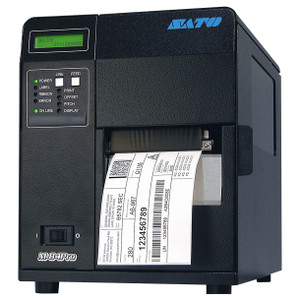
SATO M84Pro WM8430131 305dpi Industrial Thermal Printer
The SATO M84Pro WM8430131 is an industrial-grade thermal transfer printer engineered for high-volume label production in logistics, manufacturing, and warehouse environments. With 305 dpi resolution, 10 ips print speed, and a 4.1" maximum print width, it delivers sharp barcode and text output on media rolls up to 8.6" diameter. The printer supports both direct thermal and thermal transfer modes, enabling flexible media selection without hardware reconfiguration—critical for operations that balance cost (direct thermal) with durability (transfer + ribbon).
Built on proven metal-frame industrial construction, the M84Pro balances reliability with operational simplicity. The 3.5" color LCD provides clear feedback during job submission and diagnostics. Tool-free printhead and platen roller replacement, combined with field-swappable printheads for 203/305/609 dpi, means maintenance intervals extend and technicians spend less time on mechanical service calls. This printer targets integrators and end-users running 24/7 label operations where downtime directly impacts fulfillment metrics.
Key Features
- 305 dpi Resolution at 10 ips: Barcode readability and text sharpness suitable for GS1 compliance; 10 ips throughput keeps label stacks moving in high-volume shipping and sorting operations.
- Dual Print Modes (Direct Thermal & Thermal Transfer): Direct thermal for short-lived warehouse labels; thermal transfer for durable barcode tags and asset labels exposed to heat or chemical solvents.
- Field-Changeable Printheads (203/305/609 dpi): Swap resolution on-site without vendor service calls—useful when switching between density grades (e.g., tight QR codes vs. large shipping barcodes) across product lines.
- Large Media Capacity: 8.6" roll diameter and 1,968 ft (600 m) ribbon capacity reduce changeover frequency in continuous-duty environments; media width range 1" to 4.5" covers everything from small tags to full-width shipping labels.
- 16 MB SDRAM + 2 MB Flash Storage: Sufficient memory for typical label templates and barcode fonts; 2 MB user storage holds custom logos and forms without requiring frequent USB updates.
- Multi-Interface Connectivity: USB 2.0, Ethernet, RS-232C, and parallel ports ensure integration with legacy host systems and modern network-based label servers (WMS, TMS, ERP drivers).
- Tool-Free Maintenance: Printhead and platen roller swap without wrenches or screwdrivers—reduces mean time to repair (MTTR) and training burden on warehouse technicians.
- Industrial Operating Range: 41°F to 104°F (5°C to 40°C) covers most warehouse environments; AC 100-240V universal input adapts to regional power standards.
The M84Pro fits deployments where label output volume justifies dedicated infrastructure. Unlike compact desktop printers, it trades footprint for roll capacity and thermal stability. Its modular printhead design supports multi-site roll-out: purchase one chassis, stock 203/305/609 dpi heads, and avoid model-specific inventory. The combination of ethernet (for central print queue management) and USB (for operator overrides) reflects real-world mixed environments where both network printing and standalone operator submission matter.
Integration with Sato drivers for Windows-based label design software is straightforward; most WMS and TMS platforms (Manhattan, JDA, Infor) ship with native M84Pro PPD files. Ethernet connectivity enables SNMP monitoring of supply levels (ribbon, media) and print-job queuing across warehouse zones. Direct thermal mode lowers total cost of consumables but produces labels readable for 6–12 months; thermal transfer + premium ribbon extends barcode legibility to 2+ years—relevant for asset tags that must survive multiple scan cycles and environmental exposure.
The 1-year manufacturer warranty covers printhead and platen defects under normal industrial use. No NDAA or Section 889 compliance mandates apply (non-government procurement). Choose this printer when your site runs 100+ labels per hour, requires dual thermal modes, and wants field-serviceable printhead options to reduce lifecycle service costs. The 305 dpi / 10 ips combination is the sweet spot for retail-ready barcodes and manufacturing lot codes; don't overspec to 609 dpi unless your label surface is smaller than 1" or you're printing QR codes at thumbnail scale.
Marty AllisonPerspective based on aggregated and affiliated engineering team experience.
We've deployed the M84Pro WM8430131 across fulfillment centers, manufacturing facilities, and third-party logistics networks where label throughput and reliability matter equally. The key operational win is the dual-mode printhead swap—most facilities we work with don't want to buy and maintain two printers (one direct thermal, one transfer). The M84Pro eliminates that capex and operational headache. On a 500+ label-per-hour dock, the tool-free printhead and platen replacement means a technician can perform maintenance in under 3 minutes without calling vendor support. We've seen this reduce unplanned downtime from 45 minutes (waiting for service) to 10 minutes (operator swaps consumables). The field-changeable resolution is less commonly exploited but valuable when a site runs mixed SKUs—switch from 305 to 203 dpi for large shipping labels, back to 305 for small item QR codes. No hardware reconfiguration.
Where the M84Pro falls short: memory is tight. 16 MB SDRAM is adequate for label templates but not for heavy-duty image graphics or extensive font libraries. Sites with highly complex label designs (photo backgrounds, multi-language layouts) should test templates before committing. We also recommend ethernet deployment over parallel or RS-232C—ethernet enables centralized print queuing, supply monitoring, and driver updates across multiple printers. USB works for operator overrides in a pinch, but don't rely on it as your primary transport for high-volume label centers.
Technical Highlights:
- 305 dpi Resolution: Sharp enough for GS1-128 barcodes and small text (<0.1" height); 10 ips speed is moderate-to-high for label finishing operations. If you need 609 dpi, field-swap the printhead on-site—no chassis swap.
- Dual Thermal Modes (Direct + Transfer): Direct thermal runs 5–10¢ per roll for media; thermal transfer adds 15–25¢ per label (media + ribbon). We've seen single-site deployments justify both modes: direct thermal for short-lived bin labels, transfer for durable barcode tags that ride through multiple handling cycles.
- 16 MB SDRAM + 2 MB Flash: Sufficient for 50–100 label templates depending on graphic complexity. User storage (2 MB) holds custom logos and bitmaps; fonts are pre-loaded. Don't expect to store video or high-res photography in flash.
- 1,968 ft Ribbon Capacity: On thermal transfer at 10 ips, a full spool prints roughly 6,000–8,000 labels (4" width, average) before ribbon change. Reduces changeover labor on 24/7 lines.
- Multi-Interface (Ethernet, USB, RS-232C, Parallel): Ethernet is the right choice for WMS integration; USB handles operator overrides; RS-232C and parallel are legacy fallbacks—rarely used in new builds.
Deployment Considerations:
- Test label templates with your WMS driver before full rollout. Label formatting bugs often surface during pre-production runs, not in the printer's fault domain but in driver configuration. Allow 1–2 days of tuning.
- Ethernet deployment requires network drop and DHCP or static IP configuration. Work with your IT/OT team on vlan isolation and firewall rules—label printers don't need internet egress but do need internal network access to print servers.
- Operating temperature range (41°F to 104°F) is suitable for climate-controlled warehouses but marginal for unheated outdoor shipping bays or freezer environments. If your dock is <40°F in winter, specify external heating around the printer or reduce print speed to allow ribbon/media to stabilize.
- Media roll diameter (max 8.6") is a physical constraint—if your label stock comes on larger spools, you'll need to rewind or source narrower media. Confirm media width (1"–4.5" range) and core size (typically 1.5" or 3") before ordering consumables.
- Tool-free printhead swap is real, but requires operator training—show your team the procedure once, then rotate responsibility. Misaligned printheads cause horizontal streaks or dropouts; laminated quick-reference cards at the printer help.
This printer is purpose-built for mid-to-large fulfillment operations and manufacturing lines where label reliability and uptime directly affect throughput. If your site runs <50 labels per hour, consider a compact desktop model instead. For 100–1,000 labels/hour across multiple SKUs and thermal modes, the M84Pro's field-serviceable design and dual-mode flexibility justify the footprint. See the SATO catalog for alternative models and supplies.