QNAP TVS-1282-I5-16G-450W-US 12-Bay High-Performance NAS Appliance
Overview
The QNAP TVS-1282-I5-16G-450W-US is a 12-bay NAS appliance built around a 6th Generation Intel® Core™ i5-6500 quad-core processor running at 3.2 GHz — enough headroom to handle simultaneous video transcoding, snapshot replication, and active virtualization workloads without the latency penalty you get from low-power ARM designs. With 16 GB of DDR4 pre-installed and a 64 GB ceiling across four UDIMM slots, this unit scales memory to match growing workloads rather than forcing a hardware replacement cycle. If you're sizing a NAS storage appliance for a mid-sized business, a post-production suite, or a multi-user surveillance archive, the TVS-1282-I5-16G-450W-US is worth a close look.
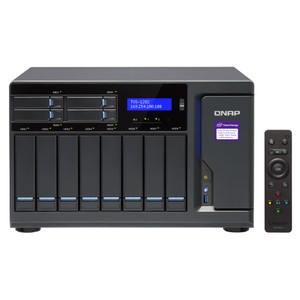
The drive bay configuration — 8 × 3.5-inch bays for high-capacity spinning media plus 4 × 2.5-inch bays for SSDs — lets you architect a tiered storage pool: fast SSD cache or hot-tier data on the 2.5-inch bays, bulk RAID storage on the 3.5-inch bays. All 12 bays run SATA 6 Gb/s (with 3 Gb/s fallback), so you're not bottlenecked at the interface. Explore the full QNAP NAS lineup to compare this unit against channel-count and CPU variants in the TVS series.
Key Features
- Intel Core i5-6500 3.2 GHz Quad-Core CPU: Four physical cores at 3.2 GHz means the NAS can run QNAP's built-in virtualization station, container station, and active directory services concurrently without CPU queuing. On ARM-based NAS units, stacking these services degrades responsiveness noticeably — the x86 architecture here keeps each workload isolated.
- 64-bit x86 Architecture: x86 compatibility opens the door to running full Linux VMs, Windows containers, and x86-compiled packages directly on the appliance. If your workflow includes custom surveillance analytics software or a VMS server co-located on the NAS, x86 compatibility is the enabling spec — ARM units require recompiled binaries or won't run those workloads at all.
- 16 GB DDR4 Pre-Installed, 64 GB Maximum: Ships with 16 GB across four DDR4 UDIMM slots. Each slot accepts up to 16 GB, bringing the ceiling to 64 GB. Expanding to 32 GB is a two-DIMM swap; going to 64 GB fills all four slots. For deployments running multiple VMs or heavy ZFS/RAID rebuild operations, more RAM directly shortens rebuild times and improves VM responsiveness — 16 GB is a reasonable starting point, but plan your memory budget before commissioning.
- 8 × 3.5-inch + 4 × 2.5-inch Drive Bays (SATA 6 Gb/s): The hybrid bay layout means you can deploy NVMe-class SSD caching alongside multi-drive RAID arrays in the same chassis. A typical production configuration: 8 × high-capacity HDDs in RAID 6 for the bulk archive tier, 4 × SSDs in RAID 1 or RAID 10 as a hot read/write cache. This avoids the cost of an all-flash deployment while still delivering SSD-level throughput for frequently accessed data. For large-scale NVR and video storage applications, the tiered layout directly reduces seek latency on active recordings.
- 512 MB Flash (DOM, Dual OS): The 512 MB DOM (Disk-on-Module) runs the QTS operating system independently of your data drives. Dual OS support means one OS partition acts as a recovery fallback — if the primary QTS installation is corrupted, the system boots from the secondary partition automatically. This eliminates the scenario where an OS update gone wrong takes the whole appliance offline until a technician intervenes.
- Intel HD Graphics: The integrated Intel HD GPU handles hardware-accelerated transcoding for media-heavy deployments — useful if you're running Plex, Emby, or QNAP's own multimedia station. It offloads video decode/encode from the CPU cores, keeping the i5-6500's compute free for storage I/O and VM tasks rather than burning cycles on format conversion.
- 450W Power Supply: Sized for a fully-loaded 12-drive configuration including SSDs, spinning HDDs, and expansion cards. A 450W PSU provides adequate headroom for 12 × 3.5-inch enterprise HDDs (typically 6–10W each at peak) plus PCIe expansion without tripping an under-power condition during simultaneous drive spin-up. For PoE network infrastructure planning in the same rack, budget this unit at roughly 200–300W at typical mixed-load utilization.
Integration and Compatibility
The TVS-1282-I5-16G-450W-US runs QNAP QTS, which supports iSCSI, NFS, SMB/CIFS, AFP, and FTP out of the box — making it compatible with VMware vSphere, Microsoft Hyper-V, and Citrix for shared datastore deployments. The x86 architecture supports QNAP's Virtualization Station (KVM-based VMs) and Container Station (Docker/LXC), so a surveillance VMS instance like Milestone XProtect or Genetec can run directly on the appliance rather than requiring a separate server. For storage expansion, the TVS-1282 supports QNAP REXP expansion enclosures via the available PCIe slots. Check the storage expansion accessories compatible with the TVS series before specifying the final BOM.
Frequently Asked Questions
Q: How many drive bays does the TVS-1282-I5-16G-450W-US have, and what drive types are supported?
A: The TVS-1282-I5-16G-450W-US has 12 total bays: 8 × 3.5-inch and 4 × 2.5-inch, all running SATA 6 Gb/s (with 3 Gb/s backward compatibility). This supports both standard HDDs and 2.5-inch SSDs for tiered storage configurations.
Q: What is the maximum RAM this unit supports, and can I upgrade the pre-installed memory?
A: The maximum supported memory is 64 GB, configured across 4 × DDR4 UDIMM slots (up to 16 GB per slot). The unit ships with 16 GB pre-installed, and you can upgrade by swapping or adding DIMMs — no chassis modification required.
Q: Can I run virtual machines directly on the TVS-1282-I5-16G-450W-US?
A: Yes. The 64-bit x86 Intel Core i5-6500 architecture supports QNAP's Virtualization Station (KVM-based VMs) and Container Station (Docker/LXC). Running a VMS application or other server workloads directly on the appliance is a supported use case, assuming adequate RAM is provisioned.
Q: What is the purpose of the 512 MB flash memory?
A: The 512 MB DOM (Disk-on-Module) hosts the QTS operating system, completely separate from your data drives. It supports dual OS partitions, so if the primary OS partition is corrupted during an update, the system automatically boots from the secondary partition — reducing unplanned downtime.
Q: Is the TVS-1282-I5-16G-450W-US suitable for 24/7 surveillance video storage?
A: The hardware is capable — 12 bays accommodate high-capacity surveillance-grade HDDs, and the i5-6500 handles simultaneous write streams without CPU saturation. For formal surveillance NVR deployments, validate drive compatibility with QNAP's HDD compatibility list and confirm that your chosen VMS software supports the QTS iSCSI or NFS target interface.
Q: Does the TVS-1282-I5-16G-450W-US include a PCIe expansion slot for 10GbE or NVMe add-in cards?
A: The TVS-1282 platform supports PCIe expansion, which allows add-in cards such as 10GbE NICs or NVMe SSD adapters — however, specific PCIe slot count and generation for this SKU are not confirmed in the available evidence. Verify slot specifications against the QNAP hardware compatibility list before ordering expansion cards.
The TVS-1282-I5-16G-450W-US hits a specific sweet spot that I see come up regularly in mid-market deployments: you need x86 compute for running a VMS or containerized app on the storage appliance itself, but you don't want to pay for a standalone server alongside the NAS. The Intel Core i5-6500 at 3.2 GHz with four cores is genuinely enough for that combined workload — I've deployed similar configurations running Milestone XProtect Essential+ alongside iSCSI targets without CPU contention above 60% at peak ingestion.
Technical Highlights:
- 12-Bay Hybrid Layout (8 × 3.5-inch + 4 × 2.5-inch, SATA 6 Gb/s): The split bay design is the key practical differentiator here. Four dedicated 2.5-inch bays for SSD caching on a unit this size means you can implement a legitimate hot/cold tier without sacrificing any of your bulk HDD capacity — most competitors at this price point make you choose one or the other.
- 64 GB DDR4 Memory Ceiling (4 × UDIMM): Ships at 16 GB, but the four-slot DDR4 layout means you can double to 32 GB with a single DIMM purchase, or go to 64 GB for memory-intensive VM workloads. That upgrade path matters when a deployment expands from 20 cameras to 80 over two years — the chassis doesn't become the bottleneck.
- 512 MB DOM with Dual OS Partitions: OS lives entirely off the data drives. The dual-partition design is a real operational safeguard in always-on environments — a failed QTS update doesn't take the array offline. That's worth noting when you're quoting five-year total cost of ownership to a client who can't tolerate unplanned storage downtime.
Deployment Considerations:
- The 450W PSU is sized for full 12-drive load, but plan your rack PDU circuit accordingly — at mixed spinning HDD + SSD load, expect sustained draw in the 200–280W range during active RAID rebuilds, which is the worst-case window for power planning.
- This is a 6th Generation Intel platform (Skylake), which is legacy hardware. Factor that into your support lifecycle planning — QTS firmware support timelines for this generation should be verified directly with QNAP before committing to a five-year deployment contract.
The TVS-1282-I5-16G-450W-US is the right call for a physical security integrator who needs to consolidate NVR storage and edge compute into a single chassis at a site where rack space is constrained and a dedicated server isn't in the budget — particularly when the camera count is in the 40–80 range and 24/7 retention requirements drive the storage BOM toward 8+ drives.