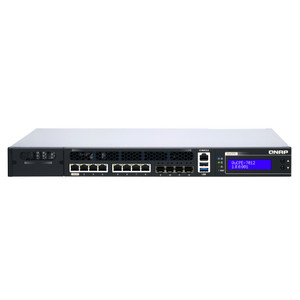
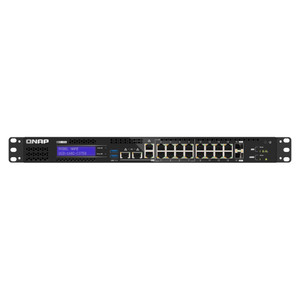
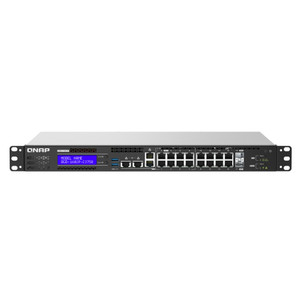
QNAP QUCPE-3034-C3758R-16G-US Desktop Universal CPE Network Appliance
Overview
The QUCPE-3034-C3758R-16G-US is QNAP's desktop-form-factor Universal Customer Premises Equipment (uCPE) appliance built around Intel's Atom C3758R platform — a purpose-designed network functions virtualization (NFV) processor that brings hardware-accelerated SD-WAN, VPN gateway, and edge compute workloads to branch and campus deployments without rack infrastructure. If you're consolidating multiple physical network appliances into a single programmable platform, or deploying virtual network functions (VNFs) at distributed sites, this is the class of device to evaluate.
The unit ships in the QuCPE-3034 chassis with 12 network ports — giving it the port density needed to handle multiple WAN uplinks, LAN segments, DMZ interfaces, and out-of-band management simultaneously from a single appliance. Pair that with three hardware acceleration engines and you have a platform that can forward and encrypt traffic at line rate without leaning entirely on the host CPU cores.
Key Features
- Intel Atom C3758R 8-Core Processor at 2.4 GHz: The C3758R is Intel's network-optimized Atom variant — not a desktop Atom repurposed for appliance use. Eight cores at 2.4 GHz give you the thread headroom to run multiple VNFs concurrently (router, firewall, IDS, WAN optimizer) without contention killing throughput on any one function. This matters on dense multi-tenant edge deployments where a 4-core appliance would be the bottleneck.
- 16GB DDR4 2400MHz Non-ECC UDIMM (2×8GB installed): 16GB is workable for lightweight VNF stacks. The Non-ECC nature means this isn't the right platform for applications where memory fault tolerance is non-negotiable — but for SD-WAN and VPN gateway use cases it's a practical baseline. The key number is the ceiling: 128GB max across two slots means you can drop in 2×64GB DIMMs and run significantly heavier virtualization workloads without replacing the appliance chassis.
- 128GB Maximum Memory Expandability (2 slots): Two DIMM slots supporting up to 64GB each gives a clear upgrade path. Deploy with 16GB for initial SD-WAN rollouts, then scale memory as you add VNF complexity — deep packet inspection, application-aware routing, or full UTM stacks — without a forklift upgrade.
- Intel QAT (QuickAssist Technology) Hardware Acceleration: QAT offloads cryptographic operations — AES, SHA, RSA, Diffie-Hellman — from the CPU cores directly onto dedicated silicon. For IPsec VPN and TLS inspection workloads, this is the difference between 500 Mbps and multi-gigabit encrypted throughput. If your primary use case is a high-throughput VPN concentrator or encrypted SD-WAN tunnel termination, QAT is the spec that justifies this platform over a generic x86 server.
- Smart NIC SR-IOV (Single Root I/O Virtualization): SR-IOV lets each virtual machine or VNF instance get direct, low-latency access to a physical NIC queue without going through a hypervisor software switch. The result is near-bare-metal network performance inside VMs — critical for latency-sensitive VNFs like session border controllers or real-time traffic classification engines.
- DPDK (Data Plane Development Kit) Support: DPDK bypasses the kernel network stack entirely, letting user-space applications poll NICs directly. Combined with SR-IOV, this enables packet forwarding rates that a standard Linux networking stack simply cannot match. For high-PPS (packets-per-second) routing and firewall VNFs, DPDK support is the architectural prerequisite — without it, you'd saturate the kernel at a fraction of the line rate.
- Desktop Form Factor with 12 Network Ports: The QuCPE-3034 chassis fits on a desk, shelf, or inside a telco enclosure without requiring 1U rack space. For branch deployments where rack cabinets don't exist — retail locations, small offices, industrial sites — the desktop form factor eliminates infrastructure prerequisites. Twelve ports on a desktop unit provides enough interface density to avoid external switching for most branch topologies.
Integration and Compatibility
The QUCPE-3034-C3758R-16G-US is designed as a VNF hosting platform. Intel QAT integration is supported by major open-source and commercial SD-WAN stacks that leverage DPDK — including those built on OpenWrt, VPP (Vector Packet Processing), and DPDK-native forwarding planes. SR-IOV compatibility requires a hypervisor that supports PCI passthrough or SR-IOV VF assignment (KVM/QEMU, VMware ESXi with appropriate driver support).
The QUCPE-3034-C3758R-16G-US (often searched as QUCPE 3034 C3758R 16G US) is part of QNAP's QNAP network appliance lineup, which spans uCPE and edge compute platforms for enterprise branch and service provider edge deployments. For guidance on right-sizing memory and VNF stack planning for uCPE deployments, see the network virtualization planning guide. If your deployment requires PoE switching or LAN aggregation at the same site, pairing this appliance with a managed PoE switch handles downstream device power and segmentation without loading the uCPE's forwarding plane.
Frequently Asked Questions
Q: What is the maximum RAM the QUCPE-3034-C3758R-16G-US supports?
A: The appliance supports up to 128GB DDR4 across two DIMM slots (2×64GB). It ships with 16GB (2×8GB) installed.
Q: Does the QUCPE-3034-C3758R-16G-US support Intel QAT hardware acceleration?
A: Yes. The Intel Atom C3758R processor includes Intel QuickAssist Technology (QAT), which offloads cryptographic operations for IPsec VPN and TLS workloads — enabling higher encrypted throughput without consuming all CPU cores.
Q: What is SR-IOV and why does it matter on this appliance?
A: SR-IOV (Single Root I/O Virtualization) allows virtual machines or VNF instances to access physical NIC queues directly, bypassing the hypervisor software switch. This delivers near-bare-metal network performance inside VMs — important for latency-sensitive network functions.
Q: Is the QUCPE-3034-C3758R-16G-US rack-mountable?
A: The QuCPE-3034 is a desktop form factor appliance. Rack mounting would require a third-party shelf or enclosure adapter — it is not a native 1U rack unit.
Q: What use cases is the QUCPE-3034-C3758R-16G-US designed for?
A: The platform targets SD-WAN edge deployments, VPN gateway consolidation, network functions virtualization (NFV) at branch sites, and any scenario where multiple physical network appliances are being replaced by software VNFs running on a single hardware platform.
Q: Can the memory be upgraded after purchase?
A: Yes. The two DIMM slots are user-accessible, and the platform supports DDR4 2400MHz Non-ECC UDIMM modules up to 64GB per slot, for a 128GB ceiling.
The QUCPE-3034-C3758R-16G-US is one of the more deployment-specific platforms in QNAP's lineup — the Intel Atom C3758R isn't just a cost-effective processor choice, it's an architecture decision. That chip carries dedicated QAT silicon for cryptographic offload, which means IPsec tunnel termination at this node won't crater your available CPU headroom the way a software-only VPN stack would on a general-purpose x86 box of equivalent core count.
Technical Highlights:
- Intel QAT Crypto Offload: Moves AES, SHA, and asymmetric key operations off the eight C3758R cores onto dedicated QAT engines — critical for multi-tunnel IPsec VPN concentrators where software crypto becomes the bottleneck well before line rate.
- SR-IOV + DPDK Stack: SR-IOV VF assignment combined with DPDK user-space polling eliminates kernel network stack overhead entirely. For VNFs doing high-PPS routing or stateful inspection, this combination is what makes the platform viable at branch-site traffic volumes — not just technically capable, but practically deployable.
- 128GB Memory Ceiling on 2 Slots: Starting at 16GB is fine for a lean SD-WAN VNF. The upgrade path to 128GB (2×64GB DIMMs) means you're not buying a new appliance when you add IDS/IPS or UTM functions 18 months into the deployment — the chassis scales with the VNF stack.
Deployment Considerations:
- The Non-ECC memory configuration is worth noting explicitly: this platform is not suited for workloads where memory fault tolerance is a hard requirement (financial transaction processing, long-running stateful session tables in carrier-grade NAT). For branch SD-WAN and VPN gateway use cases, Non-ECC is the standard trade-off at this price point and form factor.
- Desktop form factor means no native rack ears — plan for a shelf mount or telco-style enclosure if the deployment site has rack infrastructure. Don't assume 1U fit without confirming physical mounting options for your specific rack or enclosure.
This appliance is the right call for distributed enterprise branch deployments where you're consolidating a dedicated router, VPN concentrator, and basic firewall into a single programmable NFV platform — particularly where the site has no rack cabinet and needs a compact, desk-or-shelf-mountable device that can handle encrypted SD-WAN tunnels without hardware-accelerated crypto becoming the ceiling on throughput.