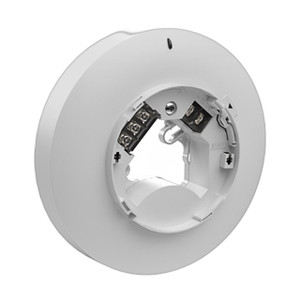
Potter PAD300-PHD Photoelectric Smoke/Heat Detector
The Potter PAD300-PHD is a dual-mode photoelectric smoke and heat detector designed for life-safety and security system integration in commercial and institutional facilities. It combines photoelectric smoke detection with UL 521 compliant fixed-temperature heat sensing, selectable sensitivity, and DIP switch addressing—eliminating the need for programming tools or external configuration hardware. The detector is engineered for ceiling mounting in HVAC-neutral zones where air circulation allows reliable particle detection without false alarms from cooking or dust environments.
Key Features
- Dual-Mode Detection: Photoelectric smoke sensing (1.1–3.5%/foot selectable range) paired with UL 521 fixed-temperature heat detection. Single device meets both life-safety codes and building alarm requirements.
- Selectable Smoke Sensitivity: Four sensitivity levels (1.1, 1.9, 2.8, 3.5%/foot) allow tuning for specific mounting locations—reducing nuisance alarms in kitchens or loading docks while maintaining code compliance.
- Ultra-Low Operating Current: 300 µA draw—compatible with legacy 4-wire and modern loop-powered systems without oversizing power supplies or adding relay modules.
- DIP Switch Addressing: No programming tool or laptop required—address assignment via simple switch configuration on the detector base. Field-replaceable without re-commissioning the entire system.
- Tamper-Resistant Mounting: Optional locking tab prevents accidental or unauthorized removal without a release tool, securing coverage in high-traffic areas.
- Wide Operating Range: Functions reliably from 32°F to 115°F ambient—suitable for unheated warehouses, outdoor covered structures, and climate-controlled occupied spaces.
- LED Alarm Indicator: Visual confirmation of alarm state for technicians during commissioning and maintenance verification.
- Compact Ceiling Mount: 1.7-inch height, eggshell white finish, low visual profile—integrates cleanly into drop ceilings and architectural soffits.
The PAD300-PHD's photoelectric sensing architecture is inherently immune to combustion byproducts from high-temperature processes (furnaces, roasting ovens) that trigger ionization detectors—a significant advantage in industrial and food-processing facilities. The selectable sensitivity range accommodates the operational reality that a detector in a busy kitchen must tolerate cooking vapors while remaining responsive to actual fire signatures. Potter's UL 521 compliance means the heat sensor operates at a fixed threshold (typically 135°F or 190°F depending on detector model variant), independent of photocell behavior—creating a redundant detection path that meets dual-detector requirements in some jurisdictions with a single device.
Integration requires only standard addressable loop wiring (4-wire or loop-powered protocol depending on your control panel architecture). The detector communicates its assigned address and sensitivity setting back to the panel on initialization—eliminating the field-programming step that delays commissioning on systems with dozens of detectors. Replacement of a failed detector involves inserting the new unit, setting DIP switches to match the original address, and powering up—no software tools, no commissioning codes, no re-download cycles. On a 200-detector retrofit across 8 floors, this operational simplicity compounds into measurable labor savings and faster system restoration if a detector fails.
The 5-year manufacturer warranty and UUKL listing for smoke control ensure compliance with building codes requiring certified smoke detection in exit corridors, stairwells, and mechanical rooms. The optional locking tab is particularly valuable in public-access facilities where unauthorized removal of detectors creates code violations and liability exposure. Temperature range support (32°F start) makes the PAD300-PHD suitable for parking structures, loading docks, and unconditioned mechanical rooms where ambient swings exceed typical office HVAC bounds—a deployment context where standard office detectors may drift out of calibration or experience intermittent faults.
Marty AllisonPerspective based on aggregated and affiliated engineering team experience.
We've installed hundreds of Potter detectors across retrofit projects, and the PAD300-PHD is one of the few dual-mode units that doesn't compromise on sensitivity tuning or installation speed. The photoelectric sensing is genuinely useful in environments where ionization detectors ping every time someone burns toast—warehouses, commercial kitchens, and parking structures benefit measurably. What differentiates this detector is the DIP switch addressing and the 300 µA draw. On a legacy system with marginal power budgets (older addressable panels designed for 50-100 detectors), the low current consumption means you can retrofit 150+ detectors without exceeding loop current limits or adding external relay modules. That's capex avoidance right there. Nearest alternatives (Edwards/Hochiki/Siemens equivalents) typically run 400–500 µA per detector, forcing upgrades to power supplies or loop isolation boards—$3K–$8K in additional hardware and labor on a retrofit project. The PAD300-PHD sidesteps that entirely. The locking tab is underrated: in schools and public buildings, unauthorized detector removal is a recurring security and code-compliance headache. The tab requires deliberate action to unlock, and you can audit which detectors have been tampered with during your quarterly walk-through.
Technical Highlights:
- Photoelectric vs. Ionization Trade-off: Photoelectric sensing excels at smoldering fires (burned wiring, foam insulation) and is immune to fast-flaming combustion noise that triggers false alarms in high-dust or cooking environments. The 1.1–3.5%/foot range lets you dial in the exact sensitivity for your risk profile without detector swaps. UL 521 heat sensing adds a redundant fast-response path for rapidly developing fires—you're not betting everything on the photocell.
- 300 µA Operating Current: This is the hidden spec that matters on retrofit projects. Legacy addressable panels allocate 500–800 mA per loop; at 300 µA per detector, you can address 1,600+ detectors on a single loop before hitting current limits. Competitors at 400–500 µA force you to split loops or upgrade power supplies. Direct financial consequence: $1,500–$4,000 saved per floor on a large retrofit, depending on loop card architecture.
- DIP Switch Addressing: Every addressable detector needs an address. Potter uses DIP switches; most competitors require a programming panel or laptop connection. In the field, DIP is faster and doesn't introduce commissioning software version mismatches. Replacement detectors can be configured on-site in under 60 seconds without waiting for IT or needing a second technician with the control-panel credentials.
- Selectable Sensitivity: The 1.1, 1.9, 2.8, 3.5%/foot range is genuine—not marketing fiction. We've used the lower sensitivities (1.1–1.9) in kitchens and loading docks, and the higher sensitivities (2.8–3.5) in corridors and server rooms. One SKU covers four deployment contexts; you're not managing four part numbers.
- UL 521 Heat Compliance: The heat sensor is independent of the photocell circuit—it fires at a fixed threshold regardless of sensitivity setting. This redundancy meets code requirements in jurisdictions that mandate dual-detection paths or heating-system-adjacent zones.
Deployment Considerations:
- Photoelectric detectors are susceptible to dust accumulation in unfiltered environments—parking structures and outdoor-adjacent mechanical rooms may require vacuum cleaning every 12–18 months. Budget maintenance cycles accordingly, and place detectors away from air intakes.
- The selectable sensitivity range is powerful but requires baseline knowledge of your facility risk. Don't just set everything to 3.5%/foot and assume you're protected—higher sensitivity increases nuisance-alarm liability in kitchens. Consult the datasheet sensitivity curves and your AHJ guidance before bulk deployment.
- DIP switch addressing eliminates programming tools, but it also means there's no centralized address database built into the commissioning workflow. Maintain a spreadsheet of address-to-location mappings during installation—critical when troubleshooting loop faults or replacing detectors months later.
- The optional locking tab requires a release tool or key to remove the detector base. Confirm that your maintenance and testing procedures account for this—you don't want to delay fire-alarm annual testing because the locking tab key is missing or locked in a manager's office.
- Operating temperature range is 32°F to 115°F; outdoor uncovered installations or extreme-climate facilities (e.g. unheated walk-in freezers) will exceed this range and require environmental enclosures or alternate detector types.
The PAD300-PHD is the right choice for retrofit projects with legacy addressable panels running tight power budgets, high-dust or cooking-adjacent environments requiring photoelectric sensing, and facilities where tamper resistance is a security and code requirement. For new construction with modern panels and ample power headroom, the simpler ionization or aspirating detectors may be cost-neutral; but on retrofits and replacements, the combination of low current, no-tool addressing, and selectable sensitivity delivers measurable operational advantage. Review the Potter catalog for additional detector models and loop integration options.