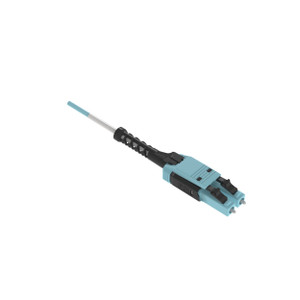
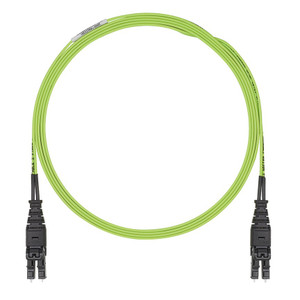
Panduit FW2ELQ1Q1NNM048 LC to LC OM4 Duplex Fiber Patch Cable, 48 Meters
The Panduit FW2ELQ1Q1NNM048 is a 48-meter duplex LC-to-LC fiber patch cable built on OM4 50/125µm laser-optimized multimode fiber. Designed for 10GBASE-SR, 40GBASE-SR4, and 100GBASE-SR10 applications, this cable bridges mid-range datacenter and enterprise backbone runs where OM3 reach limits fall short and single-mode infrastructure isn't yet justified. The aqua LSZH jacket provides instant visual identification in mixed-fiber environments, while duplex LC connectors deliver the port density required in modern switch fabrics and storage arrays. Panduit manufactures this cable to TIA-568.3-D and IEC 60793-2-10 A1a.2 standards, ensuring insertion loss ≤0.35 dB per connector and compatibility across Cisco, Juniper, Arista, and standards-compliant optics.
Key Features
- OM4 50/125µm fiber supports 10G to 550m, 40G to 150m, 100G to 150m over VCSEL optics
- 48-meter length suits datacenter row-to-row links, IDF-to-IDF backbones, and AV distribution beyond OM3 range
- Duplex LC connectors with ceramic ferrules, pre-polished to ≤0.35 dB insertion loss, ≤-50 dB return loss
- Aqua LSZH jacket (Low Smoke Zero Halogen) rated plenum-equivalent for overhead tray installations
- TIA-568.3-D and IEC 60793-2-10 compliant; tested to ANSI/TIA-526-14-B OFSTP-14 methods
- Factory-terminated and individually tested with serialized test report available on request
OM4 fiber extends effective bandwidth to 4700 MHz·km at 850nm, nearly triple OM3's 2000 MHz·km. This headroom translates to longer 10G links (550m vs. 300m), making the FW2ELQ1Q1NNM048's 48-meter span well within margin for even the noisiest 10GBASE-SR transceiver pairs. For 40G and 100G short-reach applications—common in spine-leaf fabrics and storage replication links—OM4 pushes the practical limit to 150 meters, ensuring this cable operates with 18+ dB link budget to spare. The duplex LC form factor matches the industry's dominant connector standard: each LC duplex housing occupies the same panel footprint as one SC simplex, doubling usable port count per RU in high-density patch panels. Panduit's ceramic ferrule endfaces are factory-polished to better than 50nm surface finish, eliminating the return-loss penalties that plague field-terminated assemblies and ensuring Day 1 compatibility with 25G and 50G NRZ optics when infrastructure upgrades arrive.
At 48 meters, this cable fits the gap between typical intra-rack patch cords (1–3m) and campus backbone runs (100m+). Datacenter operators use this length for row-to-row leaf switch interconnects, where structured cabling standards call for equipment distribution area (EDA) links under 90 meters but physical layouts demand more than the 30-meter OM3 comfort zone. In enterprise networks, 48 meters bridges two intermediate distribution frames (IDFs) on separate floors or wings, supporting 10G server uplinks or IP camera NVR aggregation without the cost or fusion-splicing labor of single-mode infrastructure. AV integrators deploy this length for 4K/8K video transport over SDVoE or Dante AV networks, where HDMI-over-fiber extenders and video matrix switches require known-good OM4 to guarantee sub-frame latency across 40G lanes. The aqua jacket color conforms to TIA-598-D, visually distinguishing OM4 from OM3 (aqua vs. legacy orange/aqua), OM2 (orange), and single-mode OS2 (yellow), reducing cross-patching errors during adds/moves/changes.
Installation is straightforward: minimum bend radius is 10× cable diameter (approximately 30mm) under no-load conditions, 20× diameter during pulls. Maximum pull tension is 100N (22 lbf) to avoid microbending the glass core or stressing the LC connector crimp. The LSZH jacket self-extinguishes per IEC 60332-1 and emits <0.5% HCl under combustion (IEC 60754-1), meeting plenum-equivalency for overhead cable tray in data halls and telecom rooms where PVC off-gassing is prohibited. Polarity is Type A (straight-through): transmit A-position on one end maps to receive A-position on the far end, matching the 99% of datacenter duplex links. If deploying in a polarity Method B or Method C trunk (common in 40G/100G breakout scenarios), you'll need a Type B crossover adapter or a re-keyed connector boot; this cable ships as Type A. Panduit serializes each assembly and retains IL/RL test data traceable to NIST standards—request the test report by serial number if you're documenting a TIA-942 Rated-4 installation or satisfying ISO 27001 infrastructure audit requirements.
The FW2ELQ1Q1NNM048 ships as a single 48-meter duplex assembly, ready to terminate into LC duplex adapters (coupler modules) in patch panels, media converters, or direct-attach SFP/SFP+/QSFP ports. Panduit backs this cable with a comprehensive manufacturer warranty covering materials, workmanship, and optical performance when installed per TIA-568 guidelines and operated within the specified temperature range of -20°C to +70°C. For projects requiring multiple lengths or custom polarity configurations, consider ordering in bulk and specifying serialized labeling to match your DCIM asset-tracking schema—Panduit supports custom legend printing on boots and jackets for orders of 25+ assemblies, streamlining MAC workflows and reducing the time-to-locate overhead that costs datacenters an average of 40 minutes per trouble ticket.