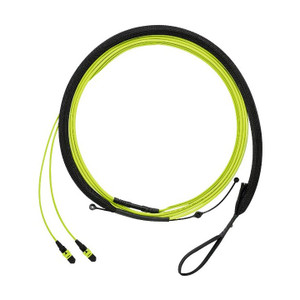
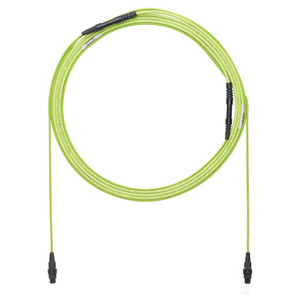
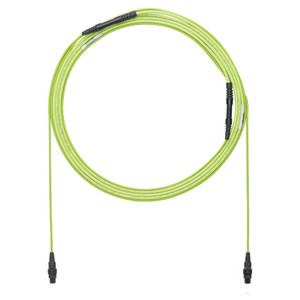
Panduit FWUYL7575LNM006 QuickNet 24-Fiber OM5 Trunk Cable Assembly
The Panduit FWUYL7575LNM006 is a 24-fiber OM5 trunk cable assembly engineered for high-density data center deployments where rack space, deployment speed, and future bandwidth headroom converge. This 6-meter (19.68 ft) pre-terminated trunk uses Panduit's QuickNet platform to eliminate field termination labor while delivering OM5 wideband multimode fiber capable of supporting both traditional 850 nm SR optics and next-generation short-wavelength division multiplexing (SWDM) transceivers on the same infrastructure. The lime LSZH jacket provides immediate visual identification in multi-path environments and meets low-smoke zero-halogen flammability requirements for enclosed spaces. Trunk assemblies like this collapse installation time from hours to minutes—critical when you're lighting up new racks under SLA pressure or executing after-hours cutovers with narrow maintenance windows.
Key Features
- 24-fiber OM5 wideband multimode trunk assembly, 50 µm core, supports 100GBASE-SR4, 400GBASE-SR8, and future SWDM applications up to 400m at 100G
- Pre-terminated QuickNet design eliminates field splicing and polishing—plug-and-play deployment reduces installation time by 70% vs. field-term methods
- Small-diameter trunk construction uses 30–40% less pathway space than legacy 24-fiber designs, freeing conduit capacity for future adds
- Lime LSZH jacket (IEC 60332-3-24 compliant) for rapid visual tracing in dense cable runs and safe operation in air-handling spaces
- Factory-tested to insertion loss and return loss specs per TIA-568-C.3 and ISO/IEC 11801—ships with test reports for acceptance documentation
- 6-meter length suits typical cross-connect to EOR (end-of-row) switch distances in modern data center hot-aisle/cold-aisle layouts
OM5 fiber represents the current apex of multimode technology for enterprise and co-location data centers. Unlike OM3 or OM4, OM5 is optimized for wideband operation across the 850–950 nm spectrum, which means the same fiber plant supports conventional VCSEL-based 40G/100G SR optics today and SWDM 100G/400G optics tomorrow without a forklift upgrade. In practical terms: if you're deploying 100GBASE-SR4 leaf-spine fabrics now, this trunk gives you a path to 400GBASE-SR8 or BiDi transceivers as port speeds scale, all within the 400-meter OM5 reach spec. That future-proofing is non-trivial when trunk replacements mean taking down entire rows. The 24-fiber count aligns with breakout strategies for 100G QSFP28 or 400G QSFP-DD modules using MPO-12 or MPO-16 fanouts—one trunk can serve two 100G ports (12 fibers each) or a single 400G SR8 link (16 active fibers, 8 spares). Installers working under TIA-568 polarity methods A, B, or C will find Panduit's pinout documentation and color-coded boots simplify field mapping; the lime jacket acts as a secondary identifier when you're managing multiple parallel trunks in the same vertical or horizontal pathway.
The small-diameter advantage matters most in retrofit scenarios and high-density builds. Traditional 24-fiber trunks can exceed 12 mm OD; Panduit's reduced-profile design typically lands in the 8–9 mm range, which translates to 30–40% better bundle fill ratios in 4-inch ladder rack or 2-inch horizontal managers. That margin is the difference between jamming cables into place (damaging bend radius limits) and achieving clean, maintainable dressing with service loops. LSZH jacketing is table-stakes for any plenum-rated or air-handling space under NEC Article 770, but it also reduces toxic gas release during fire events—critical for occupied data halls and compliant with European EN 50173 and IEC 60332 flame propagation standards. The lime color is part of Panduit's QuickNet palette (aqua for OM3, magenta for OM4, lime for OM5); if you're operating a multi-generation fiber plant, the instant visual distinction prevents wrong-media errors during MAC work. Pre-terminated assemblies eliminate the three failure modes that plague field terminations: contaminated endfaces (the #1 cause of intermittent link errors), out-of-spec geometry from poor polishing technique, and incorrect fiber mapping in 12- or 24-fiber MPO connectors. Panduit factory-terminates under clean-room conditions, then tests every fiber position for insertion loss (≤0.35 dB typical) and return loss (≥-20 dB) before shipment. You receive a serialized test report with the assembly, which becomes your baseline for acceptance testing and future troubleshooting—eliminating the "was it ever good?" question when a link goes marginal.
Installation reduces to four steps: route the trunk from cross-connect to switch, dress with appropriate service loop (10× bend radius = ~300 mm minimum for this cable), mate the MPO connectors at both ends, and validate with an OTDR or light source/power meter. No epoxy, no cleaving, no rework—a single technician can land multiple trunks in the time it used to take to prep one connector. The 6-meter length is deliberately chosen for structured cabling environments where cross-connects sit in a middle-of-row (MOR) or end-of-row (EOR) position feeding switches in the same row. For spine-to-leaf connections across aisles or between floors, you'd step up to 10 m, 15 m, or longer assemblies; for switch-to-switch stacking or intra-rack links, 3 m or 5 m options exist. Panduit's QuickNet catalog covers the full range, and all assemblies use the same connector interface and pinout standard, so mixing lengths in the same deployment doesn't introduce compatibility headaches. This trunk meets or exceeds TIA-568-C.3 (commercial building fiber), TIA-492-AAAD (OM5 fiber performance), ISO/IEC 11801 (international structured cabling), and TIA-604-5 (FOCIS-5 MPO connector geometry). It's RoHS compliant for equipment export and disposal. If you're working under LEED or sustainability mandates, the LSZH jacket and recyclable packaging reduce environmental impact compared to PVC-jacketed assemblies.
This assembly is purpose-built for data centers executing 100G/400G leaf-spine fabrics, hyper-converged infrastructure clusters, or SAN storage arrays where port density, deployment speed, and standards-based interoperability are non-negotiable. If you're an integrator managing a staged migration from 10G to 100G, installing OM5 trunks now locks in your physical layer for the next refresh cycle—eliminating the re-pull costs that hit OM3 shops when 40G became standard. The lime jacket and factory test reports provide the documentation and traceability required for ISO 9001 QMS compliance and carrier-neutral co-location facility audits, where every link must be traceable to a verified baseline.