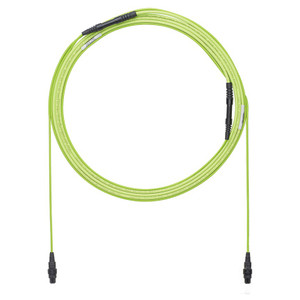
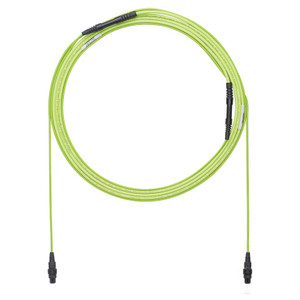
Panduit FWUYL7575LAM096 QuickNet OM5 24-Fiber Trunk Cable Assembly
The Panduit FWUYL7575LAM096 is a 96-meter OM5 SigCore trunk cable assembly engineered for high-density data center backbone deployments requiring extended reach and future-ready bandwidth. This 24-fiber PanMPO-to-PanMPO trunk delivers wideband multimode performance across 850–950 nm wavelengths, supporting shortwave wavelength-division multiplexing (SWDM) for 40GBASE-SR4, 100GBASE-SR4, and emerging 400GBASE-SR8 applications. The HD Flex construction reduces cable diameter by 30–40% compared to standard trunk assemblies, critical for congested pathway and overhead ladder-rack installations where every cubic inch of airflow and cable management space matters. Ultra insertion loss qualification ensures link budgets stay within spec on long backbone runs between IDF closets, meet-me rooms, and central equipment distribution areas. The integrated pulling eye on one end simplifies pathway installation through conduit, innerduct, or j-hooks without field termination or re-rigging.
Key Features
- OM5 SigCore Wideband Multimode Fiber – 50-micron core supports SWDM transmission across 850, 880, 910, and 940 nm wavelengths for 4× capacity increase over OM4 on the same fiber count, extending investment protection as 400G and 800G Ethernet standards evolve
- 24-Fiber PanMPO Female to PanMPO Female Configuration – Method B polarity delivers twelve duplex channels via standard backbone patching; terminates directly to QuickNet cassettes, breakout modules, or MTP-compatible switch/server optics without adapter gender mismatches
- Ultra Insertion Loss Performance – Factory-tested to ≤0.35 dB typical per-connector insertion loss (well below the 0.75 dB TIA-568 limit), preserving link budget on 96-meter backbone runs and enabling cascaded architectures with multiple mated connections
- HD Flex Low-Profile Construction – 30–40% smaller cable diameter than traditional 24-fiber trunks reduces bundle congestion in overhead pathways, under-floor grids, and vertical riser shafts; tighter minimum bend radius (10× cable OD) eases routing around corners and equipment racks
- Low Smoke Zero Halogen (LSZH) Jacket – IEC 60332-3-24 flame-retardant, low-smoke, halogen-free jacket meets European EN 50575 CPR Class Cca requirements and reduces corrosive gas emission in enclosed IT spaces, required for many international data center builds and high-value equipment rooms
- 96-Meter Extended Reach – Spans campus backbone distances between buildings, central data halls and satellite IDFs, or multi-floor vertical risers without mid-span splice points; supports OM5's 400 m reach at 40G SR4 and 150 m at 100G SR4
- Factory Pre-Terminated and Tested – Each trunk ships with end-to-end insertion loss and return loss test data; eliminates field splicing, fusion termination labor, and the risk of contamination or polarity errors during installation
- Integrated Pulling Eye – Installed on one cable end to attach pull rope or fish tape; allows direct pathway pulling up to 110 lbf (489 N) short-term tensile load without stressing the fiber or connectors, reducing installation time and contractor labor costs
- Lime High-Visibility Jacket – OM5-standard lime-green color-coding ensures instant identification in mixed OM3/OM4/OM5 infrastructures, preventing accidental cross-patching that degrades SWDM performance or causes link failures
- QuickNet Platform Compatibility – Integrates seamlessly with Panduit's QuickNet cassette modules, breakout assemblies, and SigCore patch cords for end-to-end tested channel performance; maintains <1.5 dB channel insertion loss across three mated connections (trunk + 2 cassettes)
The FWUYL7575LAM096 addresses the core challenge facing data center and enterprise network architects: how to deploy sufficient fiber capacity for today's 10G/25G access layer and tomorrow's 100G/400G spine without locking in obsolete infrastructure. Traditional OM3 and OM4 multimode backbones can carry 40G and 100G Ethernet over limited distances using parallel optics (SR4), but each speed tier consumes 8 or 20 fibers per duplex link when break-out is required, forcing costly fiber strand counts and oversized pathways. OM5 SigCore fiber changes the economics: its wideband laser-optimized design supports shortwave wavelength-division multiplexing (SWDM), transmitting four wavelengths (850/880/910/940 nm) simultaneously on a single fiber pair. A 24-fiber OM5 trunk like the FWUYL7575LAM096 can support up to twelve 100GBASE-SR4 duplex links or six 400GBASE-SR8 links—quadrupling effective capacity compared to OM4 at the same fiber count. The 96-meter length covers typical campus backbone applications: building-to-building underground conduit runs, multi-story vertical risers between telecom rooms, or horizontally distributed data halls with centralized core switching. Panduit's Ultra insertion loss qualification ensures each PanMPO connector measures ≤0.35 dB typical (compared to the ≤0.75 dB TIA maximum), leaving ample link budget for cascaded connections through QuickNet cassettes, breakout modules, or direct-attach MTP switch ports. This matters on long trunks: at 96 meters you're already consuming roughly 0.48 dB in fiber attenuation (OM5's typical 0.005 dB/m at 850 nm); adding two connectors at 0.35 dB each leaves you at ~1.18 dB total channel loss—well within the 1.9 dB budget for 100GBASE-SR4 at 100 m and the 1.5 dB budget for 400GBASE-SR8 at 70 m, with margin for dirt, aging, and an additional mated pair if you add a mid-span breakout.
Installation advantages stem from the HD Flex construction and integrated hardware. Standard 24-fiber trunk assemblies typically measure 10–12 mm outer diameter; Panduit's HD Flex design reduces this to roughly 6.5–7.5 mm by using tighter buffer tube packing and reduced jacket wall thickness while maintaining crush and tensile performance (550 N long-term, 1100 N short-term). In congested overhead ladder racks shared with copper Category 6A bundles, power whips, and cable tray fill ratios approaching NEC Article 392 limits, the 30–40% diameter reduction directly translates to more usable pathway capacity and improved airflow around fiber bundles—critical in hot-aisle containment designs where cable mass blocks convective cooling. The reduced diameter also enables tighter bend radius: the minimum bend radius under no-load is 10× cable OD (roughly 65–75 mm), versus 100–120 mm for thicker assemblies, easing 90-degree turns at rack vertical managers, equipment U-space constraints, and tight corner transitions from overhead tray to wall-mounted terminal enclosures. The factory-installed pulling eye on one end eliminates the need for breakaway pull socks or tape-wrapped pull ropes that risk snagging on conduit couplings; installers attach standard pull rope directly to the eye, route the trunk through innerduct or j-hook pathways, and cut away the eye at final termination—saving 15–20 minutes per trunk on typical data center backbone projects with dozens of inter-rack or inter-row trunks. Method B polarity follows the TIA-568 Type B standard: Position 1 on one end maps to Position 12 on the far end, Position 2 to 11, and so forth, creating twelve straight-through duplex pairs when mated to Method B cassettes or breakouts. This is the dominant polarity scheme in enterprise and colocation data centers; it ensures transmit-to-receive alignment without field flipping, crossover adapters, or custom polarity documentation.
The Low Smoke Zero Halogen (LSZH) jacket is more than a compliance checkbox—it's a safety and equipment-protection requirement for high-value IT environments. Standard PVC-jacketed cables release hydrochloric acid gas and dense black smoke when burned; in a server room or data hall fire, this creates corrosive condensation on circuit boards, disk drives, and optical transceivers, often causing more equipment damage than the fire itself. LSZH jackets meeting IEC 60332-3-24 Category C produce minimal smoke opacity (<60% light transmission) and emit non-corrosive gases, reducing secondary damage and improving visibility for evacuation and firefighting. European data centers, government facilities, healthcare campuses, and financial trading floors typically mandate LSZH for all intra-building cabling under EN 50575 CPR (Construction Products Regulation) Class B2ca, Cca, or higher. Even in North America, large colocation providers and hyperscale operators increasingly specify LSZH for above-ceiling and under-floor pathways to protect multi-tenant equipment investments. The FWUYL7575LAM096's LSZH jacket meets these requirements without sacrificing mechanical durability: it retains the same 550 N long-term and 1100 N short-term tensile ratings as standard Panduit trunks, survives -20°C to +70°C operating temperature range, and passes TIA-568-C.3 crush and impact tests. The lime-green color is standardized under TIA-598-D for OM5 fiber, ensuring that three years post-installation when multiple generations of multimode infrastructure coexist, technicians can instantly distinguish OM5 SWDM-capable trunks from older OM3/OM4 runs and avoid plugging 400G SWDM optics into incompatible fiber that causes bit errors or link flaps.
This trunk assembly ships with full factory test documentation showing insertion loss and return loss for each fiber position across all 24 strands, traceable to NIST-calibrated reference standards. Panduit's manufacturing process includes automated end-face inspection (per IEC 61300-3-35 criteria for scratches, contamination, and geometry), mechanical ferrule alignment to <0.5° angular offset, and controlled ferrule endface radius of curvature (7–25 mm) to ensure physical contact and minimal air gaps. These factory quality controls deliver the Ultra insertion loss grade—approximately half the loss of field-terminated MPO connectors and 30% better than standard factory trunks—which is the margin that makes 96-meter OM5 backbones viable for multi-tier leaf-spine fabrics with two or three cassette tiers between server NICs and spine switches. Standards compliance spans the full stack: TIA-492-AAAD defines the OM5 fiber physical and optical specs (50-micron core, 850–950 nm effective modal bandwidth ≥3500 MHz·km), TIA-568-C.3 defines the MPO connector mechanical interface and performance limits, TIA-604-5 (FOCIS-5) specifies the MT ferrule end-face geometry, and ISO/IEC 11801 Ed. 2.2 provides the international cabling-system performance model for OM5 Class OF2000 links. RoHS compliance ensures lead-free, low-halogen materials throughout the assembly for European RoHS Directive 2011/65/EU and global electronics import requirements. For data center operators migrating from 10G to 25G access and planning 100G or 400G spine upgrades within a 3–5 year window, the FWUYL7575LAM096 delivers the fiber infrastructure to support that roadmap without mid-lifecycle rip-and-replace, backed by Panduit's structured cabling warranty and the QuickNet ecosystem of tested, compatible components.