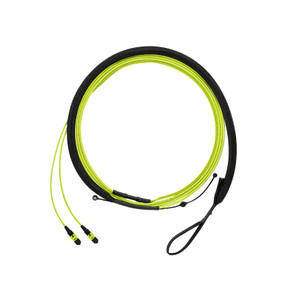
Panduit FWUYL7575LAM068 QuickNet™ 24-Fiber OM5 Trunk Cable Assembly
Panduit's FWUYL7575LAM068 is a factory-terminated 24-fiber OM5 wideband multimode trunk assembly engineered for high-density datacenter deployments where pathway congestion, extended reach, and future bandwidth headroom converge. Spanning 68 meters (223 feet) with a small-diameter LSZH jacket, this lime-green QuickNet trunk delivers 30–40% space savings over legacy trunk designs while supporting short-wave division multiplexing (SWDM) for 40GBASE-SR4, 100GBASE-SR4, and emerging 400G optics across the 850–950 nm window. Pre-terminated MTP connectivity eliminates field splicing, collapsing install schedules from days to minutes in spine-leaf fabrics, storage-area networks, and horizontally scaled compute clusters.
Key Features
- 24-fiber OM5 wideband multimode (50 µm core) optimized for 850–950 nm SWDM and legacy 850 nm SR optics
- 68-meter extended reach spans inter-row, end-of-row, and cross-zone datacenter pathways without active electronics
- Small-diameter trunk construction reduces conduit fill by 30–40%, freeing capacity for power or future fiber adds
- Lime LSZH jacket meets IEC 60332-3-24 and NFPA 262 for plenum-equivalent safety and international regulatory acceptance
- Factory-terminated MTP/MPO interfaces ship polarity-verified and insertion-loss tested, eliminating field termination defects
- QuickNet plug-and-play deployment: pull, plug, label—no fusion splicers, no epoxy, no cure time
- TIA-568-C.3 and ISO/IEC 11801 Edition 2.2 compliant for standards-based 40/100/400G migrations
- RoHS-compliant materials and TIA-492-AAAD fiber performance specifications ensure procurement and environmental compliance
OM5 wideband multimode fiber represents the most significant leap in multimode technology since OM4, extending usable spectrum from the traditional 850 nm window to include 880, 910, and 950 nm wavelengths. This four-channel SWDM capability allows a single duplex fiber pair to carry four independent 25G or 50G lanes, enabling 100GBASE-SR4 over two fibers instead of eight (OM4 requires eight fibers via parallel optics). For integrators managing 10G-to-100G migrations or deploying 40G spine fabrics, OM5 collapses fiber count, simplifies MACs, and defers costly re-cabling when optics evolve. The FWUYL7575LAM068's 50 µm core maintains full backward compatibility with existing 850 nm SR transceivers (10GBASE-SR, 40GBASE-SR4), so you install once and upgrade optics on your schedule rather than the physical layer's constraints. Panduit's small-diameter trunk design leverages tight-buffered 900 µm subunits and a reduced-OD jacketing process to shrink overall cable diameter by up to 40% compared to traditional 24-fiber trunks. In a 4-inch backbone conduit filled to NEC's 40% limit, this diameter reduction translates to 18–24 additional trunk positions—critical margin when adding storage VLANs, out-of-band management networks, or disaster-recovery replication links without ripping out existing pathways. The lime jacket provides instant visual distinction from OM3 (aqua) and OM4 (Erika violet) trunks during MACs, reducing the mis-patch risk that kills uptime in bladed environments.
Datacenter architects deploying leaf-spine topologies face a common dilemma: top-of-rack switches 15–25 meters from the spine, but end-of-row aggregation another 40–50 meters beyond. The FWUYL7575LAM068's 68-meter length bridges that gap in a single pull, eliminating mid-run splice enclosures that add 0.3–0.5 dB insertion loss and create failure points. For storage fabrics running NVMe-oF or Fibre Channel over Ethernet, every tenth of a dB matters—tight loss budgets (1.5 dB max for 100GBASE-SR4) leave zero room for splice losses when you're already accounting for MTP adapter IL, connector endface geometry, and fiber bend radius in dense patch fields. Factory termination guarantees <0.35 dB per mated connector pair and polarity verification per TIA-568-C.0 Method B (straight-through key-up/key-down), so the first packet you push is the validation test. Installation crews pull the assembly from the reel, dress it into vertical or horizontal cable managers, seat the MTP connectors into breakout modules or switch MPO ports, and move to the next run—no consumables van, no OTDR, no rework. On a 500-fiber backbone deployment, QuickNet trunks collapse a four-day fusion-splice schedule into six hours of pulling and two hours of testing. LSZH jacketing meets the IEC 60332-3 flame-spread and IEC 61034 smoke-density thresholds required for European datacenters, Asian colocation facilities, and increasingly for North American enterprise campuses adopting international safety baselines. The lime color simplifies DCIM documentation: OM5 trunks photograph distinctly under white LED or sodium-vapor aisle lighting, and cable-management audits via smartphone capture populate asset databases without ambiguity.
Panduit's compliance matrix—TIA-568-C.3, ISO/IEC 11801 Ed. 2.2, TIA-492-AAAD (OM5 fiber spec), and TIA-604-5 (FOCIS-5 MPO geometry)—provides the standards anchor required when your datacenter's lifespan outlives three transceiver generations. OM5 is explicitly called out in TIA-568-C.3 Addendum 1 and ISO/IEC 11801-1 for SWDM applications, meaning your physical layer investment is backed by international consensus rather than a single vendor's roadmap. When 800G SR8 or 1.6T optics arrive requiring tighter modal bandwidth or different wavelength plans, the installed OM5 base gives you the widest possible compatibility window. For integrators serving finance, healthcare, or government verticals where infrastructure refresh cycles stretch to 10–12 years and unplanned downtime costs five figures per minute, OM5 trunks are the insurance policy that keeps the physical layer off the critical path.