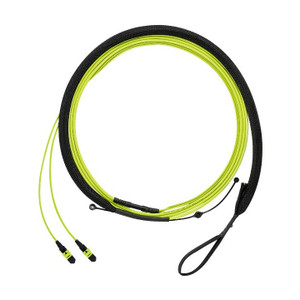
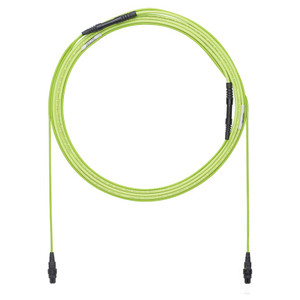
Panduit FWUYL7575KAM094 QuickNet™ 24-Fiber OM5 Trunk Cable Assembly
Panduit's FWUYL7575KAM094 is a factory-terminated 24-fiber OM5 trunk cable assembly delivering 94 meters of wideband multimode connectivity for high-density data center deployments. OM5 fiber supports short-wavelength division multiplexing (SWDM) across four wavelengths per fiber pair, enabling 40GBASE-SR4 and 100GBASE-SR4 transmission over extended reach without requiring parallel fiber ribbon architectures. The lime LSZH jacket meets plenum-equivalent fire safety requirements while occupying 30 to 40 percent less pathway space than legacy OM3 trunks, critical when retrofitting existing cable trays or designing new structured cabling systems to TIA-942 standards. At 308 feet, this assembly bridges typical main distribution area (MDA) to equipment distribution area (EDA) spans in medium-to-large server halls while maintaining service loop reserves for proper bend-radius management at termination panels.
Key Features
- 24-fiber OM5 50/125 μm wideband multimode trunk, factory-terminated and tested under QuickNet™ quality program with guaranteed insertion loss under 0.35 dB per mated connector pair
- 94-meter overall length supports cross-connect backbone runs in raised-floor data centers, colocation cages, and enterprise server rooms with headroom for proper cable dressing and future reconfiguration
- SWDM-ready fiber supports 40G/100G over four wavelengths (850/880/910/940 nm) on a single fiber pair, reducing transceiver port counts by 75 percent versus parallel 100GBASE-SR10 optics and simplifying spine-leaf fabric scaling
- Lime LSZH jacket complies with IEC 60332-3-24 flame propagation limits and produces minimal smoke/zero halogen emissions under fire exposure, required in enclosed data halls, international installations, and any space sharing air-handling plenums with occupied areas
- Reduced outer diameter construction (30-40% smaller cross-section than equivalent OM3/OM4 24-fiber trunks) improves airflow around cable bundles, reduces weight loading on overhead ladder rack, and increases usable tray fill capacity without violating NEC 300.17 40% fill ratio limits
- Backward compatible with installed OM3/OM4 optics at legacy link distances—supports 10GBASE-SR over 300m, 40GBASE-SR4 over 150m using standard 850nm transceivers—allowing phased migration without forklift infrastructure replacement
- Forward compatible with 200GBASE-SR4 and 400GBASE-SR4.2 short-reach applications when paired with next-generation BiDi transceivers, protecting investment against bandwidth obsolescence through multiple hardware refresh cycles
- Factory polarity testing and end-face inspection eliminate field termination labor, specialty tooling requirements, and the cleanroom conditions needed for epoxy-and-polish connector attachment—reduces installation time by 60-70 percent versus pull-and-terminate field fiber runs
- Meets TIA-492-AAAD OM5 fiber performance specifications, TIA-568-C.3 commercial building cabling standards, ISO/IEC 11801 Edition 2.2 generic cabling requirements, TIA-604-5 FOCIS-5 MPO connector geometry, and RoHS material restrictions
OM5 wideband multimode fiber represents the current endpoint in 50 μm laser-optimized fiber evolution, purpose-built for data centers running 40G/100G Ethernet today and planning 200G/400G upgrades within the next three-to-five-year hardware refresh window. Unlike OM3 fiber (2000 MHz·km effective modal bandwidth at 850 nm) and OM4 (4700 MHz·km EMB), OM5 specifies minimum effective modal bandwidth across four distinct wavelengths in the 850-950 nm SWDM transmission window: 850 nm, 880 nm, 910 nm, and 940 nm. This multi-wavelength optimization allows a single duplex LC or quad-fiber MPO connection to carry four independent 25G data streams aggregated into 100GBASE-SR4, using one fiber pair instead of the eight fibers required by legacy parallel 100GBASE-SR10 optics. For integrators designing Clos spine-leaf topologies or expanding existing 10G three-tier core-distribution-access fabrics to 40G/100G, OM5 eliminates the transceiver port-count penalty and fiber pathway congestion that made first-generation 40G/100G deployments cost-prohibitive at scale. The economic advantage compounds in high-radix switch environments: a 32-port 100G leaf switch consumes 64 fiber strands with OM3/OM4 parallel optics but only 16 strands with OM5 SWDM optics, reducing trunk cable requirements by 75 percent and freeing pathway capacity for future expansion without requiring costly conduit additions or tray replacements.
The 94-meter length in this assembly directly addresses typical horizontal backbone distances in ANSI/TIA-942-B Rated-3 and Rated-4 data centers. In raised-floor designs with centralized MDA cross-connect fields and perimeter or pod-based EDA equipment rows, the MDA-to-EDA fiber span commonly falls in the 70-100 meter range after accounting for vertical rise to overhead cable tray, horizontal tray run, drop to EDA cabinet, and required service loops at both termination points. This assembly provides sufficient length to cover those distances while maintaining the 30mm minimum bend radius required by TIA-568-C.3 for OM5 fiber under no-load conditions (increased to 50mm during installation pulls). Panduit's factory testing program validates each trunk assembly against insertion loss budgets (maximum 0.35 dB per mated connector pair, typically 0.25 dB), return loss performance (minimum -20 dB across all wavelengths), and end-face geometry per IEC 61300-3-35, ensuring optical link margins remain within IEEE 802.3 specifications even after accounting for patch cord interconnections, in-line splice losses, and transceiver coupling variations. The QuickNet™ designation indicates end-to-end manufacturing control: Panduit draws the fiber, cables the trunk assembly, attaches and polishes connectors, performs automated test and inspection, and serializes each assembly with traceable lot codes—providing single-source accountability for performance warranty claims and eliminating the finger-pointing between fiber suppliers, cable manufacturers, and connector vendors that complicates field-terminated installations.
Pre-terminated trunk assemblies fundamentally change the installation labor model for backbone fiber deployments. Field termination of a 24-fiber trunk using epoxy-and-polish LC or SC connectors typically requires 6-8 hours of technician time (assuming proficiency and no re-dos), plus consumables inventory for epoxy, polish films, connector bodies, crimp rings, dust caps, and isopropyl alcohol cleaning supplies. The process demands a clean work surface isolated from airborne particulates, a precision fiber cleaver, a polishing puck and fixture, and an optical microscope or video inspection probe for end-face validation. Factory trunks reduce that to under 45 minutes of pull-and-dress labor: route the trunk through the designated pathway, secure it to cable tray or J-hooks at NEC-compliant support intervals, dress the service loops into the termination cabinets with proper bend-radius protection, remove the factory dust caps, and plug into the patch panels or direct-attach equipment ports. For contractors working under fixed-price bids or accelerated deployment schedules, the labor arbitrage alone justifies the factory trunk premium; the elimination of field re-work due to contaminated end-faces or failed insertion-loss testing adds further cost avoidance that doesn't appear on the initial material quote but compounds quickly across large campus or multi-building rollouts.
The small-diameter trunk construction directly addresses the pathway congestion crisis in legacy data centers originally designed for 1G/10G Ethernet densities. A 24-fiber OM5 tight-buffered trunk occupies roughly the same tray cross-section as a 12-fiber OM3 loose-tube trunk, effectively doubling fiber density without requiring ladder rack replacement or conduit upsizing. In retrofit scenarios where existing 4-inch ladder rack is already approaching the NEC Article 300.17 40-percent fill limit, the diameter reduction creates margin for adding new fiber trunks without violating code or forcing costly infrastructure modifications. The smaller bundle diameter also improves convective airflow around cable groups in overhead tray runs and under raised-floor plenums, reducing the localized hot spots that thermal imaging surveys often reveal around densely packed cable bundles in high-airflow cooling designs. For installations using hot-aisle/cold-aisle containment strategies, maintaining unobstructed under-floor airflow paths is critical to avoiding bypass air losses that degrade cooling efficiency; compact trunk cables contribute measurably to preserving those design airflow rates.
LSZH jacketing has transitioned from a European-market requirement to a North American best practice as data center fire safety standards evolve beyond the traditional plenum/riser classifications in NEC Article 770. Low Smoke Zero Halogen compounds limit visible smoke obscuration (measured per IEC 61034 light transmission testing) and eliminate halogenated flame retardants that produce corrosive hydrochloric or hydrobromic acid gases under combustion. In data centers where the equipment space shares air-handling plenums with occupied office areas—or in any installation governed by international building codes (IBC) that reference IEC fire-performance standards—LSZH jacketing is often a mandatory procurement specification. Even in purely domestic U.S. builds, specifying LSZH provides future-proofing against evolving fire marshal interpretations and reduces liability exposure in the event of a cable-involved fire incident. The lime jacket color follows TIA-598-D Appendix G color-coding recommendations for OM5 identification, providing instant visual differentiation from aqua OM3, erika violet OM4, and legacy orange OM1/OM2 fibers during moves-adds-changes or troubleshooting. This color discipline becomes critical in mixed-generation data centers where multiple fiber types coexist in the same cable trays and termination panels; mis-patching an OM5 transceiver into an OM3 fiber link costs link budget margin and may fail to support 100G transmission over the designed distance.
This assembly ships with polarity method B configuration per TIA-568-C.0 Annex A (straight-through key-up to key-up pin assignment), the most common polarity scheme for duplex LC breakout applications and standard transceiver pairing in switch uplink and storage fabric installations. Integrators running method A (key-up to key-down crossover) or method C (array-based pair-flipping) infrastructures can request Panduit's custom QuickNet™ build service for non-standard polarity configurations or hybrid connector types mixing MPO trunk connectors with LC or SC fanouts. The 24-fiber count aligns with common MPO-24 trunk connector deployments, 12-fiber duplex LC breakout cassettes (supporting twelve duplex links), or direct-attach to 24-port LC patch panels in switch cross-connect designs. For spine-leaf architectures where each leaf switch requires 4-8 uplinks to spine switches, a single 24-fiber trunk provides enough strands for six 40G SR4 uplinks (using 4 fibers per link) or six 100G SR4 uplinks (using 4 fibers per link via SWDM optics), plus spares for future growth or failure-domain redundancy. Backward compatibility with installed OM3/OM4 active equipment is full-spec and transparent: OM5 fiber supports 10GBASE-SR over 300 meters, 40GBASE-SR4 over 150 meters, and 100GBASE-SR10 over 100 meters using the same 850 nm VCSEL transceivers deployed on earlier multimode fiber generations, allowing phased transceiver and switch upgrades without requiring immediate cabling replacement.
Compliance with TIA-568-C.3 (Optical Fiber Cabling Components Standard), ISO/IEC 11801 Edition 2.2 (Information Technology - Generic Cabling for Customer Premises), IEC 60793-2-10 Type A1a.3 (Sectional Specification for Category A1 Multimode Fibers), and TIA-604-5 FOCIS-5 (Fiber Optic Connector Intermateability Standard) ensures this trunk assembly passes third-party data center certification audits under Uptime Institute Tier, LEED data center criteria, and ISO 27001 physical infrastructure requirements. These certifications increasingly gate insurance underwriting, tenant lease agreements in colocation facilities, and procurement approvals for government or healthcare deployments subject to FISMA or HIPAA physical-security frameworks. For integrators building or refreshing high-density server environments where pathway space constraints, installation-speed requirements, future bandwidth scaling demands, and fire-safety compliance converge as simultaneous design constraints, the FWUYL7575KAM094 delivers a tested, traceable, standards-compliant backbone link engineered to support current 100G leaf-spine fabrics and next-generation 200G/400G migration paths without requiring disruptive re-cabling during production operation windows.