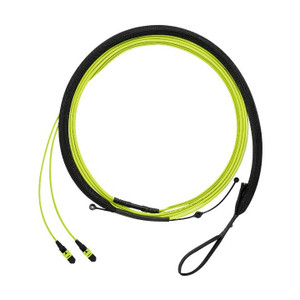
Panduit FWUYL7575KAM080 QuickNet OM5 24-Fiber Trunk Cable Assembly with PanMPO Connectors, LSZH, 80m
The Panduit FWUYL7575KAM080 is a factory-terminated OM5 trunk cable assembly delivering 24 fibers of wideband multimode capacity in a single lime-jacketed run. Designed for datacenter spine-leaf topologies and inter-row links requiring 40GBASE-SR4, 100GBASE-SR4, or emerging 400G short-reach applications, this 80-meter assembly uses PanMPO female-to-female connectors with Method A polarity and Ultra insertion loss grading. The low smoke zero halogen (LSZH) jacket meets international fire safety codes for indoor installations, while the HD Flex cable body and integrated pulling eye simplify routing through congested cable trays and overhead pathways. Pre-terminated at the factory and individually tested, QuickNet trunks eliminate field termination labor and variability, cutting deployment time from hours to minutes while guaranteeing insertion loss and return loss performance out of the box.
Key Features
- OM5 Wideband Multimode Fiber: 50µm core optimized for short wavelength division multiplexing (SWDM), enabling four-lane 100G transmission over a single fiber pair and future-proofing for 200G and 400G Ethernet standards without re-cabling
- 24-Fiber PanMPO Connectivity: Dual female PanMPO connectors (compliant with TIA-604-5 FOCIS-5) terminate all 24 fibers in compact, high-density housings—ideal for breakout to six duplex LC ports or direct switch-to-switch trunk connections
- Method A Polarity and Ultra IL Grade: Follows TIA-568-C.0 Method A straight-through pinout for structured cabling compatibility; Ultra insertion loss classification ensures ≤0.35 dB per mated connection, maximizing link budget for multi-tier datacenter fabrics
- LSZH Flame Rating: Low smoke zero halogen jacket compound meets IEC 60332-1 and 60754 requirements, producing minimal smoke and no corrosive halogen gases during combustion—mandatory for European installations and recommended for enclosed equipment rooms
- HD Flex Small-Diameter Design: Reduced outer diameter cable body (compared to legacy round jacketed trunks) consumes 30-40% less pathway fill, improving airflow in overhead trays and enabling higher fiber density per U of vertical cable manager
- Factory Pre-Terminated and Tested: Each assembly is connectorized, inspected, and insertion loss tested at the Panduit factory, with test results traceable by serial number; eliminates field fusion splicing, epoxy-polish labor, and the risk of contamination or improper end-face geometry
- Integrated Pulling Eye: Stainless steel pulling eye on one end accepts standard cable grips or pull ropes, distributing tensile load across the cable strength members rather than the fiber cores—critical for long horizontal or vertical pulls through conduit and j-hooks
- 80-Meter Reach: 262.5-foot length suits inter-row distribution within a single datacenter hall, cross-connects between MDA and HDA locations, or building-to-building links across a campus—well within OM5's 440-meter 40G channel limit and 150-meter 100G SR4 reach
- Lime Green Jacket for OM5 Identification: TIA-598-D compliant lime cable color clearly differentiates OM5 infrastructure from OM3 (aqua) and OM4 (Erika violet) runs, preventing accidental cross-patching during MACs and simplifying inventory audits
- QuickNet System Integration: Part of Panduit's modular QuickNet platform—compatible with QuickNet cassettes, breakout harnesses, and centralized fiber enclosures for plug-and-play horizontal and backbone distribution
OM5 fiber extends the multimode roadmap by introducing wideband optimization across the 850 nm to 950 nm spectrum. Traditional OM3 and OM4 fibers are characterized at 850 nm only; OM5 adds effective modal bandwidth measurements at 880 nm, 910 nm, and 940 nm per TIA-492-AAAD and IEC 60793-2-10 Type A1a.3. This wideband performance enables short wavelength division multiplexing transceivers to transmit four independent 25 Gbps or 50 Gbps channels over a single fiber, delivering 100 Gbps or 200 Gbps per fiber without parallel optics. For the FWUYL7575KAM080's 24-fiber trunk, SWDM architecture means twelve fiber pairs can support twelve 100G links in BiDi mode, or the same 24 fibers can be broken out to conventional 100GBASE-SR4 optics (four fibers per link) for six 100G connections. The flexibility to support both legacy parallel optics and next-generation SWDM transceivers within the same physical infrastructure protects capital investment as transceiver technology evolves.
PanMPO connectors use a twelve-fiber-per-row MT ferrule and stainless steel guide pins to achieve precise fiber-to-fiber alignment across all 24 cores. The female connector bodies on both ends of the FWUYL7575KAM080 accept male MPO patch cords or mate directly with female MPO adapter modules in cassette housings and patch panels. Method A polarity (also called \"straight-through\" or \"key-up-to-key-up\") maintains a 1:1 fiber mapping from transmit to receive when using a female-to-female trunk between two male jumpers; this is the dominant polarity scheme in structured cabling systems per TIA-568-C.0 Annex A. Ultra insertion loss grading guarantees each of the 24 fiber connections exhibits ≤0.35 dB loss when mated, compared to ≤0.50 dB for standard Grade B MPO connectors. On an 80-meter channel with two mated connections (one at each end), the total connector budget is ≤0.70 dB, leaving ample margin for 100GBASE-SR4's 1.9 dB loss budget and ensuring reliable link operation even after multiple cleaning and re-mating cycles.
The LSZH jacket compound is engineered for installations where smoke toxicity and density are regulated—data halls in Europe (where CPR Construction Products Regulation often mandates Class B2ca or Cca cables), equipment rooms adjacent to occupied spaces, and any pathway that doubles as a return air plenum under certain building codes. During combustion, LSZH materials produce less than 0.5% hydrogen chloride by mass (per IEC 60754-1) and maintain light transmittance above 60% in smoke chamber tests (per IEC 61034), allowing occupants and first responders to navigate during a fire event. The lime jacket color—standardized by TIA-598-D for OM5 fiber—provides instant visual identification in crowded cable trays, reducing the risk of incorrect patching during additions or troubleshooting. While OM4 (Erika violet) remains common in existing datacenters, new builds and expansions increasingly specify OM5 to maximize future bandwidth without re-pulling backbone trunks.
HD Flex cable construction uses a reduced-diameter outer jacket and tight-buffered fiber arrangement to achieve a smaller overall cross-section than traditional round-jacketed trunk cables. The resulting space savings are measurable: where a legacy 24-fiber trunk might occupy 0.75 inches of diameter, the HD Flex design typically measures closer to 0.50 inches, reducing cross-sectional area by approximately 40%. This translates directly to higher fiber density in vertical cable managers, overhead J-hook runs, and under-floor trench ducts. For example, a four-inch-wide vertical manager that previously accommodated eight round trunks can now fit twelve HD Flex trunks, supporting an additional 96 fibers (four extra trunks × 24 fibers each) in the same physical footprint. The smaller diameter also improves bend radius compliance; Panduit specifies a minimum dynamic bend radius of ten times the cable diameter during installation, meaning the FWUYL7575KAM080 can navigate tighter turns around equipment racks and through congested pathways without risking fiber microbending or attenuation spikes.
The integrated pulling eye on one end of the assembly is a stainless steel loop crimped to the cable's aramid strength members. During installation, a pull rope or cable grip attaches to the eye, transferring tensile forces to the strength layer rather than the optical fibers themselves. This is critical for long pulls (the 80-meter length often requires routing through multiple overhead cable trays or vertical risers) and for installations where the trunk must be pulled through conduit or innerduct. Without a pulling eye, installers must fashion a cable grip around the jacket or tie off to the connector boot—both methods risk damaging the fiber cores or breaking the epoxy bond inside the connector ferrule. Panduit rates QuickNet assemblies for a maximum pulling tension of 200 pounds when using the pulling eye; exceeding this limit can cause permanent fiber attenuation due to stress-induced microbending. The single-end pulling eye configuration assumes the opposite end (without the eye) is fed into the pathway first, and the pull originates from the eye end.
An 80-meter trunk sits in the middle of the length spectrum for datacenter horizontal and backbone applications. It's long enough to span from a main distribution area (MDA) on one side of a 20,000-square-foot datacenter floor to a horizontal distribution area (HDA) on the opposite side, or to connect a server hall to a network operations center in an adjacent building on a campus. At the same time, 80 meters remains well within the distance limitations of multimode Ethernet standards: 40GBASE-SR4 supports up to 150 meters on OM4 (and OM5 exceeds OM4 performance), while 100GBASE-SR4 is rated for 100 meters on OM4 and 150 meters on OM5. For emerging 400GBASE-SR8 applications, OM5 extends reach to 100 meters (compared to 70 meters on OM4), making the FWUYL7575KAM080 a viable backbone trunk for 400G spine switches in leaf-spine fabrics where spine and leaf tiers are located in different rows.
Factory pre-termination is the cornerstone of the QuickNet value proposition. Traditional field termination of MPO connectors requires fusion splicing a factory-stub cable (with pre-polished ferrule and pigtail) to the trunk cable, then heat-shrinking a protective boot over the splice. This process demands a fusion splicer, cleaver, and trained technician, and each splice introduces 0.1-0.3 dB of insertion loss and a potential failure point. Field epoxy-polish termination of MPO connectors is even more labor-intensive and sensitive to contamination, often resulting in inconsistent end-face geometry and high return loss. By contrast, every QuickNet assembly leaves the factory with connectors already installed, each fiber cleaved and polished on automated equipment, and the entire assembly tested for insertion loss and return loss across all fibers. Test data is recorded and can be retrieved via the assembly's serial number, providing a traceable performance baseline for acceptance testing and future troubleshooting. Installers simply route the trunk, plug both ends into patch panels or switch modules, and verify link light—deployment time drops from two hours (for field splicing both ends) to under fifteen minutes.
The FWUYL7575KAM080 integrates into Panduit's broader QuickNet ecosystem, which includes cassette modules (12-fiber or 24-fiber MPO-to-LC breakouts), high-density fiber enclosures (1U and 2U rack-mount), and inter-rack jumper cables. A common deployment pattern uses the FWUYL7575KAM080 as a backbone trunk from an MDA patch panel to an HDA cassette module; the MDA end plugs into a female MPO adapter, while the HDA end mates with a QuickNet cassette that fans the 24 fibers out to twelve duplex LC ports. Those LC ports then connect to top-of-rack switches via short duplex LC jumpers. This architecture centralizes the high-fiber-count backbone in a few robust trunks, while distributing duplex connectivity at the edge—simplifying MACs (moves, adds, changes) since only short jumpers need to be swapped when server assignments change. The Method A polarity of the trunk ensures that when paired with Method A cassettes and duplex jumpers, transmit and receive lanes align correctly without manual fiber re-arrangement or the need for Type B flip adapters.
Lime green jacketing per TIA-598-D is more than cosmetic. In a datacenter with mixed fiber generations—OM3 (aqua), OM4 (Erika violet), and OM5 (lime)—color coding prevents accidental cross-patching that would underutilize the infrastructure. For example, patching an OM5 trunk to an OM3 transceiver works electrically, but the link will only achieve OM3 distance and bandwidth specifications, wasting the OM5 investment. Conversely, attempting to push 400GBASE-SR8 over OM3 will fail to meet distance requirements. Visual differentiation by jacket color allows technicians to quickly verify that both ends of a link use the same fiber grade, and it simplifies inventory audits—racks with lime trunks are clearly flagged as OM5-capable infrastructure. TIA-598-D also specifies that OM5 fiber buffer tubes (the 900 µm tight buffer around each individual fiber inside the trunk) are lime as well, so even during breakout or troubleshooting with the jacket stripped back, the fiber grade remains identifiable.
Standards compliance for the FWUYL7575KAM080 spans cabling, connector, and safety domains. The OM5 fiber meets TIA-492-AAAD (US) and IEC 60793-2-10 Type A1a.3 (international) specifications for 50/125 µm wideband multimode fiber, including minimum overfilled launch bandwidth of 3500 MHz·km at 850 nm and minimum effective modal bandwidth of 1850 MHz·km at 950 nm. The cable assembly as a whole complies with TIA-568-C.3 (optical fiber cabling components) and ISO/IEC 11801 (generic cabling for customer premises), ensuring interoperability with standards-based switches, transceivers, and structured cabling systems worldwide. The PanMPO connectors conform to TIA-604-5 (FOCIS-5), which defines the mechanical interface, ferrule geometry, and alignment pin dimensions for MPO multi-fiber connectors. LSZH jacket flammability meets IEC 60332-1 (single vertical flame test) and halogen content limits per IEC 60754-1/-2, satisfying European CPR Class Cca requirements and many international building codes. Finally, the assembly is RoHS compliant, restricting lead, mercury, cadmium, and other hazardous substances to levels safe for end-of-life disposal and recycling.
For integrators building or expanding leaf-spine datacenter fabrics, storage area networks, or cloud service provider infrastructure, the Panduit FWUYL7575KAM080 delivers the combination of deployment speed, performance headroom, and physical density that separates professional-grade installations from ad-hoc builds. The 80-meter length covers the majority of intra-building and inter-row distribution scenarios without the signal budget penalty of fusion splices or the labor cost of field termination. OM5's wideband capability ensures compatibility with both current 100GBASE-SR4 parallel optics and future SWDM transceivers that quadruple fiber efficiency, protecting the trunk investment as switch and NIC technology evolves. When installation timelines are measured in days rather than weeks, and every rack unit of cable manager space translates to revenue-generating compute density, factory-terminated QuickNet trunks with Method A polarity, Ultra insertion loss grading, and integrated pull eyes are the pragmatic choice for meeting both immediate go-live deadlines and long-term bandwidth roadmaps.